



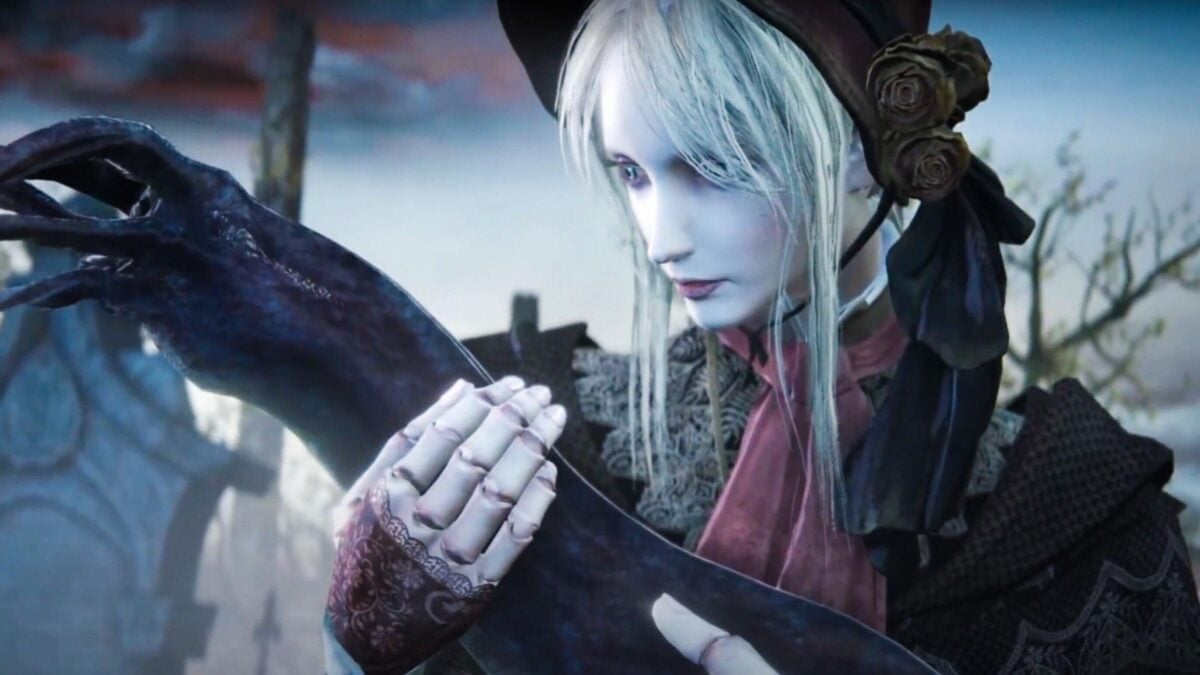
First, they came for Uncharted and I understood. Then, they came for The Last of Us and I begrudgingly relented. Eventually, they came for more: God of War, Ghost of Tsushima, and Helldivers. But I’m sorry, I have to draw a line in the sand. Millions have clamored for more Bloodborne for over a decade now, be it in a sequel or some kind of spiritual successor like The Duskbloods, but I don’t think anyone meant that they wanted an animated movie adaptation, right?
In case you missed the shocking bit of news, Sony recently announced that it was developing yet another movie from one of its properties. This time around, it’s Bloodborne, Sony’s most famously inert IP of the 2010s, making the jump to the big screen and being co-produced by the Youtube personality Jacksepticeye. As I’ve already alluded to, shoving games into this pipeline has become a pretty typical move on the conglomerate’s part, and at times it has sort of worked out. The Uncharted movie starring Tom Holland and Mark Wahlberg didn’t exactly light the world on fire (I frequently forget I watched it and I actually kind of enjoyed the thing) but The Last of Us did become a ratings hit—not to mention a critical darling—for HBO in its first season, even if it felt like it stumbled often and misunderstood much of the series’ appeal, especially in its notably weaker second season.
But now with several projects in various stages of production–God of War at Amazon seems to be the next one up, while Helldivers‘ director Justin Lin has just announced that principal photography on that film is beginning in a few weeks–it seems Sony’s eye has turned a little further back and finally decided to show some love to From Software’s beloved gothic epic, which has been stranded on the PS4 with no remake, remaster, or sequels.
While many took to the internet to poke fun at several aspects of the announcement, from the involvement of Jacksepticeye to jokes about Bloodborne now running at less than 30 frames per second (animated films often sit around 24, by comparison), I’ve taken umbrage with the project for, admittedly, far dorkier reasons.
If I may betray the slightest hint of a ‘tude, I think this movie is doomed in ways that the rest of Sony’s adaptations don’t need to worry about. I like some of these games well enough (sorry Tsushima, maybe I’ll find the time for you someday) but they’ve also largely benefitted from borrowing the language of films. The Last of Us borrows a few pages from Danny Boyle’s genre-defining horror flick 28 Days Later. 2018’s God of War largely preoccupied itself with framing the action of the game like a “oner”–an extensive shot for a film or show that takes the form of one lengthy take, though some sequences use editing trickery to simply create the illusion of one. Helldivers is literally born from Paul Verhoeven’s satire Starship Troopers, and Ghost of Tsushima and its sequel feature filters that reproduce the aesthetics of famed Japanese filmmakers like Takashi Miike, Shinichirō Watanabe, and Akira Kurosawa.
Moreover, each of these games and franchises seem to have been developed in an informal house style–one that stresses minimalistic UI and incredibly realistic, filmlike graphics, setpieces, and dramatic performances–that has become the de facto calling card of many first-party PlayStation titles dating back to the PS3. These games always seemed to aspire to become films and TV shows, “graduating” from the echelons of video games to pierce the mainstream. Now, many of them have reached their final, hollower forms and accomplished just that.
All games have mechanics, and I would never suggest that PlayStation’s more filmlike games lack them in comparison to Bloodborne. But I will argue that, divorced from its quintessentially game-y qualities, a Bloodborne film sounds painfully boring and dull, lacking as it does the more typical plots, character dialogue, and the like that those other adaptations rely on.
One of Bloodborne‘s key mechanics is the visceral attack. If you fire a preemptive shot from your gun at just the right moment—or if you manage to stun or surprise a foe entirely—you may sink your weapon (and maybe even your hand) into an opponent and quite literally rip them a new one. The sharp slicing sound that plays as you plunge into your opponent becomes like music to the ear of a Bloodborne player, who has likely taken a bruising while practicing the visceral attack’s tricky and precise execution. Imagining the animated adaptation of some foreign, alien Hunter onscreen recreating it sans the figurative blood, sweat, and tears leaves me cold.
Bloodborne is also a mystery, perhaps even From Software’s most winding and obtuse one. Most of Bloodborne is a kind of masquerade: it doesn’t obscure its themes necessarily, but it does disguise its biggest ambitions until one makes significant headway into Yharnam’s living nightmare. Unearthing and exorcising its secrets and demons, be them the Chalice Dungeons’ numerous bosses and atrocities or the thing in Byrgenwerth Lake, is at once a physical and spiritual act. I trust the Bloodborne movie will look and sound the part, but more than most games, I think you’re doing yourself a disservice by not feeling what Bloodborne has to offer, and I struggle to conceive what that looks like on the big screen except for “cool.” That doesn’t quite do it for me, but maybe it’ll be enough for others.
I also just don’t trust this thing. Folks love to wax poetic about and deify From Software and its approach to storytelling, specifically how often it conveys very little via dialogue and a straightforward, linearly told plot. Instead, the developers have often deferred to an approach that communicates by way of environments, flavor text describing items in menus, character design, and what I can only describe as seemingly psychotic babble from every NPC littered throughout the studio’s games. How does any of that, which I find utterly charming and bewitching, survive the filmmaking process, especially at a time where scripts for Netflix films and shows are evidently dumbed down to appeal to audiences glued to their phones?


As a result, an adaptation will almost definitely consecrate a certain reading of the events of Bloodborne—a fate bound to play out again given Alex Garland’s imminent Elden Ring film—especially seeing as how it’s a deep world, not necessarily a large one. There are intriguing events across Yharnam’s timeline that could be explored and elaborated upon, like the founding of the Healing Church and its corruption, but I don’t see a way to tell this story without needing to return to the consequential (and action-filled) night of the hunt that the game already lays bare. At that point, you’ve lost me.
I don’t reject a canon interpretation of the game’s plot—despite its esoteric airs, Bloodborne is also one of From Soft’s more literal texts—but the notion of canonization itself feels blasphemous to an understanding of what makes these games and this oeuvre tick. It misunderstands the appeal of diving into these mysterious and alluring fantasies headfirst and making heads from tails, up from down.
I worry a Bloodborne film will be none of the things I’ve come to cherish about the game. In fact, I know it won’t. My concern isn’t that my favorite game of all time will be sullied. It’s that any attempt to adapt it to another medium will fundamentally mistake what makes the game so special, butchering and repackaging these qualities into some kind of fan-service, aura-farming slop that’ll wear its name anyway. Some other thing that most definitely won’t be Bloodborne. After such prolonged silence and inaction, seemingly even indifference from PlayStation, is that really the fate that Bloodborne ultimately deserves?