








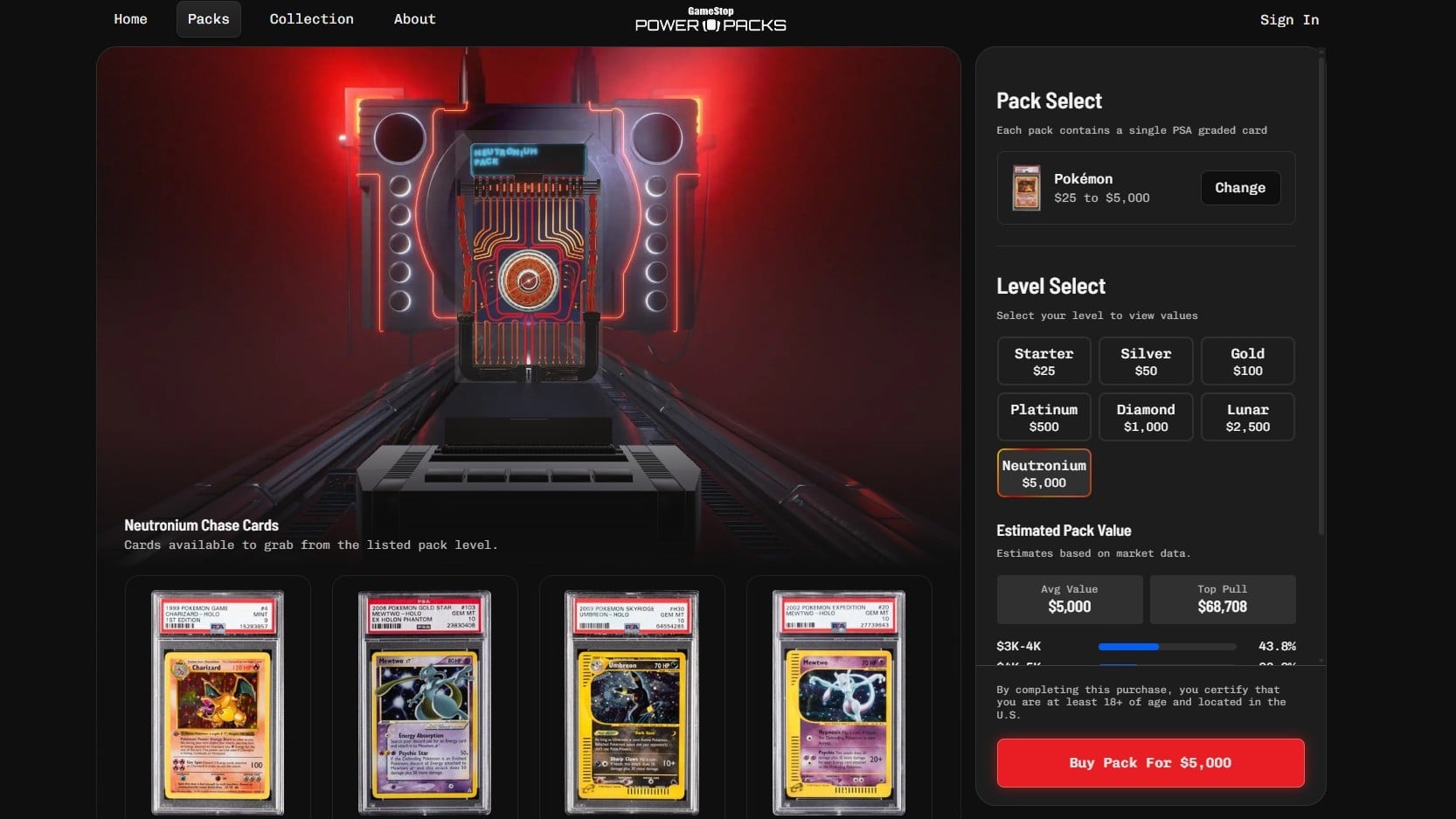
As GameStop tries to buy eBay with $56 billion of fictional money, it’s also putting a lot of effort into pump its own profits by price-gouging customers on collectibles like trading cards. Today, the retailer came up with a brand new way to do that: selling single, randomized, PSA-graded Pokémon cards for $5,000 a pop.
This unhinged behavior went live on GameStop’s website today as part of its “Power Packs” program. Power Packs have been live for several months now as part of a collaboration with card-grading site PSA, allowing customers to spend a flat amount of money to “rip” a digital card pack that has a single PSA-graded sports or Pokémon card in it. Once you see what the card is online, you can either choose to have it shipped to you, sell it using GameStop’s platform and give GameStop a cut of the money, or, for whatever reason, have it stored for you in a climate-controlled secure facility in Delaware until you want it.
The prices for a “rip” range from $25 all the way up to, as of today, $5,000. Previously, the upper limit was $2,500. The more you pay, supposedly the better the probability that you receive a card worth a lot of money, though a glance at the “estimated pack value” listed on the website makes it clear that the odds are always in favor of the house. If you spend $5,000 on a single PSA card in the “Neutronium” tier (yes, that’s what it’s called), sure, you have a 0.4-percent likelihood of pulling a card worth more than $40,000. You also have a 72-percent chance of pulling something worth less than what you spent on it, and a 25-percent chance of getting something worth a little bit more. And to be clear, those are just estimates sourced from the site trying to sell you this stuff. But hey, you could get a PSA 10 Charizard! There’s a chance! I guess!
This is basically just what those Lucky Box vending machines do, just with the added element of whatever veneer of legitimacy GameStop has left. It’s yet another glaring sign of the inability of adults to be normal about a children’s trading card game, right in there with grown men nearly choking each other out over vending machine packs and prices of recent sets skyrocketing due to high demand from adults who can afford to drop hundreds to buy stores out. But of course it’s also a testament to GameStop’s ongoing greed, similarly demonstrated in its refusal to charge a normal price for all sorts of Pokémon TCG products. The company has tried a number of different approaches to turning around its fortunes and making some quick cash on a trend in recent years, ranging from NFTs to Bitcoin to its current push around retro collectibles. I guess Cohen’s gotta pay for eBay somehow.
