




About halfway through High on Life 2, I found myself standing at a reception desk filling out paperwork—not metaphorical paperwork, but actual paperwork. Line after line, box after box. I kept waiting for the punchline, convinced that at any moment the game would yank me out of it, and while it did try, I decided that after 10 minutes of monotony, I was committed to seeing how it would all play out. By the 30-minute mark, I was still filing paperwork, and I wasn’t sure whether I had been outplayed or whether I was witnessing one of the boldest comedic bits I’ve seen in a shooter. When the whole thing ultimately amounted to nothing, I couldn’t even be mad. High on Life 2 had completely weaponized my patience, and I found it hilarious.
That moment captures the sequel perfectly. It’s chaotic, crude, and still deeply unserious on the surface, but there’s far more intention beneath it than I expected. High on Life 2 tells a surprisingly compelling story influenced by player choice, delivers sharper performances across its new and returning Gatlians, and introduces mechanical upgrades like skateboard traversal that take combat and exploration to the next level. It’s bigger, funnier, and more ambitious than the first game, even if it isn’t flawless.
High on Life 2’s Story Actually Sticks the Landing
The first High on Life was funny, but its story existed as little more than a vehicle for all the chaos. In High on Life 2, on the other hand, I was genuinely invested. The setup is simple enough: after dismantling an intergalactic cartel and enjoying the spoils of bounty hunting, a shadow from the past resurfaces and puts a price on your sister’s head. Things eventually spiral into a conspiracy centered around a pharmaceutical empire that has taken commodifying life to grotesque extremes.
Without spoiling specifics, the story builds steadily toward an explosive and heartwarming ending that had me glued to my seat. There appears to be one definitive conclusion, but the way that conclusion unfolds clearly shifts depending on the choices I made with various NPCs throughout the game. What’s refreshing is that High on Life 2 never outright tells you which NPC interactions will matter later. There are few clear warning signs telling you which characters are important. You simply make decisions in the moment and live with the outcome at the end. Some optional missions and conversations even impact the epilogue in ways that I didn’t expect.

In the end, that’s what made High on Life 2‘s story stick the landing for me. It never felt like I was trying to game the system but simply responding naturally to characters and situations in the way that I wanted, without feeling pressured to choose one path or the other. Beyond the branching narrative elements, the satire itself lands harder this time as well. The “take down Big Pharma” premise could have easily been surface-level parody for the sake of parody, but the writing digs into exploitation and commodification in a way that hits closer to home than it might initially seem. It’s still ridiculous, irreverent, and crude, but there’s a big heart behind the absurdity.
High on Life 2’s Gatlians Are More Than Just Weapons
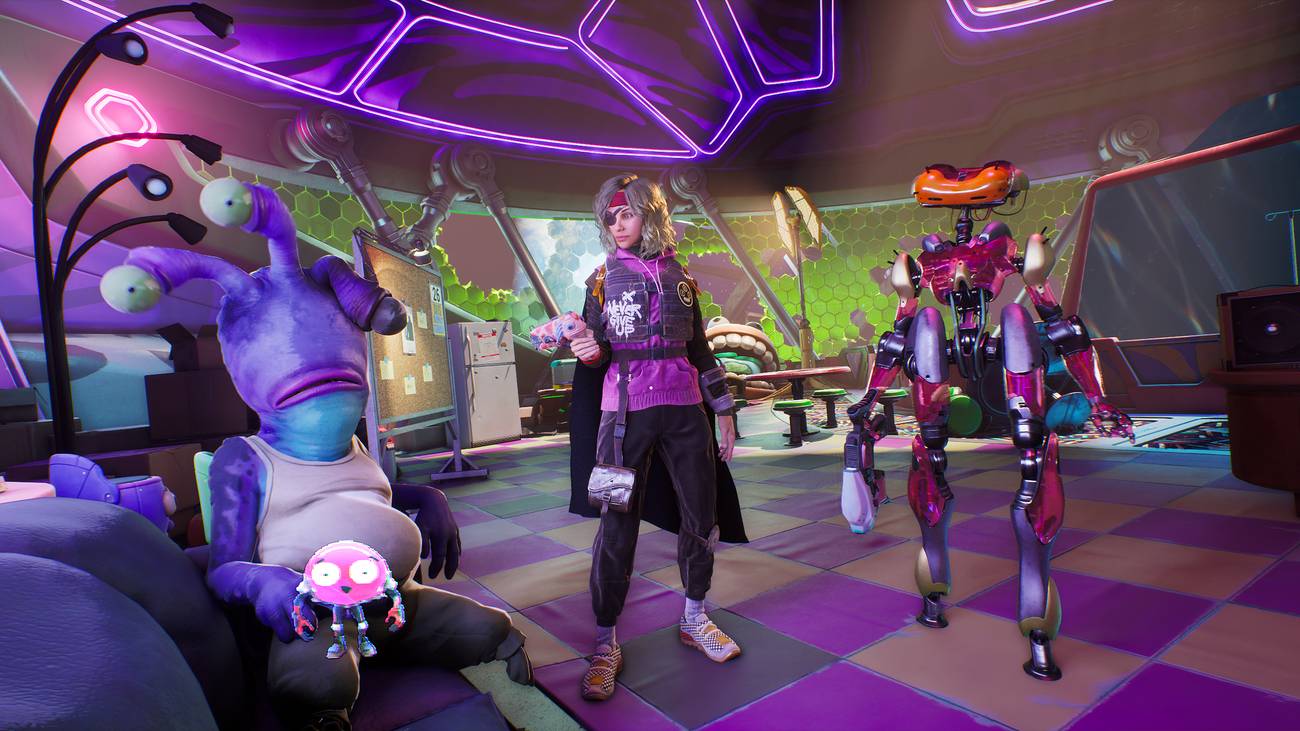
A big part of that investment comes from High on Life 2‘s new and returning Gatlians. Returning weapons feel more fleshed out, and the new additions bring fresh personality and mechanical variety to the arsenal. I was actually pleasantly surprised by the character development for the new Gatlians, with Travis and Sheath being standout examples of that. As they should, no Gatlian felt like a mere weapon but an actual character in the game that I cared about and felt connected to. Of course, none of that would have been possible without High on Life 2‘s impeccable voice talent.

Ken Marino’s performance as Travis is the standout for me. He’s relentless, absurd, and charming all at once, and he is so hilarious and lovable that I was tempted to keep him equipped the whole time simply because I didn’t want to miss a single line of dialogue. Ralph Ineson, as Sheath, was also excellent. Hearing his voice immediately stood out to me, especially as someone who appreciated his work as Cid in Final Fantasy 16. Finally, Richard Kind, though not a voice behind a Gatlian, also delivers as Senator Muppy Doo.
I was actually pleasantly surprised by the character development for the new Gatlians, with Travis and Sheath being standout examples of that.
Importantly, High on Life 2 includes accessibility options that allow players to adjust both enemy chatter and weapon chatter, and given how vocal the Gatlians are, that matters. Actually, it matters even more because the sequel’s audio mixing is a bit strange without some adjustment. With the audio settings at default, I could barely hear the dialogue at times, and considering the High on Life series stands out for its dialogue, that was a problem. However, once I turned down the music and the sound effects a bit, things felt a little more balanced.

Mechanically, the gunplay is tighter and more responsive across the board. Combat is fast, often overwhelming, and intentionally chaotic. At times, arenas can feel almost too hectic to process everything that’s going on, but that part feels like High on Life‘s identity rather than a flaw. The variety of High on Life 2‘s Gatlians stands out here as well, with each weapon bringing a different playstyle, as well as unique utility abilities that feed into exploration and puzzle-solving.
Boss encounters in High on Life 2 frequently revolve around newly introduced Gatlian abilities in the same way that Zelda‘s dungeon bosses do. Some bosses are mechanically straightforward, but they are structured to highlight specific Gatlian mechanics, acting as both a tutorial for said mechanics and an opportunity to practice them. There is one boss fight in particular that ranks among the most creative boss fights I’ve ever experienced in a video game. It combines unique mechanics and humor in a way that had me laughing, not necessarily because it was over-the-top funny, but because I was amazed at what I was seeing. I won’t spoil it, but it’s a moment that proves how willing this sequel is to experiment.
High on Life 2’s Skateboard Changes Everything

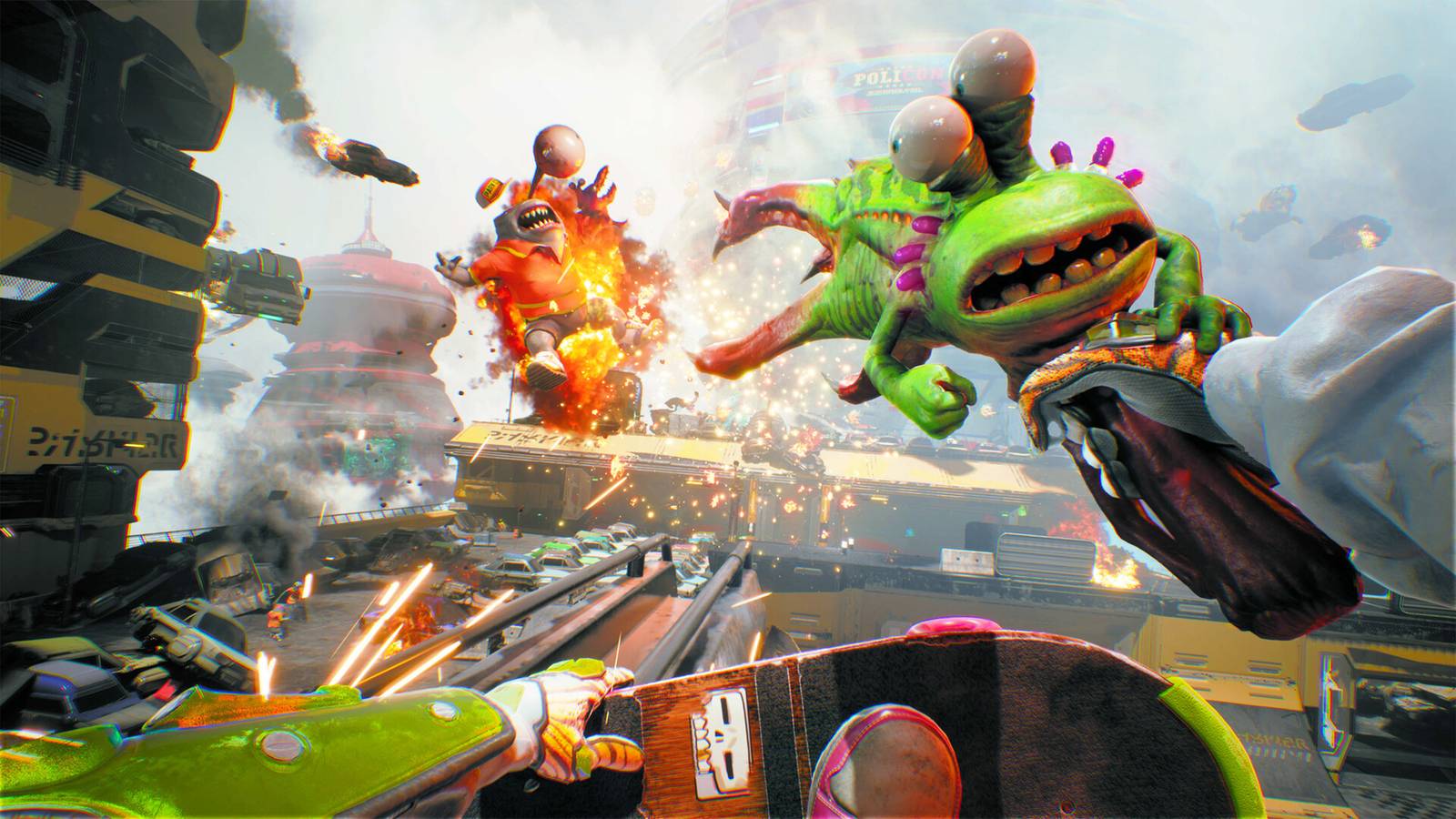
One of the biggest gameplay evolutions in High on Life 2 comes in the form of the new skateboard. What could have been a novelty addition ends up being one of the most important parts of the game’s traversal and combat. Movement is faster and far more engaging, with the ability to grind rails and reach destinations quicker. Verticality now plays a much larger role in High on Life 2, and the skateboard is a big part of that shift in design. You’re encouraged to move up, down, and across the world in ways the first game really never explored, and it’s incredibly fun and fulfilling.
The skateboard also plays a major role in combat. You can ram enemies, launch the board as a projectile, or use it to evade attacks. It can also be upgraded by participating in High on Life 2‘s skateboard races and collecting skate letters like something straight out of a Tony Hawk game. Early on, I struggled with momentum management and found myself crashing into walls more often than I’d like to admit, but once the mechanics clicked, the flow of both exploration and combat improved dramatically.

Exploration in High on Life 2 is actually a big deal, and the game regularly encourages you to do it. Lugloxes are scattered throughout the world, containing currency, various cosmetic rewards, and upgrades that are essential if you want to perform better in combat. While some are easily accessible, the more important Lugloxes are gated behind Gatlian abilities in a clear Metroidvania-style design kind of way. Returning to previously inaccessible areas with new tools is satisfying, especially when those detours result in valuable weapon upgrades. The game isn’t brutally difficult on normal settings, but thorough exploration nonetheless makes the game’s toughest encounters smoother and opens up more flexibility in combat.
Beyond loot, exploration introduces a wide range of NPC encounters. Some are throwaway jokes. Others branch into optional missions that can even influence High on Life 2‘s ending. While wandering off the beaten path isn’t necessary in the game, that kind of design still makes it worthwhile. The three major hub regions in the game also give exploration more variety. Pair that with a surprisingly relaxing retro and lo-fi soundtrack, and it offers a thoroughly relaxing experience between firefights and big story beats.

Exploration also extends the game’s total runtime. My playthrough wrapped up in around 17 hours, and that included a healthy amount of hunting down Lugloxes and diving into optional encounters. Looking back at everything I left unfinished, it’s easy to see that number stretching closer to 25 or even 30 hours for completionists. However, with one of the main points of criticism for the first High on Life being its relatively short length when compared to its price tag, High on Life 2 might meet the same criticism from players who don’t find the exploration side of the game to be a meaningful way to spend their time.
Exploration also extends the game’s total runtime…it’s easy to see that number stretching closer to 25 or even 30 hours for completionists.
High on Life 2 has a multitude of customization options as well. You can tweak your skateboard’s appearance, change your suit, and even purchase decorations to personalize your home base. For players who enjoy collecting cosmetic rewards as I do, there are plenty of unlockables that make the thorough exploration of each of its major hub areas feel worth it in the end. At the same time, I found myself conflicted. Because the game is entirely first-person, you rarely get to actually see the suit you’re wearing outside of menu screens. The skateboard is more visible during traversal, but even that can be hard to appreciate mid-combat or while moving at full speed. Part of me wished there was an optional third-person toggle, even if only in hub areas, just to admire the customization more directly.

That said, I also understand why Squanch Games kept the focus locked in first-person. The Gatlians are the centerpiece of the whole experience. Their expressions, animations, and constant commentary need that up-close-and-personal feel that only first-person gameplay can provide. Shifting perspective would inevitably dilute that, but when a game invests this much into cosmetic personalization, it’s hard not to want those changes to feel like they actually matter.
My PC playthrough of High on Life 2 wasn’t without issues, regardless of how much I enjoyed it overall. I experienced occasional performance dips, a handful of crashes, several instances of falling through the map, and a few moments even forced full restarts. Thankfully, frequent autosaves prevented significant progress loss, but the instability was noticeable. These issues feel fixable, and it wouldn’t be surprising to see them addressed through post-launch patches, but they are still worth acknowledging.
High on Life 2 Is an Upgrade in All the Right Ways

High on Life 2 could have easily relied on the novelty of talking guns and crude humor again. Instead, it expands on its foundation in some big and important ways. The story actually feels like it has higher stakes this time, with player choices even factoring into how the ending unfolds, and the Gatlians feel like more than delivery systems for jokes thanks to sharp performances and stronger writing. The skateboard feels great in traversal and combat, exploration ties into upgrades and even impacts the epilogue, and there’s far more to do than just the main story. It isn’t without issues, from technical instability and uneven sound mixing to customization that can be hard to fully appreciate in first-person, but none of that overshadows its greatest strengths. In the end, High on Life 2 understands what made the original work and pushes it forward in ways that actually matter.


- Released
-
February 13, 2026
- ESRB
-
Mature 17+ / Blood and Gore, Intense Violence, Nudity, Strong Language, Strong Sexual Content, Use of Drugs and Alcohol
- Developer(s)
-
Squanch Games
- Publisher(s)
-
Squanch Games
- Surprisingly compelling narrative backed by strong vocal performances
- Creative, memorable boss encounters
- Skateboard transforms traversal and combat
- Exploration is fun, relaxing, and worthwhile
- Technical instability and sound mixing issues
- Customization can lack meaningful visibility