





Marvel’s Wolverine, the latest superhero action game from Insomniac, was released this week after getting a lukewarm reception from critics. Now that it’s in players’ hands, one aspect that’s drawing particular criticism on social media is the game’s no-fail QTEs. However, while this game mechanic deserves criticism and reevaluation, it’s not the lack of a fail state that makes it bad. It’s the lack of an open-ended, creative follow-through.
Marvel’s Wolverine launched exclusively for the PS5 on September 15. It is, by and large, a conventional arcade beat ’em up with gorgeous visuals. But you wouldn’t know that from the online discourse, which has been heated, to say the least. The most widespread critique of the game is that it’s too easy—that it assumes, as the default, that the player is a novice who cannot navigate a three-dimensional environment without killing himself or becoming hopelessly lost.
YouTube gaming critic Skill Up encapsulated a lot of these criticisms in his negative review of the game, which currently has over 3 million views:

Do we need to have a scent trail, a GPS pin, white-painted platforms, and a literal arrow sign to show us where to go in a linear game? Maybe not. But also, maybe? I’m always reminded of this editorial that Kotaku alum Patricia Hernandez wrote; we might not be as smart as we imagine ourselves to be.
Players also criticized Wolverine’s motorcycle sequences, with good reason. Steer the wrong way and you can crash into a truck head-on, throwing you off the bike. But if you just let the controls go—like Luke at the end of Episode IV—Wolverine will negotiate the sequence on his own, surviving by ricocheting off obstacles and hugging the barriers on the side of the road. As someone who died at least twice trying to complete these sequences, I found this to be a hilarious indictment of my gaming skills. It was my good-faith attempt to avoid death that ultimately led to it. It would have been better if I had never picked up the controller at all.

Which brings us to the game’s QTEs.
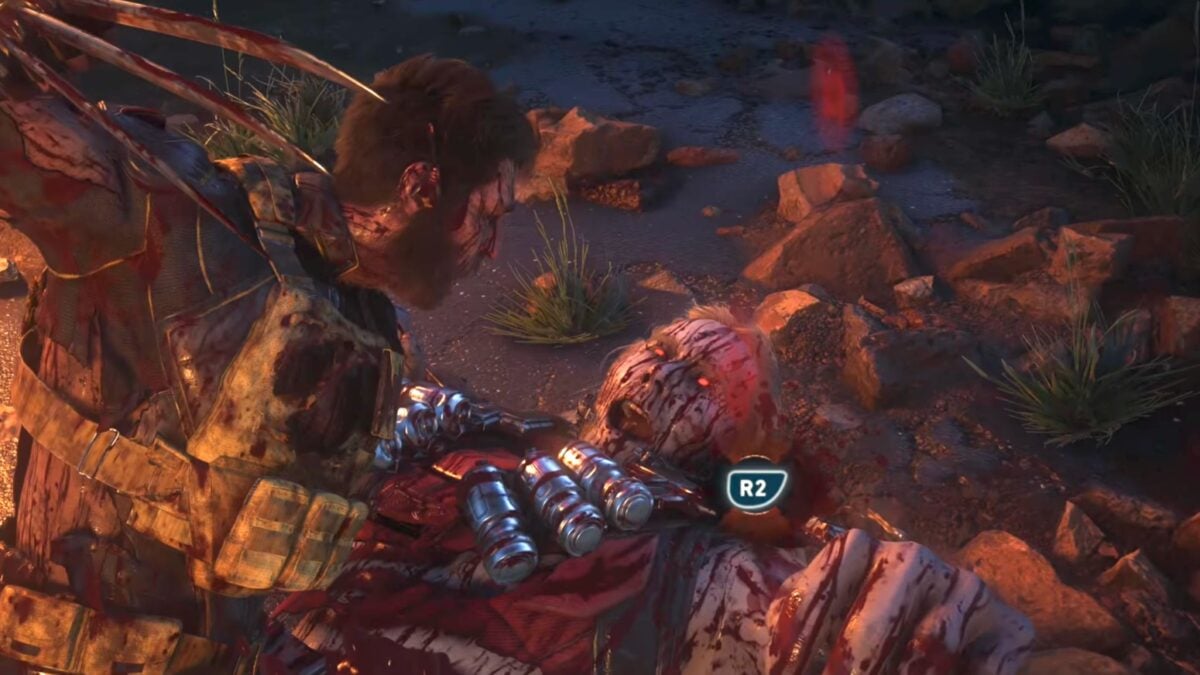
There are numerous moments throughout the game in which on-screen prompts direct you to press the shoulder or face buttons. Press the right shoulder button, and Wolverine will stab with one claw. Push the left shoulder button, and he’ll stab with the other. Push both at the same time…you get the idea.
If you press the wrong buttons, Wolverine will autocomplete the actions anyway. and you’ll move on to the next sequence. Press no buttons, and Wolverine will still advance. There is no way to “lose,” in the traditional sense, so long as we define losing as “restarting from the last checkpoint.”
It begs the question: What was the intent of having these sequences in the first place? I think it’s important to establish some necessary context to show there was a better way to have implemented this.
The first time I ever encountered QTEs was while playing Resident Evil 4, which popularized their implementation. The villagers pushed a boulder down the hill, and I had to tap a button to run from it. I had to push two more buttons to dodge, last minute, out of the way. Fail to do so, and the boulder would crush me.

Two things about this sequence stand out to me. The first is that the button actions are contextual. The running is done by mashing a button rapidly, which makes sense; it’s a frantic, hurried motion. The final dodge roll is done by pressing two buttons simultaneously, which also makes thematic sense, as it’s a sudden, complex, acrobatic move.
The second is that there are two different outcomes for the sequences aside from death. If you press the final prompt early, you’ll dodge behind the rock. If you press it late, you’ll dodge behind the tree in front of the rock. In a functional sense, the result is the same, but the narrative surrounding that outcome changes.
![Resident Evil 4 (PS4 PRO) Leon vs Krauser Knife Fight [1080P 60FPS]](https://i.ytimg.com/vi/_nYSAdI4ABk/hqdefault.jpg)
Later in the game, you face Krauser in a knife fight. It’s one of the most tense moments in the game, and again, the buttons are contextual. You press two buttons for complex movements, and you mash one button for a test of strength. The button prompts come quickly with little time to react, because it’s mirroring how Leon is in that moment: off-balance and reactive. Fail once, and you’re dead.
Meanwhile, in Heavy Rain, there’s an early fight scene between playable character Scott Shelby and Troy the pimp, which has two things worth pointing out. The first is that the outcome of the fight is predicated on whether you successfully pull off the majority of the QTEs—you can miss a few and still win the fight. QTEs don’t have to be all or nothing.

The second occurs at 2:20 in the above. The game asks you to do a complex move—to rotate the joystick to do a hook punch followed by an aggressive throw. Again, the movement of the joystick mirrors the movement of the character and feels intuitive.
I’m giving these examples to make a point: QTEs are made good by the manner in which they’re applied and narratively built into a game. QTEs are not made good purely by having a fail state, and it’s perfectly fine that failing them in Wolverine doesn’t lead to a restart. It would be thematically dissonant if they did, because it would compromise the power fantasy of being Wolverine.
Generally speaking, Wolverine‘s QTEs are not of the “gotcha” Krauser variety; they happen slowly and predictably because they’re meant to reinforce the feeling of heroism. Of all people, Wolverine is the guy most likely to survive making a catastrophic mistake, thanks to his healing factor.
![Marvel’s Wolverine DLSS 5 Boss Fight – WOLVERINE vs OMEGA RED Looks TOO REAL | [4K HDR]](https://i.ytimg.com/vi/NQyezpg4a0M/hqdefault.jpg)
Instead, what’s wrong with these QTEs is their lack of follow-through. Players have posted side-by-side videos showing the differences between successfully completing a QTE and failing one, and the difference is negligible:
Completing VS Failing QTE in the Sabertooth Arm Wrestling sequence in Marvel Wolverine pic.twitter.com/6kEi6VWnmW
— NikTek (@NikTek) September 15, 2026
Imagine if Insomniac created different cutscenes that would play after the QTE, one for winning the arm-wrestling match and another for losing, or had different, contextual quips from the characters. Wouldn’t that be a lot more entertaining?
Now apply that logic to the QTE fight scenes. I don’t think people would have minded that Wolverine didn’t die or “fail,” so long as we saw some visual consequence for doing so. We should see some flesh ripped off his body. We should see alternate animations of him getting hurt. Maybe you would stumble into the next encounter nearly dead, with no room for error. Maybe the fail state could even change based on how many motions you missed, rather than having a simple succeed-or-fail approach.

Add to this that the requested motions are overly simple—largely single-button presses instead of multi-button presses or even joystick movements. The games I cited from years ago understood that you could rotate the joystick to pantomime a hook movement, and move the whole controller downward to mimic a full-body tackle. This is a downgrade.
I reviewed Marvel’s Wolverine for Complex, and I actually enjoyed it quite a bit. I feel like the accusations that it’s easy are overblown (and if it is too easy for you, turn up the difficulty setting, because that’s why it’s there). But the QTE criticism is more interesting to me, because I feel like players are right to be frustrated, but they’re articulating that frustration by defaulting to popular complaints about the game’s perceived simplicity, a line of argument that I would argue has less merit. The QTEs are a separate problem independent of difficulty concerns—and they deserve their own discussion, because they’re indicators of a problem that goes beyond player accessibility.
The “no-fail” QTEs are not an example of the game being “dumbed down.” Rather, they’re an example of lazy follow-through. To have a productive discussion about gaming, we need to be accurate and specific. And then, we can stop being frustrated at the developers for the wrong reasons and start being frustrated at them for the right ones.
