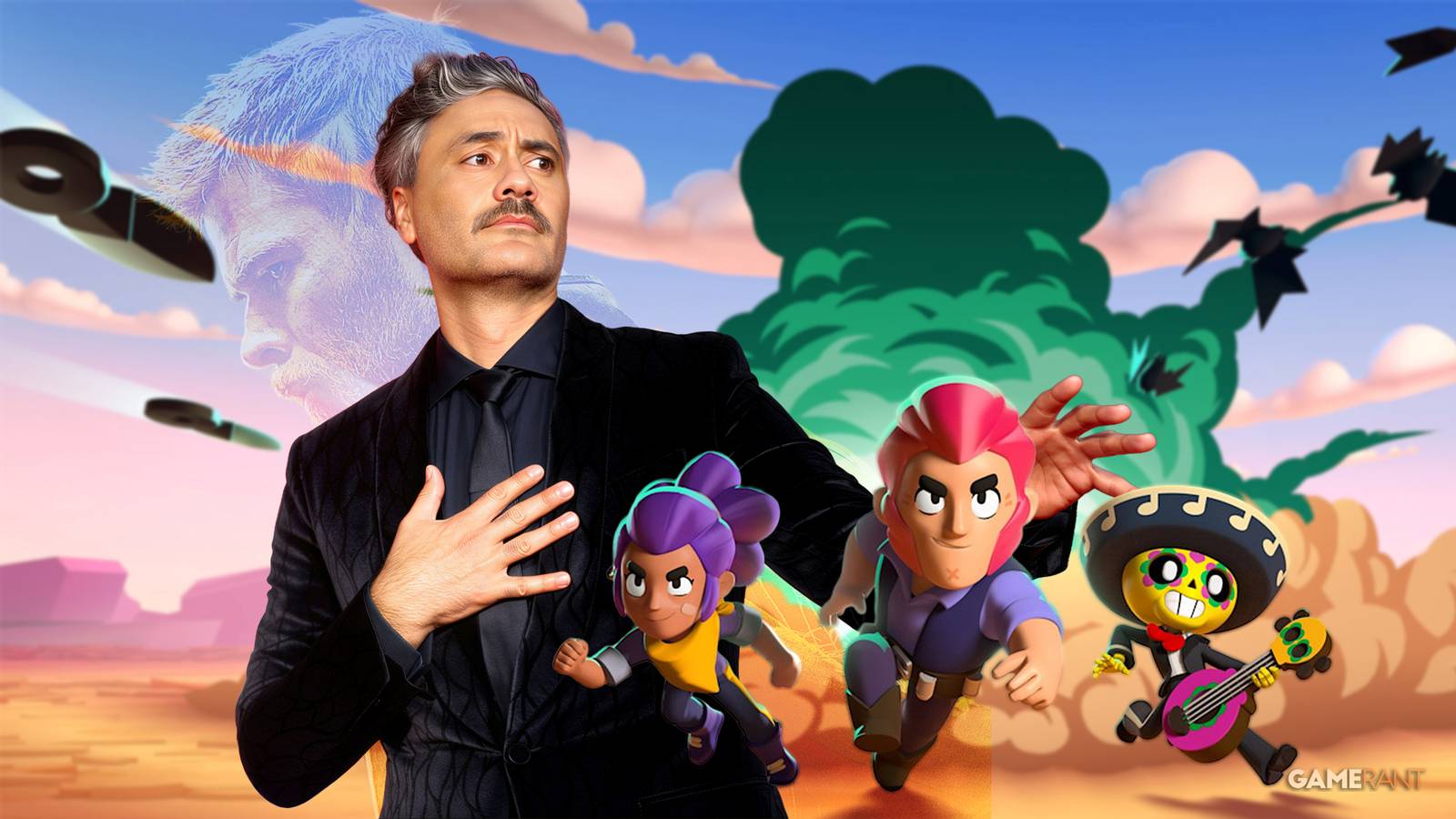




Thor: Ragnarok and Love and Thunder director Taika Waititi is certainly no stranger to chaos—if that wasn’t already made clear in his ability to take serious stories with comedic undercurrents and essentially flip the script by making comedies that tell stories instead. He has often made statements about how he can’t be taken seriously, even jokingly calling himself “lazy” because he prefers to keep things simple and doesn’t mind when they get messy. And yet, he won an Oscar for his film adaptation of Jojo Rabbit and earned plenty of accolades for his work in other areas as well. Needless to say, when he finds an environment that thrives on chaos rather than rigidity, he tends to prefer it. That’s why his recent collaboration with Brawl Stars developer Supercell makes sense, and even why he enjoys playing the game in his spare time.
Brawl Stars recently launched its 101st Brawler, Najia—a launch that was accompanied by a trailer that Waititi actually wrote. The animated short leans into the same unpredictable energy that defines much of his film work, following Najia through the strange, puzzle-filled world of Pyramid Quest as things quickly unravel before her. It’s not a one-to-one translation of his style, but his fingerprints are clearly there, especially in how the trailer embraces the idea that things don’t always go according to plan. That ultimately lines up with how Waititi himself views Brawl Stars as a game, which he said in a recent interview with GameRant works best when players stop trying to control everything and simply give in to the chaos.
Taika Waititi’s Chaotic Creativity Is Why His Brawl Stars Collaboration Makes Sense
Interestingly enough, Waititi has been playing Brawl Stars for a while now, primarily as a way to connect with his kids while he’s away. That doesn’t mean he hasn’t enjoyed it, though, as he claims it was the chaotic nature of the game that drew him to it in the first place. After being introduced to the game by his brother-in-law, he quickly saw it as an experience that was perfectly on brand for him as someone who prefers when things aren’t neat, tidy, or restrictive. When asked what has kept him coming back to the game, Waititi replied:
“I was just drawn to the chaos, to the chaotic nature of the game and the eclectic worlds and there are so many players. I actually got overwhelmed at first with so many buttons and so many options and so many this and this and this, and I was like, “Oh, there are too many things!” And then I realized it’s okay to just to give in to the chaos, and you don’t need to understand it all. You can kind of get lost in all of these things and then go and just play and have a brawl, and then get out, and it’s okay if you lose. That’s the cool thing about it. I get so hung up on winning all the time, and because I get stressed out when I lose, it’s quite a cool lesson to learn. It’s like, it’s okay, look at it. They’re tiny little cartoon characters.”
That perspective isn’t something Waititi stumbled into with Brawl Stars either. In fact, it has been a defining part of his filmmaking for years. In movies like Thor: Ragnarok, Jojo Rabbit, and even What We Do in the Shadows, Waititi has consistently shown a preference for stories that feel loose, unpredictable, and willing to pivot at a moment’s notice. His films are rarely one-dimensional in tone too, with jumps between absurd comedy and genuine emotional weight, sometimes within the same scene, creating an experience that feels intentionally off-balance to maintain audience engagement and relatability.
That unpredictability is often the point. Waititi has openly gravitated toward what he describes as disruptive or chaotic forces, using them as a creative engine rather than something to rein in. In Jojo Rabbit, for example, he took one of the darkest periods in history and filtered it through satire and childlike imagination, using humor as a way to both disarm and challenge viewers. With Thor: Ragnarok, he applied that same instinct to a blockbuster franchise, taking a traditionally serious character and depicting him as someone far more playful—even haphazard.
In movies like Thor: Ragnarok, Jojo Rabbit, and even What We Do in the Shadows, Waititi has consistently shown a preference for stories that feel loose, unpredictable, and willing to pivot at a moment’s notice.
But that’s ultimately why his collaboration with Brawl Stars makes sense. Whether he’s directing a film or writing a short animated trailer, Waitit’s goal of creating something that feels alive, a little messy, and open to surprise tends to stay the same. In that sense, his takeaway about Brawl Stars isn’t just him commenting on his experiences with the game, but almost a reflection of the same philosophy that his work has always been built around.
Waititi’s Love for Najia Comes Down to How Quiet She Is
Interestingly enough, Waititi’s work on Najia’s launch trailer for Brawl Stars isn’t necessarily because she’s a chaotic character, but because she’s a quiet one. To the acclaimed writer/director, the 101st Brawler’s most endearing characteristic is the fact that she doesn’t talk, as he confirmed when asked what he likes most about Najia:
“Her silence. She’s just enigmatic, and you don’t really know anything about her. And she’s staunch and kind of cool, calm, but also feels impatient, doesn’t suffer fault. Also, I liked that I didn’t have to write a lot of dialogue for someone because, you know, she doesn’t talk. So it was awesome, and I could just do it in that classic way of motion pictures and just showing rather than telling. So, that’s what attracted me to her and the fact that she kind of rules this world of chaos within the chaos inside the pyramid where nothing makes sense to us, but it only makes sense to her and her snakes. Also, I like female characters.”
That idea of “showing rather than telling” has actually been another consistent thread throughout Waititi’s career. Even in his earlier films, like What We Do in the Shadows or Hunt for the Wilderpeople, he often uses visual humor, awkward silences, and character behavior to carry a scene rather than exposition. There’s a kind of controlled looseness in those moments, where they feel like they almost hit a bit closer to home than a carefully engineered dialogue exchange might. That approach has followed him into larger productions as well, where he has been known to encourage improvisation and let actors experiment with their performances instead of giving them strict boundaries with his direction.
In the same way, Najia’s silence in the Pyramid Quest trailer for Brawl Stars is a perfect fit for how Waititi tends to think about storytelling. It allows him to lean into visual storytelling and atmosphere, while still letting the surrounding chaos carry the experience forward. That balance between restraint and unpredictability is something Waititi has spent years perfecting, and it’s a big part of why his work, whether on a Hollywood film or a short game trailer, continues to stand out.



- Released
-
December 12, 2018
- ESRB
-
E10+ (Everyone 10 and older) for Fantasy Violence
- Engine
-
Proprietary Engine