

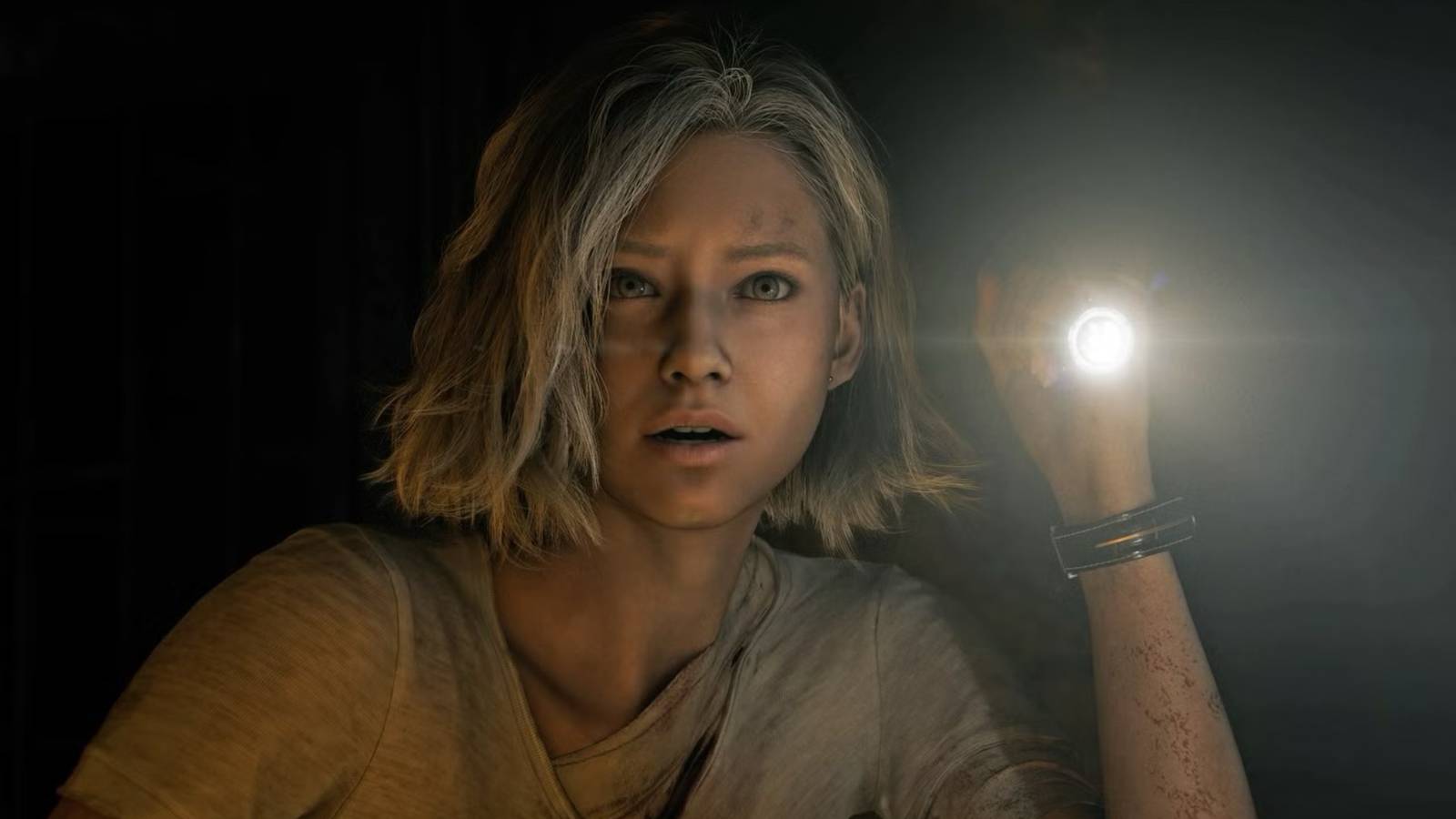



Housemarque’s last game, 2021’s Returnal, begins with protagonist Selene Vassos waking up alone on an alien planet. She takes her first steps into the unknown and finds her own corpse, a discovery accompanied by the startling realization that she’s stuck in a cycle–on planet Atropos, the finality of death has been replaced with the inevitability of a new beginning.
Housemarque’s newest game, 2026’s Saros, begins with protagonist Arjun Devraj waking up alone on an alien planet. He takes his first steps into the unknown and is killed. A few seconds later, he comes to the startling realization that he’s stuck in a cycle–on planet Carcosa, the finality of death has been replaced with the inevitability of a new beginning.
Saros is a game built atop of strong foundations set by Returnal. To that end, the similarities between the two games are numerous and immediately apparent. Saros’ premise and the way that it is realized on-screen are strikingly familiar and it often sounds, looks, and plays just like its predecessor. But those similarities are just what’s on the surface. Like Carcosa itself, once you dig a little deeper, Saros’ feels very different and demands to be taken on its own terms.
“We’re really proud of Returnal and feel we created something really special,” said creative director Gregory Louden. “Even to this day, I love to play Returnal. But we also knew that we wanted to take key aspects, [and] then evolve them with Saros and almost redefine what Returnal could be. It was about building on a sense of strength. If anything, [Returnal] helped re-energize us that we actually had something that players [really] loved. It reinforced our trajectory.”
“We knew that Returnal was something really special,” added art director Simone Silvestri. “It’s really unique. [So it was like], ‘Okay, let’s capture the essence of that and then let’s do a little twist on it and let’s build on it and let’s showcase our arcade DNA into a different source.’
“But I think that there are a lot of differences. The core one to me is Returnal is all about avoiding and it’s what our associate game director calls an obstacle course. [With] this one, which is more of a playground, you get to interact with the bullets, then you can treat them as resources. So we basically really took what was really good about Returnal and then deepened our understanding of that and expressed it in a new world, a new IP, a bigger, wider experience that we really felt we wanted to go for.”
Anchoring that new experience is Arjun Devraj. As a protagonist, Arjun establishes himself as a contrast to Selene from the very outset. She approached the planet Atropos with a scientific curiosity, initially meeting the alien threats with shock, but quickly moving to analyzing and documenting it all–albeit with a degree of apprehension.
Although Arjun has his wits about him, his inclination isn’t to learn about and understand Carcosa, it is to struggle against it; to fight it sometimes with a determination that teeters on recklessness. Arjun isn’t on a mission of exploration and discovery–not of Carcosa and, at least initially, not of himself. He knows who he is and why he’s there. His objective is to search and rescue.
The three hours I played the game, naturally, didn’t delve too deep into the various mysteries Saros lays the groundwork for, using flashes of striking imagery that no doubt are symbolic of things yet to be revealed. But one thing stands out as a signpost clearer than anything else: the voice of a woman beckoning him. She’s waiting for him and she is on Carcosa. It’s unclear how he knows this, but he is certain of it.
Again, the finer details of the narrative will become apparent deeper into the game, but Saros did paint enough broad strokes to anchor me to Arjun, Carcosa, and the objective. The necessary pieces to put together a small part of the puzzle are offered immediately: Arjun is an Enforcer; he works for a mega-corporation called Soltari; a colony was established on Carcosa to extract a compound called Lucenite, which is worth trillions; the colony, mining crews, and emergency investigation units dispatched to Carcosa have gone missing; members of his team are also missing-in-action; the woman is there. Even early on, the hooks and the performances are compelling enough to feel like Saros is a game that has narrative ambitions alongside its focus on intense gameplay.
While Selene was on Atropos on her own, Arjun is joined by the surviving members of his team, Echelon Four. They have hunkered down in a place called The Passage, which is a base of operations that houses a strange pool of swirling red energy that Arjun emerges from after he is killed, along with a few other things. Each member of Echelon Four is grappling with the mysteries of Carcosa in different ways and is motivated by different objectives. Through them, I learned that Arjun had been missing for a significant period of time, and what felt like an instant to me was long enough for the team to conclude he had abandoned them. Worse still, other members of the crew had succumbed to some sort of madness and either gone missing or had to be killed.
Arjun is a complicated man, and, based on initial cutscenes and conversations, actor Rahul Kohli looks poised to show those complexities in a memorable way. Arjun often states that his motivations, and his primary concerns, are to complete the mission, find the missing colony, and help other people. He projects his altruism, but on a couple of occasions, it feels like he’s trying to convince himself of this, and more selfish motivations slip through the facade. That’s not to say he’s a bad person or is scheming; it’s more of an indication that, like the others, he may be more vulnerable than even he realizes. And perhaps the mysterious woman he’s searching for could be influencing his decisions more than he lets on.
“With Arjun, we wanted to create another character for players to study and examine,” explained Louden. “We like to create characters that are discovered, not told … I’d say ‘come back stronger,’ as much as it being a gameplay term, is also about Arjun’s journey as a person. And then when we collaborated with Rahul [Kohli], he brought his own sense of authenticity and a real sense of realism to the performance to make it feel like you’re with this person on this hostile alien planet with this ominous eclipse, and you can feel the power and sort of the charisma of him as a person and then discover him as you continue through the arc.”
‘[Arjun] to me is so interesting because there’s so many layers of depth to him, to the world that he interacts with, to the narrative that surrounds him and the story that he himself drives. But one of the most important things is also the gameplay that is driven through Arjun, and we wanted to describe this unstoppable force against this alien planet. We went into the artistic design of the costume and it’s a lot of ’80s sci-fi inspirations [with] contact sport and law enforcement [vibes] in space. What makes him special is the person that he is; the life that he has lived and the determination that he shows whenever he’s faced with a challenge on Carcosa.”
According to Housemarque, Saros is an exploration of themes such as regret, power, and corruption, among other things. Because of this, it hopes to depict characters joining Arjun as similarly nuanced. Kayla, for example, is a technician who explodes with anger when Arjun returns to The Passage because she thought he’d abandoned them. She lashes out, saying people have died in the time Arjun was missing, but her fury feels like it is as much an expression of hopelessness as it is grief.
What sticks out prominently is the idea of duality, which runs through every part of Saros. Like Arjun, there is more to the others on Carcosa, too. Stack, for example, comes off as a calming voice, someone who understands the gravity of the situation and knows that he needs to be the voice of reason. And yet, there are moments when he insists that he needs to be out there, facing the danger, and he obsesses over this in a way that is almost like he’s not totally in control of himself.
That happens a lot. Characters are cogent in one moment, and then a little off in another. In more extreme cases, they’re clearly possessed by rage and fanaticism that usually leads back to the same thing: the sun, an ever-present, grossly incandescent entity that impacts Carcosa and the people on it in severe ways. It certainly seems like there are layers to peel back, and what’s underneath might not be something we, or he, likes. The sun’s place in all this won’t become clearer until we can play the full game.
A Ballet Of Bullets
In my hands-on, I played through Arjun’s first assignment: following a Soltari signal. After stepping out into Carcosa and facing off against bat-like critters and stationary turrets firing balls of blue energy at me, I felt like I was picking up where I left Returnal, forced to stay agile to make myself a harder-to-hit target, firing my weapons at enemies to chip away at their health, and carefully weaving between dozens of projectiles and behind obstacles to stay safe. That worked well for the most part, but enemies started aggressively pursuing me in a way that didn’t happen until the later stages of Returnal. The salvos of projectiles go from casually avoidable to overwhelmingly omnipresent–wherever I pointed my camera, there were things flying towards me, to the point where it started to feel like Saros was making demands of me that I couldn’t meet.
This was Saros’ way of telling me that threading the needle to stay alive won’t work for long, and it’s how it drives home the necessity of the biggest gameplay difference between Returnal and Saros: the shield. Housemarque wants players to throw themselves at the danger instead of trying to get around it. By pressing the R1 button on the DualSense controller, Arjun forms a bubble around himself that absorbs all blue projectiles that come into contact with it. There is a bar representing power that depletes while doing so. However, is can later be refilled by absorbing projectiles.
Aggression is the name of Saros’ game, and before long I was sprinting through waves of projectiles instead of trying to dodge them. This strategy applies to both offense and defense. For the former, it’s necessary in closing distances; for the latter, it becomes possible to punch a hole into seemingly impenetrable walls of bullets to dash to safety.
In my skirmishes, I began running directly at enemies to deliver brutal punches, which made short work of the annoying turrets that liked to pepper me from the outskirts of the battlefield. The more beast-like enemies mixed projectiles with up-close swipes and the shield was excellent at helping me get out of pressured situations and re-establish my footing. Housemarque is calling this new flavor of its combat “bullet ballet,” which gives it more elegance than it perhaps represents, at least in the way I was playing. I certainly didn’t feel like I was doing ballet; I felt I was becoming a wrecking ball.


“This idea [started from the] opportunity of the projectile. Rather than being purely threats, we could pull [players] forward and use [bullets] to engage with them,” explained Louden. “When you change your perspective of projectiles, I think the game flips on its head. I love it when a game makes you look at something different and you feel the mastery.
“The enemies are meant to be vicious and hostile, but in the end, you can master them. And it’s really about listening to the game and listening to yourself as a player and flowing. Don’t view it as something you run away from. Don’t view it as hell. View it as a dance. View it as a ballet so you can really own them and feel that power as Arjun as you continue through the game.”
Saros’ gameplay also has the same tendons connecting its various parts that Returnal used to make the loop feel cohesive and satisfyingly circular: the active reload mechanic will shorten the time between when you’re firing and not firing guns; an adrenaline mechanic will reward you with bonuses as long as you don’t get hit and stack up levels; you have dashes and jumps that can be extended by holding the corresponding buttons; and Power Weapons can be relied on to dish out a lot of damage in various ways–some will hone in on enemies, others will lay down bombs like mines, and so on.
These in-between-firing-guns actions that I do almost subconsciously now after playing Returnal quietly build momentum that, when utilized correctly, feels like it embodies Arjun’s determination. Despite having largely the same toolset, Selene always felt like she was on the back foot and then emerged victorious by beating the odds. Arjun, by comparison, can be played with an aggression that feels more empowering. That is, until you overcommit and get smoked in an instant–you might feel powerful, but you’ll still routinely find yourself in a desperate fight for survival.
Strength in Numbers
True to the studio’s roots, Saros is another very challenging Housemarque game, but there have been some changes made to make sure that, even if you bite the dust, the time you spent on one of its roguelite runs is still fruitful. The tagline for Saros is “come back stronger,” and that is achieved by talking to The Primary, a machine that serves as the eyes, ears, and voice of Soltari. By interfacing with what is basically an overbearing robot middle-manager that’s constantly monitoring your time-on-task, Arjun can spend lucenite gathered during a run to unlock permanent upgrades that not only change the way the game is played, but also give the player a degree of agency in how Arjun develops. This is a big change in Housemarque’s design, but it doesn’t undermine the challenge of the game. Some upgrades make a significant difference, like Second Chance, which, as the name implies, brings Arjun back for one more chance when he dies. Others are smaller, but remain meaningful by boosting attributes such as armor integrity, health, shield capacity, the amount of lucenite you gather, and so on.
The question that came to mind, for me, was how that sense of growth impacts what Housemarque wants players to feel as they explore Carcosa. The lack of these systems in Returnal meant that, as a player, and as Selene, I felt like I was at the mercy of Atropos and that my journey was one of desperation. But the ability to make Arjun more powerful over the course of his journey stands to shift that dynamic.
“I think it’s really important for us that we always think about how we want the players to react and feel. So in a lot of ways, you could say Saros is about [the] power fantasy,” said Louden. “It’s about this sort of growth and it’s about coming back stronger … so the sensibility of Arjun as a Soltari Enforcer [through] the gameplay we offer, [that] feeling is critical. Even the lens of Soltari, this corporation you work for that’s using you to go to this planet and essentially extract the resources, it’s all done with a lot of attention and detail to try to inhabit this sense of power, but also this sense of this kind of emotional response.”
“There is a lot of power in the corruption as well,” said Silvestri. “But there is also a lot of corruption in power. There is a lot of depth in that journey itself.”
Although I didn’t use it, Housemarque has previously said that players will also be able to customize the gameplay experience to their liking by using modifiers. Options such as making perfect reloads easier, increasing lucenite collection radius, and preventing the shield from consuming Power when used, will no doubt sound appealing to those having a little trouble with the game. However, there is a trade-off system to counterbalance these advantages. If you want more lucenite, you may have to reduce the amount that you keep when you’re killed; the shield being less strict about usage could mean you do less damage to enemies.
This is a very smart extension of the risk-versus-reward system from Returnal, which also makes its return with similar implementation. In Returnal, it was mainly oriented around Obolites and weapons, some of which had a risk of causing a suit malfunction. To undo this, players are given a little challenge to complete, such as killing a certain number of enemies or opening a certain number of chests, for example. Saros has a similar approach for weapons, which have a downside you need to factor in alongside any improvements they may offer.

The big gameplay twist comes from the aforementioned sun–more specifically, the eclipse. The menacing celestial body feels like an everpresent watcher; like the Eye of Sauron, but constantly bearing down on you. During each run, Arjun will inevitably encounter a point where progress is halted and the only way forward is to summon the eclipse. By doing so, Carcosa is enveloped in a malevolent energy that shifts the tone of the game drastically. From that point on, the world is corrupted and looks as if it has been plunged into the depths of hell. Everything looks like it has been lit on fire, eldritch creatures and alien flora suddenly appear, and pools of boiling acid pop up.
“The eclipse was one of the earliest ideas we had as a means to escalate the experience and almost wash over the world and provide this whole other layer to the experience,” explained Louden. “We always start from gameplay. So we did a lot of exploration in order to find the perfect gameplay response for the eclipse, and we have the idea of corruption. So corrupted projectiles, corrupted weapons, corrupted artifacts–the idea that it is all over the planet. But then we wanted it to escalate. The sky erupts in fire and you’ll get to see even more as you experience through the game. Also something that we paid a lot of attention to detail in is in the soundscape and the music.
“Once the eclipse happens, we wash the world in drone metal. So we basically create this [musical] cocktail of dark electronic [and] drone metal that kind of washes over [the world] and this distorted guitar that creates this whole different ambience for you to explore. And then, last but not least, the characters: what happens to these people when there’s this corrupting influence, and how does it change people that were once your anchors, that maybe you lose in the madness of it all.
“It’s definitely been this sort of overall kind of ominous force that we’ve used that is actually one of the greatest mysteries of the game for you to discover. Duality and the mystery of the eclipse is a driving aspect of Saros and part of Arjun’s journey.”
“There’s also duality because you have the normal version [of Carcosa], especially the first biome [which has] this nice, vibrant palette,” said Silverstri. “There is ominous architecture, but it’s not as aggressive. But then you put the eclipse on and now it’s like, ‘Okay, this is now overwhelming.’ And we do that for every biome–every biome has this duality. And the cool thing is that we try to change the player experience with that eclipse.
“In the Ancient Depths you’re going through the bones of a mining operation of some sort, and then you put eclipse on and the machines come alive, so now the platforming is different, the whole sensation of the level is different. This duality is woven through everything, including the way to traverse the world. One thing that I wanted to focus on is that each biome feels unique and also feels unique in its escalation as well. We want to reward the player every single time they manage to progress, so they should have a surprise and they should have a payoff.”
A New Dawn
The name “Carcosa” is likely a reference to the fictional lost city of the same name from Robert W. Chambers’ The King In Yellow, a collection of weird fiction short stories that also drew inspiration from Ambrose Bierce’s An Inhabitant of Carcosa. It is presented as a place that almost exists in its own hellish pocket of time and space; a planet with twin moons that is constantly changing and growing. In the Cthulhu mythos, it is home to Hastur the Unspeakable, a being that aims to consume life until it is able to ascend to the rank of an elder god.
While the idea of a growing and shifting planet is the perfect touchstone for a game in which each run features a different configuration of landmasses, Saros’ eclipse is where Housemarque’s take on Carcosa channels its inspirations most. This is when the planet takes on an almost Lovecraftian identity. The dangerous creatures that inhabit it are imbued with a corrupted energy that can no longer be shielded against. Instead, taking damage reduces Arjun’s maximum armor, which can only be restored by using his Power Weapon. But in the thick of battle, you may not even get the chance. The eclipse is transformative enough to the gameplay that it became something I dreaded doing. During that phase of a run, I felt like I, and by extension Arjun, had lost that sense of empowerment and was pushed onto the back foot.
Housemarque has never been a slouch when it comes to presentation, but Saros is a big leap forward. Not in the technicalities of the visuals; yes, the environments look sharp and the character models detailed. The particle effects and vibrance of projectiles contrasted against the color palette of the planet’s biomes are as dazzling as ever. But what really leaves a mark is the atmosphere. Returnal’s atmosphere is one of isolation–feeling alone and constantly facing the unfamiliar. But there are quiet, sombre moments to be found too; the silence after hectic battle; the gentle waving movement of the strange luminescent tendrils that look like Atropos’ version of grass. I didn’t find that in Saros–everything in Carcosa sucks when the eclipse happens.
The entire time I was playing Saros under the eclipse, the dramatic shift into a fiery color palette instilled a discomfort in me. From visuals to the sound design–much of which involves snarling from unseen monsters lurking somewhere nearby, or the faint wails and groans of someone having a much worse time than me–it all comes together in a way that truly makes the planet bristle with a hostile energy.
Similarly, the way the architecture changes had me stopping and just looking around. Craggy cliffs, surrounding deep red land that looks like it could be made of blood and sinew; barren trees that look brittle enough that they’d crumble if touched; towering cathedral-like structures as majestic as they are unsettling; cold stone buildings made of dense slabs of stone and metal mathematically layered and placed to create an unnerving kind of symmetry. At times, I felt like I was guiding Arjun through Hades; other times, through something out of Denis Villeneuve’s Dune. Either way, it all comes together to be truly arresting.
At times it reminded me of macropsia, a sensation of having distorted perceptions which, in turn, makes structures or objects feel impossibly large and extremely close. It is often accompanied by an overwhelming feeling of futility. While macropsia is linked to neurological conditions, it’s the closest I’ve come to describing the experiences I had as a sickly child that repeatedly suffered from intense fevers. At their worst, those macropsia-like shifts in scale would make me feel small and helpless. While not quite as severe, the world of Saros at times also channeled the surreal quality of those symptoms.

“It always came from wanting to create a really special sort of cosmic horror experience for players. And from there, we just evolved in and added even more depth,” said Louden. “We explored different elements of the eclipse–worship of the eclipse. It was wanting to create this special kind of experience for players that takes different elements from Japanese manga, from anime, from science fiction, classics, literature, and create this cocktail with a British South Asian protagonist going through this science fiction world, if that makes sense.”
“We grew up on so many different references, and when we started to look at the architecture, the main central theme and thread was the eclipse,” said Silverstri. “And so early civilization, mysticism, I like to go deep into history and find something that I can ground things in, but then we need to abstract ourselves. We need to go back a couple of layers and say, ‘Okay, that’s a starting point. How do we challenge that? Let’s find something that is really weird and really opposite of it. Let’s put it in, see what happens when we have this visual friction between elements.’
“One example of this is in the architecture, because we wanted to have some civilization that is built to celebrate the eclipse and worship it. And then we have these touches where you can see what that means. We call it the Twisted Enlightenment, where they literally opened themselves up to the eclipse. And I wanted to start with neoclassical architecture because it’s all about epic scale and very big statues, but it was very soft and friendly. And so we picked Italian Futurism, which was born in the 1920s, as a reaction–so it’s the opposite of it. And that gave us this contrast that brought these sharp, violent, rhythmical, vertical lines into everything. And it became this concept that we called the violent beauty, which became a pillar for the art direction and a pillar for Carcosa and the civilization that is on that.”
There are so many examples of how Saros is undoubtedly walking the same path as its predecessor. Ironically, however, with Returnal and Saros, Housemarque–a developer that has played in a number of different genres, also seems to be settling on its own identity. It might look like an amalgamation of other styles and inspirations, but it’s common to reach for the familiar when trying to comprehend the new. In Housemarque’s case, the team believes it has a firm grasp of the kinds of games it wants to make. For Saros, it’s something it hopes will stick with players for a long time to come; something “monstrous” to quote Louden.
“We want to explore cosmic horror and all the monstrosity of it of what the eclipse can do to people through its corruption. We want to create something that I think is a driving factor for our games: something that moves you, [that makes] you feel emotions and you feel changed by.
“It’s hard to put a finger on, but it’s Housemarque and this [is a] new chapter. It’s Housemarque in 2026 with our unique voice of bullet ballet, mysterious and haunting narrative, a dark sci-fi world just creating something really special and unique.”
“We live on the fringe,” added Silvestri. “We are just on that edge of being a little too extreme, so that you can find touch points that you are familiar with, but then there’s always something different about it. To me, that’s the essence of Housemarque, that there’s nothing like this out there. And I say that with confidence because I try to find things that are similar, because I like our games, so I want to play more [like them], but it’s not easy.”
For some, Saros’ similarities to Returnal may temper their excitement somewhat. But, having played a few hours, it has become clear to me that, like Selene and Arjun, Housemarque is approaching the familiar armed with knowledge, experience, and tools that it hopes it can use to push further into the unknown.