



Spoilers for POKEMON Detective Pikachu ahead!
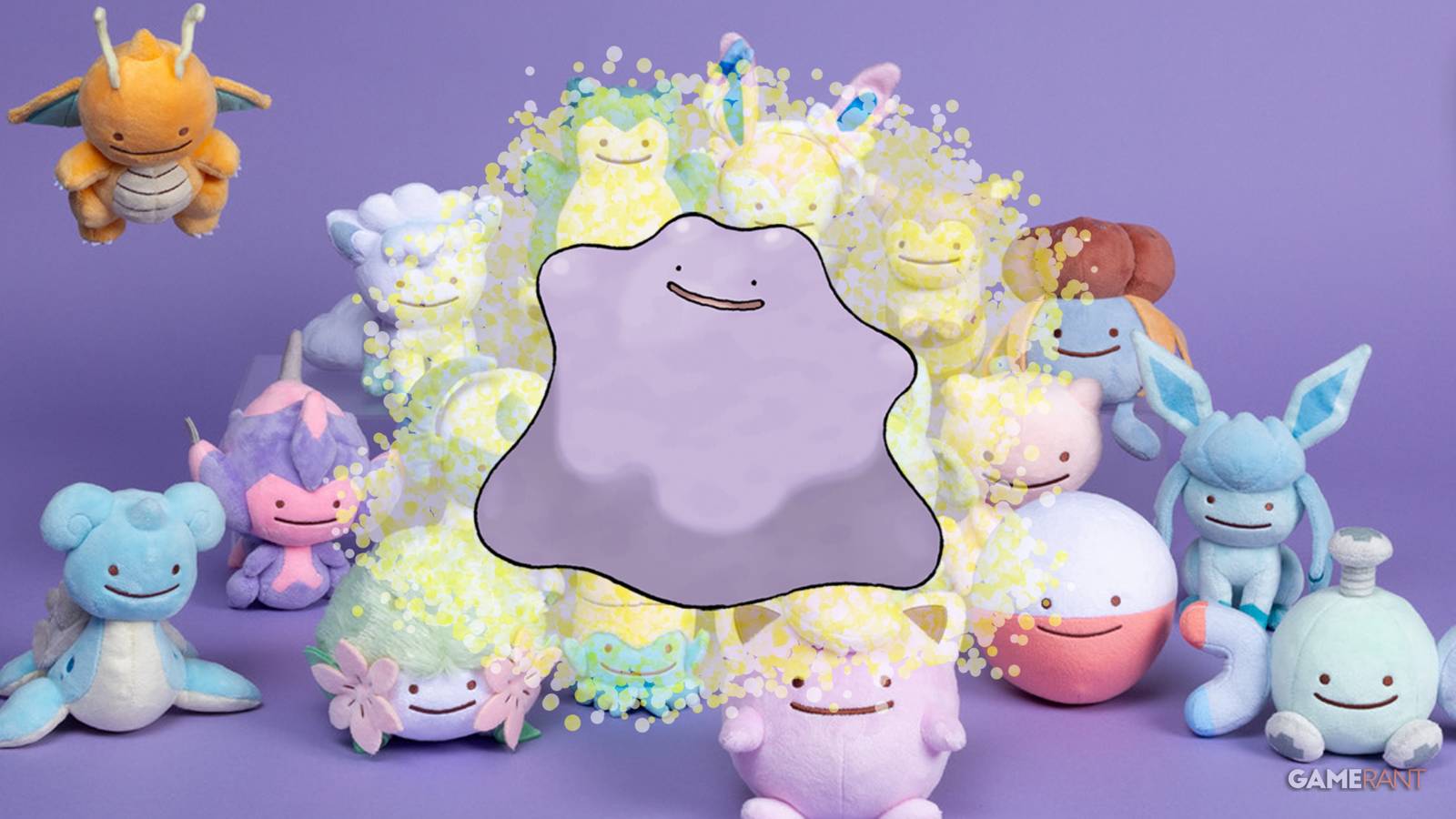
Pokemon Pokopia puts a special spotlight on Ditto, the Transform Pokemon. Ever since the series started with Pokemon Red and Blue (or Green in Japan), the darling doppelganger has won over many with its dopey dot-eyed smile. Ditto’s smile is actually so iconic that most depictions of it outside of in-game Pokemon battles has it keep the expression even when transforming – even though the title of “Transform Pokemon” implies it should be able to perfectly duplicate whatever it’s imitating. But it’s cute and gives Ditto its own identity even when using its powers, so it’s no surprise that Pokopia kept it.
Ditto’s signature tell wasn’t actually always a part of its lore, though. In fact, the first time the franchise showed a dot-eyed Ditto transformation in the anime episode “Ditto’s Mysterious Mansion,” the Pokemon’s unchanging face was explicitly mentioned to be a flaw of that particular Ditto. It’s fascinating to see what was originally a single-episode joke become part of a Pokemon’s core identity.
Pokemon Pokopia Solves Animal Crossing’s Biggest Villager Problem
One of the major sticking points for Animal Crossing: New Horizons players regarding villagers is essentially fixed by Pokemon Pokopia.
Ditto’s Eternal Expression From Ditto’s Mysterious Mansion
The original dot-eyed Ditto transformations appeared in episode 35 of the original Pokemon anime: “Ditto’s Mysterious Mansion.” During a storm, Ash Ketchum and friends take shelter in a theater where they meet a girl named Duplica and her Ditto. The two dream of becoming a double-act where they wow audiences with their Pokemon impressions, but Ditto always struggles to nail the facial part of transforming, even when the rest of the body is perfect. Near the end of the episode, Ditto finally gets a handle on changing its face and helps defeat Team Rocket.


Drag weapons to fill the grid
Drag weapons to fill the grid
EasyMediumHard
In the mainline Pokemon games, any Dittos on the battlefield will have their opponent’s face when transforming, so the trademark smile isn’t a problem for any Dittos the player may encounter. But that’s just in actual player-involved battles and only in the main games; side material like spinoffs and the Pokemon trading card game are another story.
The first time dot-eyed Ditto made a video game appearance was in Pokemon Snap on the Nintendo 64 in 1999. Early in the Cave stage, the player can find what looks like a Bulbasaur during the initial descent. If they hit it with a Pester Ball, though, it will turn into a Ditto. Even before it’s exposed, it has two dot-like eyes instead of Bulbasaur’s big eyes and tiny fangs.
The Evolution of Ditto’s Smile
Most portrayals of Ditto continued to just stick to its purple blob form and avoid any visual transformation issues. However, there were a few notable deviations that cleverly used the Ditto face to help keep it identifiable.
In 2005, Ditto got a few trading cards during the EX Delta Species expansion that gave it different types, and the art changed accordingly to fit with the type: instead of the familiar smiling blob, Grass Ditto showed it imitating a Bulbasaur, Fire Ditto had it imitate a Charmander, and so on. These differently-typed Ditto transformations all had it with the base form face, helping players identify at a glance that they were playing with a Ditto instead of whatever it was turned into. Only two cards after this set used the Ditto face: one where it was disguised as a Numel, and a Korea exclusive that showed Ditto-faced Lapras, Pikachu, Magikarp, and Lotad hanging out with a few base form Ditto. There’s also one that shows it mid-morph into a Pikachu that still has the face, but if you want to get technical, that one isn’t a full transformation yet.
The first mainline video games to show a Ditto keeping its face were Pokemon Diamond and Pearl. At the Veilstone Game Corner, there are three different kinds of Clefairy that can appear during the slot machines’ Bonus Rounds: a normal Clefairy, a Shiny Clefairy, and a Ditto transformed into a Clefairy. The Ditto will keep its face in this form and is a sign that the Bonus Round has a low chance of repeating.
One of the more infamous appearances of dot-eyed Ditto comes from the POKEMON Detective Pikachu movie. Near the end of the film, Howard Clifford’s assistant Ms. Norton is revealed to be a Ditto, having hidden it with sunglasses before. But once the glasses come off, it turns out they’re hiding dot eyes, and many fans felt that seeing a Ditto-face on a human was rather uncanny. Once the Ditto starts transforming into other humans, it gets even creepier.


Pokopia Dream Islands and Dolls, Explained
Everything you need to know about accessing and making the most of resource-farming worlds in Pokopia.
Ditto’s Face is Both Charming and Smart Advertising


While it’s no star in battle, Ditto is one of the most iconic members of Generation 1’s original 151 Pokemon. Its gimmick in battle is cool, but players who actually give Ditto a try will find that it’s often not a sustainable team member. Its horrible base 48 HP doesn’t change when in disguise, even though the rest of its stats do, and each of the moves that come with the new form only have 5 PP each that can’t be restored. In a series where almost any Pokemon is salvageable in the single-player campaign, Ditto stands out for how ironically restrictive it is for being the “Transform Pokemon.” So to salvage Ditto’s image without buffing it in the games, Pokemon had to make Ditto more marketable.
Beyond the previous examples, there are other spinoffs and a huge amount of Ditto Pokemon merchandise that show it transformed but keeping its smile, which is a great way to promote the Pokemon. The issue with shapeshifter characters on a marketing level is that they’ll spend very little time looking like themselves, so they have to have something else to make them stand out or recognizable even when they’re transformed. The Pokemon Company realized that Ditto keeping its face in every form was just what it needed to make it memorable for general audiences.
Ditto really was the perfect protagonist for Pokopia. In a game without combat, the otherwise weak Pokemon shines by showing its potential in other areas. Having it keep its doofy smile, even in humanoid form, is a great compromise to let players still use it as a character to project themselves onto while never forgetting that they’re playing as, well, Ditto. And while it was never obscure, maybe Pokopia’s fantastic critical reception will lead to a Ditto renaissance in the main series where it gets at least a little bit of a buff.




- Released
-
March 5, 2026
- ESRB
-
Everyone / Users Interact, In-Game Purchases