



Although they haven’t exactly disappeared, third-person shooter games are way rarer than you might think. Sure, we still get the occasional massive release like Gears of War: E-Day (which rocks, by the way), but the genre doesn’t have an active AA or indie scene like its first-person counterpart. Admittedly, this development was a reaction to that period in the late 2000s when everyone was dropping third-person shooters, many of which were middling and barely left an impression.
Look, I am a sucker for a cover system, and I never say no to one of these releases. While the current climate kind of sucks, we can always revisit those “middling” shooters from yesteryear to get our fill of awkward running animation, rough heroes in armor, and brown color palettes. Those might sound like negatives, but they aren’t for me.
“Time forgot” is a vague term, but I’m going to try to stick to truly forgotten games. I’m not going to include titles like Spec Ops: The Line and Binary Domain, as both of those are relatively well-known nowadays. Also, I’m just ranking these games, and I’m not saying these are the best third-person shooters of their era.
That said, I consider all these games worth playing, if you can get your hands on them.
7
Fracture Lets You Change The World
A Third-Person Shooter Tech Demo
Released in the same year as Dead Space, Army of Two, and Gears of War 2, Fracture was certainly not the best third-person shooter of 2008, but it wasn’t the worst either. Day 1 Studios has pedigree thanks to the MechAssault games, and Fracture highlights fascinating tech and mechanics with serious potential. Using special weapons like the Entrencher, you manipulate the dirt around you, causing pillars to shoot up or vortices to drag things down (among other things).
Unfortunately, Fracture wraps this cool terraforming concept in a lackluster campaign that does the bare minimum and nothing else. In theory, this tech should provide quite a bit of player freedom, but the execution doesn’t do that. You run through linear levels and deform the terrain when you are allowed to. A cool sandbox mechanic is reduced to a button prompt to get through obstacles. To its credit, Fracture isn’t a cover shooter; conversely, I don’t think it’s better than most cover shooters.
Shout out to Wanted: Weapons of Fate, which also came out in 2008. For a short-as-heck movie tie-in game, it’s better than it has any right to be.
6
Blades Of Time Should Be Called Rifles Of Time
A Hack And Slash That Works Better As A Third-Person Shooter
OK, I know what you are thinking: “Isn’t this a hack and slash? “Blades” is right in the title!” Well, yes and no. Primarily, Blades of Time is a character action game akin to something like Devil May Cry, albeit with far simpler and more floaty combat. However, you also use rifles, and they are not a small part of the equation. In fact, the gunplay feels better than the swords, especially before you upgrade the latter’s elemental moves.
Like Fracture, Blades of Time features an awesome central mechanic: Time Rewind. At nearly any moment, you can record your actions for a few seconds and then spawn a clone that repeats those moves, which you need for both puzzles and combat. Although it takes some practice, Blades of Time handles this idea well, and mastering it feels genuinely good. It’s a shame the campaign is mostly a repetitive slog that devolves into endless arena battles.
5
Inversion Lets You Defy Gravity
It’s Gears Of War, But With A Gimmick

I promise, this will be the last TPS about gruff men running around in makeshift battle suits. Inversion and Fracture are essentially the same game: mid-budget third-person shooters that waste a fantastic gimmick on a mediocre campaign. Unlike Fracture, Inversion completely copies Gears of War‘s playbook, delivering an identical cover shooter mechanic system. If you don’t enjoy classic GoW, you will absolutely hate its Temu version.
I love GoW, so I enjoy Inversion for what it is. The gimmick is the ability to reverse gravity with a single button press, especially on your enemies. You can yank an enemy out of cover, drop heavy objects on them, and mess with the environment. The game doesn’t constantly allow you to do what you want, but it lets you experiment quite a bit more than Fracture, which is the main reason it ranks higher.
4
Wet Is Amazing Like 30% Of the Time
The Other 70% Are Mostly Just OK

- I included a bit of gameplay footage in the intro, just to illustrate how Wet generally plays. Don’t mind the visual fidelity, as I compressed the file a bit to make the size more manageable.
Sometimes, you just have to give it up for the rule of cool.
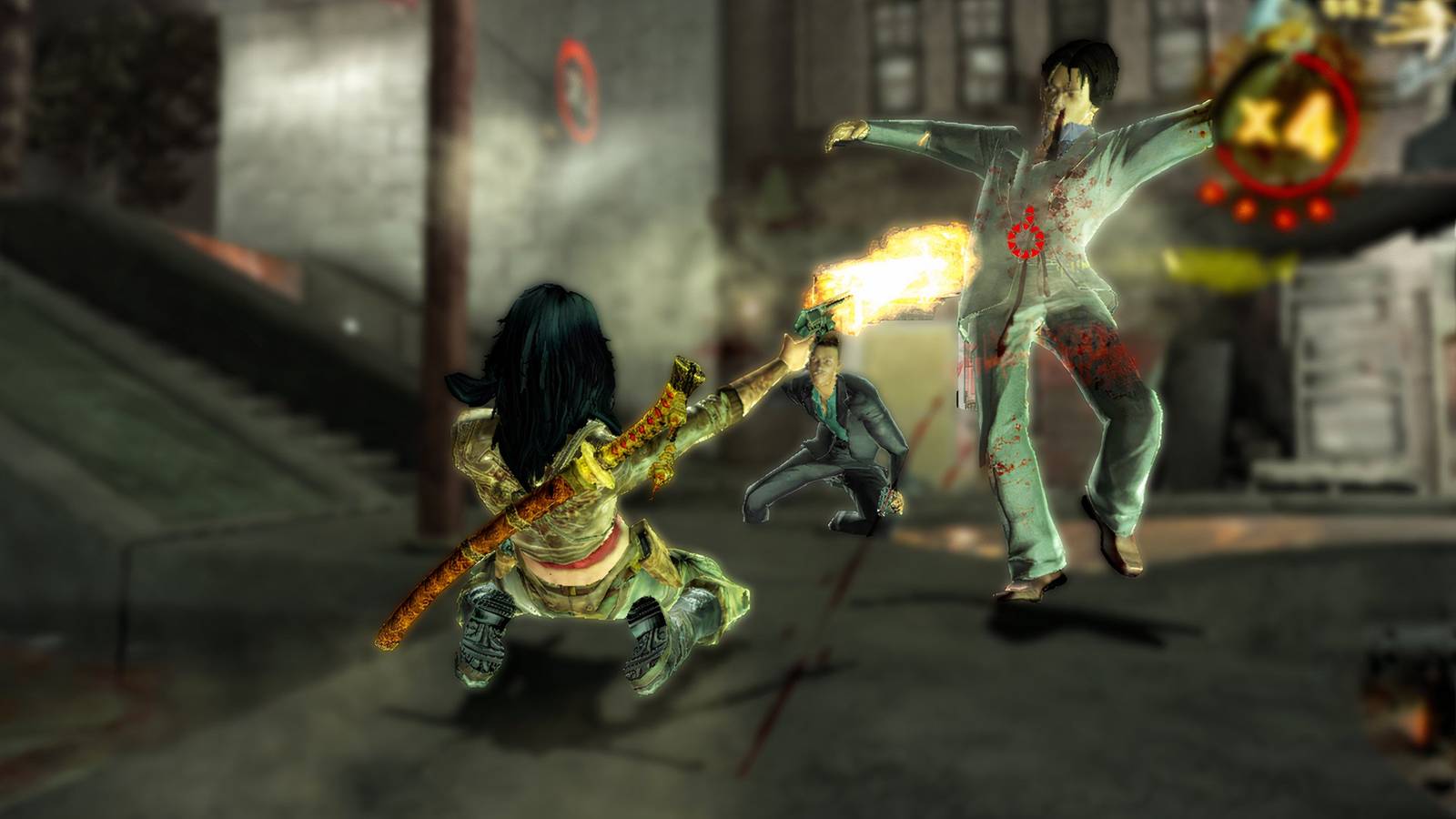
Remember that time Bethesda published a weird grindhouse love letter with gun-fu action and starring a foul-mouthed protagonist voiced by Eliza Dushku? Wet sounds so awesome that it seems too good to be true, and that’s only partially the case. Don’t get me wrong, this 2009 shooter is fun in spurts and has a neat aesthetic that sets it apart from most of its contemporaries; however, Wet is the definition of style over substance, and the former isn’t even always present.
Rather than the shooting, the gameplay revolves around movement, which lets you execute acrobatic stunts while activating slo-mo like a mix of John Woo and Max Payne. When things click, Wet can be downright incredible, but these moments don’t tend to last very long and are let down by a lack of polish. The campaign relies heavily on monotonous wave arenas, and it’s kind of weird that the most useful weapon in a third-person shooter is a sword.
Still, a really cool game, at times.
3
Hunted: The Demon’s Forge Could Only Have Come Out In 2011
A Fantasy Cover Shooter
Remember that time Bethesda published a weird medieval-fantasy cover shooter and hack-and-slash hybrid? Also, it was developed by a team that isn’t known for either of those genres, with inXile Entertainment specializing in RPGs, for the most part. Despite being maybe the most “unique” game in this article, Hunted: The Demon’s Forge also has the most “developed by committee” feel, coming across like a hodgepodge of trends smashed together with little rhyme or reason.
You play as two mercenaries, an elf named E’lara (who mains crossbows) and a human named Caddoc (who focuses on melee). Solo players can swap between the two at specific points in levels, although the game was clearly designed with co-op in mind. Personally, I never got to play this with a friend, so I ran through the long-ish campaign on my own, jumping back and forth between excitement and boredom.
Hunted: The Demon’s Forge is weird. Even though snapping for cover in a fantasy setting seems wrong, the shooting mechanics are generally more fun than the basic melee combat, and also far more survivable. The visuals aren’t great, the story doesn’t have much going on, and the stages mostly consist of arenas fighting the same few enemies… but I found myself getting into the zone on more than one occasion.
Find the odd one out before the timer hits zero.
2
Dark Sector Was Warframe Before Warframe
A Messy Third-Person Shooter That Still Manages To Deliver A Good Time

Did you know that Digital Extremes existed before Warframe? Wild, I know! After playing its role in writing Unreal Tournament‘s legacy, the studio set out on its own in the mid-2000s, releasing two pretty bad FPS games called Pariah and Warpath. After that, Digital Extremes dropped Dark Sector, which kind of seems like a precursor to Warframe nowadays. Although far from perfect, I consider this one to be just a straight-up good game, albeit one that is very 2008.
Stuck in development hell for roughly a decade, Dark Sector wears its turbulent history for all to see, and it’s just kind of all over the place. Starting out as a stealth-action hybrid before dropping the former in favor of Gears of War-style shooting, the campaign is a gritty Cold War shooter with monsters, robots, and The Glaive. The latter is the best part of the game and the main reason to play it.
Although you can swap other weapons, you spend most of your time wielding the three-bladed boomerang and a pistol, with the former providing quite a bit of tactical options in the middle of combat. You throw it to decapitate enemies, pick up ammo, or adopt an element. It doesn’t always control 100% smoothly, but it feels great when it lands.
1
Stranglehold Is A Legitimately Incredible Third-Person Shooter
An Awesome Send-Up To Hong Kong Action Movies

How about we end things with a genuinely great game? Stranglehold is a John Woo movie in video game form; in fact, it’s a sequel to 1992’s Hard Boiled, one of the best action movies of all time, and stars Chow Yun-fat as the protagonist, Tequila. Released in 2007, the game doesn’t play like Gears of War, doesn’t look like brown sludge, and doesn’t force you to constantly hide behind a broken wall. Stranglehold is its own thing.
In many ways, Stranglehold is the gun-fu game that Wet tried to be. Tequila could slide across tables, ride handrails, swing from chandeliers, and wall-run off pillars, all while entering slo-mo to line up midair headshots. The combat feels damn amazing, and it’s amplified by destruction physics that makes you feel like an absolute killer.
If there is one negative to say, it would be that Stranglehold relies entirely on its destruction and core gunplay. The levels are just linear corridors that rarely diverge from the standard loop, and you see everything the game has within the first hour or so.