





Player freedom is one of those things that has become a pretty big selling point for modern action RPGs, whether that means being able to go wherever you want, put together whatever build you can dream up, or make choices that actually change something about the world around you. Bigger worlds and more powerful hardware have obviously given developers plenty of room to make that freedom even more impressive over the years, but what’s funny is that plenty of action RPGs were already finding creative ways to hand control over to the player long before any of that was possible. In fact, some SNES games were doing things more than 30 years ago that plenty of games still don’t give you much say over today.
Of course, freedom looked a little different on the SNES than it does now. These weren’t massive open worlds filled with hundreds of icons to clear off a map, and most of them were still going to make sure you ended up where the story needed you to be eventually. But some let you decide who joined your party, how your characters developed, which parts of the world you wanted to explore, and even what that world would eventually become. Others were simply happy to give you a bunch of tools and trust you to figure out how you wanted to use them. Considering how tightly controlled plenty of games can still feel today, these near-perfect SNES action RPGs were surprisingly willing to get out of the player’s way.
For the purposes of this list, SNES includes games originally released for the Super Famicom, even if they weren’t officially released for the SNES in North America at the time.
Secret of Mana
It Let You Decide How Your Entire Party Fought
- Freely switch between all three party members in combat.
- Let any character use and level multiple weapon types.
- Customize AI-controlled allies’ combat behavior through the Action Grid.
Secret of Mana is probably one of the first games that comes to mind whenever SNES action RPGs are mentioned, and even now, there is a surprising amount of flexibility hiding underneath what looks like an otherwise straightforward combat system. Once all three characters have joined the party, you’re free to switch between them whenever you want, and no one is really locked into one specific weapon, either. There are eight different weapon types to use, and each character develops their own proficiency with those weapons simply by using them. So, if you decide you want one character wielding a sword for most of the game and then suddenly feel like handing them a spear or a pair of gloves instead, Secret of Mana isn’t going to stop you from doing that.
What makes that even more impressive is how much control you have over the two characters you aren’t currently playing. Secret of Mana‘s Action Grid lets you adjust how aggressive each AI-controlled party member should be and how much they should prioritize charged attacks, which is the kind of thing plenty of modern action RPGs still simplify down to a couple of broad commands—and that’s if they let you change companion behavior at all. There are obviously far deeper party systems today, but for a game released in 1993, Secret of Mana was remarkably comfortable letting you decide who you wanted to control, what everyone fought with, and how the rest of the group should behave when you weren’t controlling them yourself. And that’s more than many modern action RPGs can say of themselves today.

Put the consoles in the correct order.
Tales of Phantasia
Your Party Didn’t Have to Fight the Developer’s Way

- Adjust party formations and AI tactics to suit different fights.
- Choose which techniques party members have available and manually issue commands.
- Experiment with different abilities, equipment, spells, and optional techniques.
Tales of Phantasia helped establish a combat system that would eventually become one of the defining features of the Tales series, but what I find even more impressive is how much say it gives you over everyone besides the character you’re directly controlling. Cress might be the one you’re actually moving around the battlefield in the original Super Famicom release, but you can change your party’s formation, decide which techniques are equipped, alter the tactics used by your AI-controlled companions, and even jump into the battle menu to manually tell a spellcaster exactly what you want them to cast and who you want them to cast it on.
That probably doesn’t sound revolutionary anymore, especially after decades of RPGs building on the same idea, but even modern games can be surprisingly stubborn about letting you tell AI companions what to do. Sometimes you get a few broad presets and have to hope for the best, while other games barely give you that much. Tales of Phantasia was already letting players mess with tactics and formation in 1995, while still giving them plenty of techniques, spells, equipment, and optional content to discover outside of combat. It might still be a fairly traditional RPG adventure, but once the fighting starts, it’s far more interested in letting you run the party yourself.
Dragon View
It Was Perfectly Fine With Letting You Get Lost

- Freely explore a large overworld instead of simply following a fixed route.
- Discover hidden caves, upgrades, magic, and other rewards off the main path.
- Choose which visible enemies to engage or avoid, including tougher fights you can attempt early.
Dragon View is probably going to be the least recognizable game on this list for a lot of people, but it might also be one of the best examples of just how willing some SNES action RPGs were to let players wander off and figure things out for themselves. Rather than moving around a simple top-down map between towns and dungeons, Dragon View gives you a huge pseudo-3D overworld that you can freely explore, complete with areas and secrets tucked away where you aren’t necessarily going to stumble across them by following the most obvious path.
There is a real reason to go looking around, too, because Dragon View hides weapon and armor upgrades, magic, health upgrades, and other useful items throughout its world, with some caves and secret areas requiring a little extra attention to find. Enemies on the overworld are visible rather than being forced, random encounters, so you can even avoid a lot of fights if that’s what you want to do, and because the combat leans heavily on player skill, it is technically possible to take down enemies that your stats suggest you probably shouldn’t be fighting yet. There are plenty of modern RPGs that give you a giant world and then immediately cover it in markers telling you exactly where everything is. Dragon View had far fewer places to go, obviously, but it was much happier to simply point you toward the world and let curiosity lead the way.
Front Mission: Gun Hazard
Build Your Mech, Pick Your Partner, or Just Get Out

- Build and customize your Wanzer with different weapons and equipment.
- Choose AI companions based on the abilities and support you want for a mission.
- Leave your mech and continue exploring or fighting on foot when the situation calls for it.
Considering Front Mission is primarily known as a tactical RPG series, Front Mission: Gun Hazard is already a pretty unusual game before you even get into how much freedom it actually gives you. Rather than moving units around a grid, you’re piloting a Wanzer through side-scrolling real-time combat, and there are a lot of ways to make that Wanzer feel like your own. You can buy different equipment and weapons, choose which special weapons you want to bring into a mission, upgrade your gear, and take one of several AI-controlled allies along with you. Those companions aren’t interchangeable, either, as they have different abilities and can fill different roles depending on what you need for a particular mission.
But my favorite part is that Gun Hazard doesn’t even force you to stay inside the giant robot the whole time. You can climb out of your Wanzer and continue moving through a stage on foot, which is sometimes useful for getting into areas your mech simply can’t reach. It might sound like a super small thing at first, but it says a lot about the way the game approaches player freedom. Instead of treating the Wanzer as the only way you’re allowed to interact with its levels, Gun Hazard gives you another option and occasionally rewards you just for remembering it exists. Add in the ability to experiment with different weapons and companions, and this is the kind of game where two players can approach the exact same mission with very different ideas about what they should bring with them.
Terranigma
You Can Actually Change What the World Becomes

- Pursue optional side activities that determine how certain towns develop.
- Influence the growth of civilization by spreading inventions, products, and ideas between settlements.
- Make choices that can permanently affect whether some locations expand or remain unchanged.
Terranigma is a bit of an interesting case here because its main story can actually be fairly linear, especially earlier on, so this isn’t a game where you’re going to walk out of the opening area and immediately head wherever you want. The freedom actually comes later, when Ark has restored enough of the world for humanity to return and the game starts giving you the opportunity to have a much more direct hand in how civilization develops. Towns that begin as small settlements can eventually grow into much larger cities, and a lot of that development is tied to optional things you choose to do rather than objectives you absolutely need to complete to reach the credits.
What’s especially fun is how specific some of those choices can get. You can help inventors with their work, carry products and ideas from one part of the world to another, help businesses grow, and watch towns physically change because of what you’ve done. There’s even an election in Loire where voting for the wrong candidate can prevent the town from developing further, which can then interfere with the development of other places connected to it. Modern RPGs are infamous for telling you that your actions change the world, for it to merely result in a few unique lines of dialogue or putting a different NPC in charge. Terranigma, on the other hand, was letting you walk back into places and actually see the differences firsthand, and the fact that much of that growth is optional makes it feel like something you helped create rather than something the story simply did for you.

Guess the games from the emojis.
Guess the games from the emojis.
Easy (120s)Medium (90s)Hard (60s)
Star Ocean
Even Your Party Wasn’t Set in Stone
- Recruit different optional party members, with some choices locking others out.
- Shape relationships through Private Actions, which can affect character endings.
- Develop characters through an unusually flexible skill and item-creation system.
The original Star Ocean might have one of the strongest arguments on this entire list, because it was already playing around with the kind of companion freedom that still gets treated like a major feature when a modern RPG does it well. Four characters are permanent members of the party, but there are only four remaining spaces and more optional characters available than you can possibly recruit in a single playthrough. Some recruits can even prevent others from joining, so putting your party together isn’t just a matter of finding everybody and rotating them in whenever you feel like it. You are actually making choices about who gets to come with you, and those choices can change what you see later on.
Then there are Private Actions, which allow the party to split up in towns so you can interact with individual characters and trigger optional scenes. Those interactions affect hidden affinity values between characters, and those relationships can eventually change their ending scenes. On top of that, Star Ocean has a surprisingly involved skill and item-creation system that lets you decide how characters develop outside simply watching their stats rise every time they level up. The developers themselves said they wanted players to be creative and play in whatever style they wanted, and you can really see that philosophy all over the game. For something released in 1996, Star Ocean is almost ridiculous in how many opportunities it gives you to make one playthrough meaningfully different from another.
Trials of Mana
You Start Making Huge Choices Before the Game Even Begins

- Choose three party members from six protagonists before the adventure begins.
- Determine which of three major story routes you follow through your lead character.
- Build each character through branching Light and Dark class paths that substantially change their abilities.
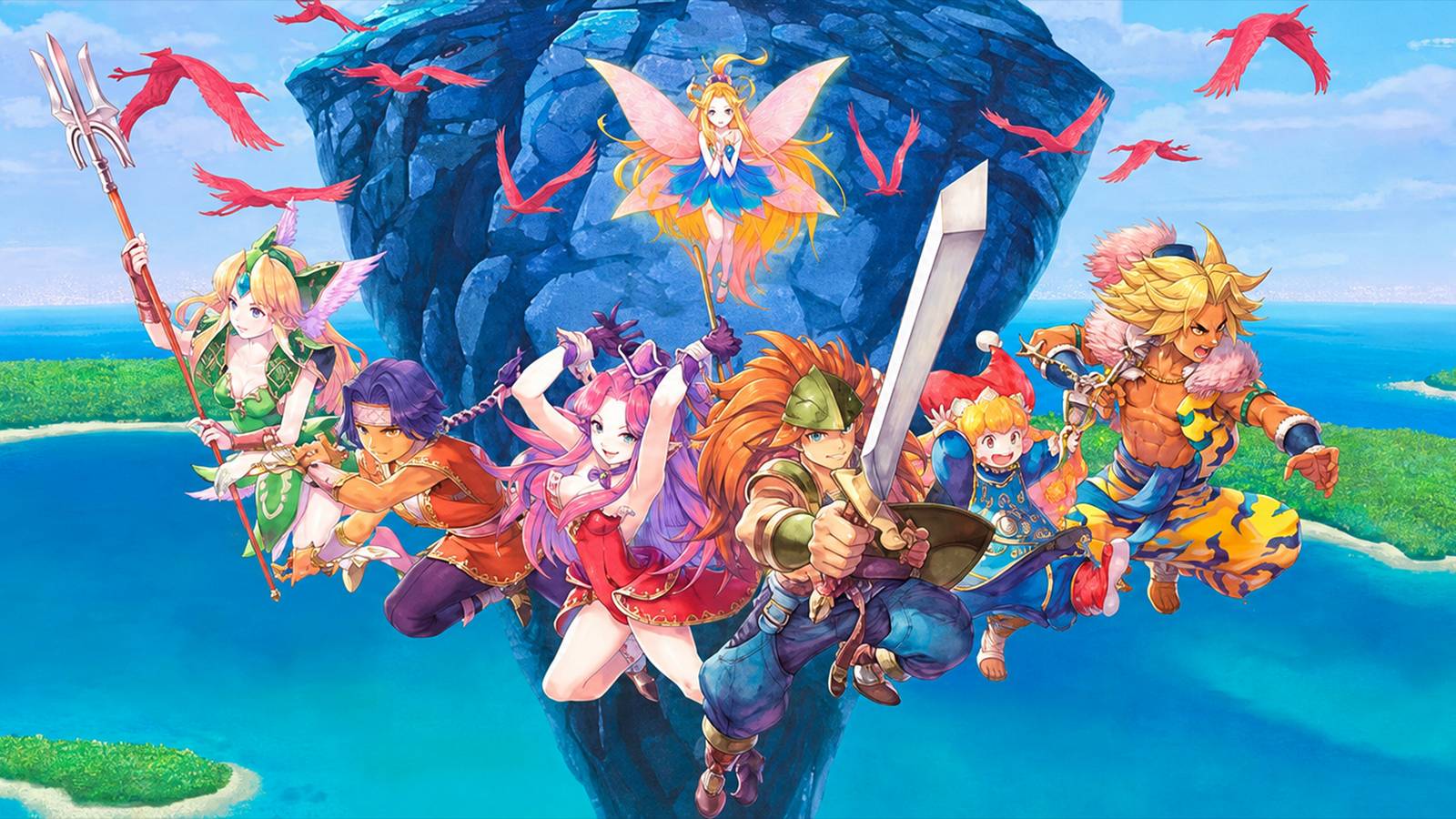
And finally, there’s Trials of Mana, which doesn’t even wait for you to start playing before handing you one of the biggest decisions in the game. There are six protagonists, but you only get to choose three of them for your party, which works out to 20 possible three-character combinations. More importantly, the character you pick as your main protagonist determines which of three main story routes you’re going to follow, including which major enemies you’ll eventually face near the end. That’s already more control over the adventure than plenty of RPGs give you after you’ve spent dozens of hours playing them, and Trials of Mana asks you to make that call before you’ve even had much of a chance to know what you’re getting yourself into.
Your choices don’t stop with the party, either. As your characters grow, each one can eventually branch into Light or Dark classes, followed by another class change that branches again and gives them different abilities, spells, and strengths depending on the path you take. So, even two players who somehow started with the exact same three characters could end up with very different versions of that party by the time the game is over. That combination of party composition, different story routes, and branching character progression gives Trials of Mana the kind of replayability that still feels impressive today. There are obviously action RPGs now with much larger worlds and much deeper character builders, but there are also plenty that decide your hero, companions, story, and basic playstyle for you. Trials of Mana was already asking players how they wanted their adventure to look back in 1995, and then actually letting their answers matter.