






It’s not uncommon nowadays for upcoming games to release a free demo, run a network test or open beta, or otherwise let players experience the game ahead of launch and provide feedback as to what is and isn’t working for them. But what is rare and pleasant is actually getting to see very specific, significant, and direct results of that feedback actually implemented, like we have with The Adventures of Elliot: The Millennium Tales, including the feedback that one of the main characters needs to shut their dang pie hole.
Typically, publishers will answer questions about what changes were made in response to feedback from such events with hand-wavey stuff like “more polish,” but for The Adventures of Elliot, Team Asano and Square Enix actually published a list of fixes last month that are pretty significant. (These changes are based on feedback from the game’s “debut demo,” released last year. It has a new demo, the “prologue demo,” out now.) There are a bunch of changes to menuing to make accessing weapons and powers faster, there’s a huge change to equipping Magicite that makes it way easier to effectively give Elliot “load-outs,” Elliot’s base move speed was (necessarily!) increased, and multiple difficulty levels were added. These are not small changes! The speed at which they were made suggests maybe some of them had already been on the developers’ minds beforehand, but I’m genuinely impressed at how much came out of that demo last year.
But the biggest and most interesting change for me is one not listed in that post, explained to me by producer Naofumi Matsushita. Matsushita told me that the team was genuinely “surprised” to learn that a lot of players didn’t like how much Faie, Elliot’s fairy companion, talked. And yes, Faie really did seem to have a statement for every situation, interjecting commentary about everything from seeing a treasure chest to getting hit by an enemy. Matsushita told me the team truly did not perceive the endless chatter as an issue until players told them. “Since we had been involved with the game’s development for such a long time, we had naturally grown very fond of Faie ourselves, and in hindsight I think we may have become a little biased because of that,” he said.
For that reason, he continued, Team Asano added an option to reduce her dialogue in the settings, which I am sure many people will immediately activate when they first meet her in the game.
Matsushita and I spoke over email in a wide-ranging interview in which we discussed topics such as the invocation of nostalgia for Square Enix’s HD-2D games, Team Asano’s move from traditional RPGs to this action-RPG, and whether or not you can pet the cats in The Adventures of Elliot. Here’s our full interview to peruse ahead of The Adventures of Elliot: The Millennium Tales‘ release on June 18 on Switch 2, PS5, Xbox, and PC.
Kotaku: Tell me about the origins of The Adventures of Elliot: How did the idea for the game come about, and what was the original prototype of it like?
Naofumi Matsushita: Through the HD-2D visual style, we first explored the RPG genre with Octopath Traveler, followed by the strategy genre with Triangle Strategy. Building on that progression, we wanted this latest HD-2D game to reach an even broader, newer audience, which led us to adopt the action RPG genre. In the first playable prototype, Elliot looked different from his current appearance, and we used a temporary field that is no longer in use where we mainly focused on action elements—repeatedly testing things like sword swings, jumping, and other mechanics. As we progressed, we decided to complete a small map in its entirety, even if it was simple. We brought it to a reasonably playable state, including enemies and other elements, and used it primarily to evaluate how the game felt to play overall.
What are the most significant ways in which The Adventures of Elliot evolved over the course of its development, and how did those evolutions come about?
Matsushita: After the prototype was completed, when we first set out to create the fields and towns of the Age of Safekeeping, we were also finalizing Elliot’s design and Faie’s functionality in parallel. When those elements were implemented and became playable, I really felt that the game had evolved significantly. In addition to Elliot’s movements, I felt a real sense of satisfaction with the fairy controls, using abilities like warp and sprint. Since we established the specifications for each element in a systematic order based on necessity, we worked on refining each element one by one as needed.
The Adventures of Elliot follows a tradition of recent HD-2D character-driven games evoking a certain retro style pioneered by Final Fantasy, Dragon Quest, the Chrono series, Live A Live, and other Square Enix greats. Were there any other ideas it borrowed from its predecessors? Is the time-traveling theme meant to evoke Chrono Trigger in any way?
Matsushita: We’re truly delighted to hear that the game evoked past Square Enix games! Team Asano has worked extensively on RPGs over the years, and we have always believed that the past plays a crucial role in storytelling. From the idea of allowing players to actually experience that past, the concept of a storyline that takes players through different eras via the Doorway of Time was born. As a result, rather than exploring every corner of the world, this story focuses on unraveling the history of a single nation within a specific region. Rather than drawing direct inspiration from past titles, the game is designed to feel like a classic story and to capture the essence of Square Enix’s earlier works in its overall concept. This is partly because I personally love Square Enix games from that era, and many of the staff members share that sentiment. While we didn’t intend to directly reference Chrono Trigger in particular, the sense of nostalgia players may feel likely comes from a team that genuinely appreciates those older titles. For example, I have fond memories of two-player modes in games like Final Fantasy IV and the Mana series, and we’ve incorporated similar elements here with our own unique twist.
Apart from the combat, are there any specific ways in which Adventures of Elliot seeks to differentiate itself from Square Enix’s recent HD-2D games like Octopath Traveler?
Matsushita: Most of the games our team has created so far, such as the Octopath Traveler series and Triangle Strategy, have had an ensemble cast. Given that, choosing to make the game an action RPG, having a single protagonist, and naming him Elliot were each challenges in their own right. Since the game involves traveling across different eras, we felt that if we crafted the experience so players could empathize with Elliot, including how he feels when visiting each era or facing crises, it would allow for a deeper immersion in the story. In that sense, Elliot is a character packed with many elements we, the development team, love, and we took special care during development to ensure that his character never strays too far from what players might think or feel.
Q: In what specific, significant ways has the HD-2D style evolved from its debut with Octopath Traveler to now?
Matsushita: With Live A Live, for example, we took care to adapt the presentation for each era and highlight the unique characteristics of every chapter.
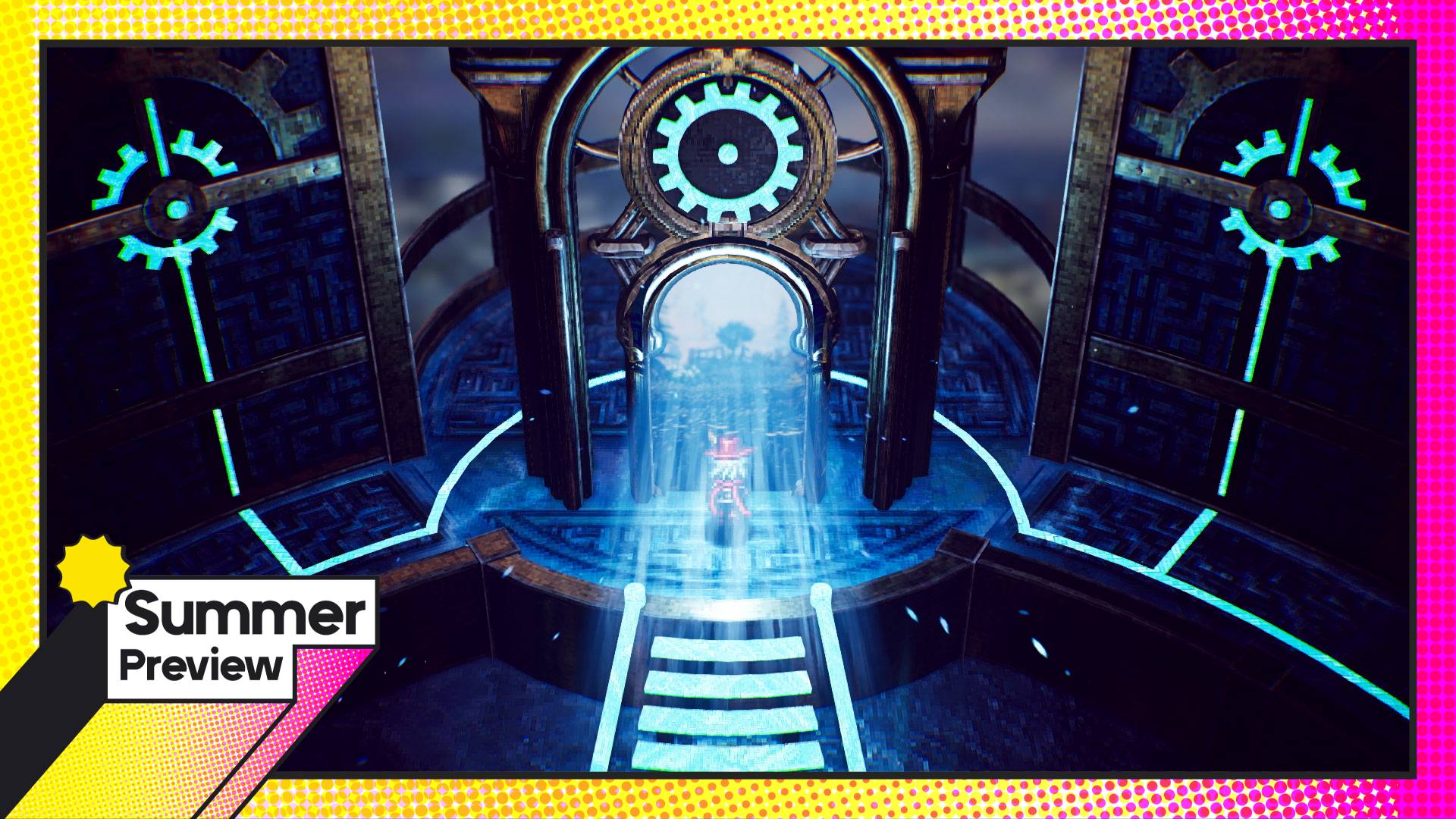
With this title, however, we generally felt that pixel-based 2D action games tend to have screens dominated by the ground plane of the map, making it difficult for players to feel any sense of three-dimensional depth and causing the visuals to feel somewhat flat. To address this, particularly in the overworld, we adopted a “drumroll” approach, curving the map into the background so that distant terrain becomes visible. By incorporating original techniques to further maximize the visible range, we were able to create an experience that conveys a strong sense of depth while still remaining a 2D action game. This was also an area where we spent a significant amount of time carefully fine-tuning the details in close collaboration with the development studio. As a result, even though these titles all fall under the HD-2D style, each game has its own unique characteristics and features tailored to it.
This team has a long history of turn-based RPGs. I read that you made this an action game to broaden the game’s audience, but what about an action game do you think speaks to more people than turn-based RPGs? Do you think RPG fans will still want to play?
Matsushita: To be honest, it wasn’t so much that we were trying to leverage the strengths of action games in comparison to RPGs; rather, we felt that by changing the genre, we could introduce HD-2D to players with different tastes. With that in mind, we focused our development efforts on crafting a time-travel story—the kind of narrative RPG fans would expect. As with all previous titles from Team Asano, we also made a point of creating detailed event scenes and side quests. We introduced an Easy difficulty setting and the ability for Faie to revive characters on the spot because we wanted players who aren’t particularly skilled at action games to feel like they’re able to make progress, if they put in the effort. Since our team’s slogan is “exceeding our fans’ expectations,” we gave it everything we had to create a game that would satisfy fans of Team Asano’s past works. Ultimately, we believe this is also an effort to win over RPG fans as well.
Were there any specific challenges that arose from going from a party of heroes to a solo adventurer?
Matsushita: I’d say Elliot’s background and personality. During the scriptwriting process, I was particularly careful to ensure that he would be widely liked and wouldn’t come across as someone people might find off-putting.
What are some of the techniques that the team used to differentiate weapon types from one another meaningfully in the game’s style?
Matsushita: First, we focused on giving each weapon’s basic actions distinct characteristics. For example, swords have a wide frontal range, spears only strike directly ahead, chains and sickles have a circular range but can miss targets that are too close, and hammers also cover a wide frontal area but are slow to swing. We also introduced magicite as a progression element typical of RPGs, some of which even alter weapon actions.
Last year, Square Enix put out a survey asking questions about Adventures of Elliot of those who played the demo. What feedback was gained from the survey last year, and how is it being implemented?
Matsushita: We would like to once again thank all the players who provided feedback on the Debut Demo. Thank you very much!
From the development team’s perspective, we’ve received a great deal of positive feedback from players both in Japan and overseas. We feel there is strong demand for many of the core game systems, and that players are largely satisfied with those elements. Regarding detailed adjustments and requests, we carefully reviewed the feedback we received. I discussed it with Fukebaru-san, the development director, and carefully considered each suggestion before deciding whether it should be implemented in the game. In particular, we made several menu–related improvements, such as separating the map open and close buttons, allowing players to access the magicite menu immediately without navigating additional layers, and increasing the protagonist’s base movement speed, all with the goal of improving overall quality of life. In addition, by adding a total of four difficulty options including “Easy” and “Very Hard,” we aimed to make the full version of the game accessible to a broader range of players.
As for feedback that surprised us, it would probably be the requests to reduce the frequency of Faie’s dialogue (that she talks too much). Since we had been involved with the game’s development for such a long time, we had naturally grown very fond of Faie ourselves, and in hindsight I think we may have become a little biased because of that. We’ve since added an option that allows players to lower the frequency of her dialogue, so if it’s something that concerns you, we hope you’ll make use of it.
I’ve played Bravely Default; am I going to be okay if I trust Faie?
Matsushita: I’m a fan of Bravely Default myself, and since I also served as producer on the HD Remaster version, I completely understand how you feel (laughs). I’d love for you to play the game and see everything first-hand, including whether Faie can be trusted.
…Cat collecting? Can you pet the cats? Is the development team full of cat fanatics? How do the dog people on staff feel about this?
Matsushita: Asano-san is a cat person, but the development director, Fukebaru-san, and I are actually dog people. That said, we wanted to properly understand the mindset of cat lovers, so we assigned the “Cat Collecting” feature to members of the development team who are cat lovers. Compared to dogs, cats also blend naturally into a wide variety of environments, which made them particularly well-suited for this feature as well. I hope players will enjoy finding and collecting them across each era. As for whether you can pet the cats, while the animation is designed to make it look like you’re petting them, you can’t actually do so yourself… Sorry! Instead, there are features that allow you to give your cat treats or play with it using toys once it has become attached to you.
Out of curiosity, who is the composer on this game? Is there anything I should be paying close attention to with regard to the soundtrack?
Matsushita: The composers are Tomohiro Nakamichi and Yuto Moritani. We were introduced to them by the music production company IMAGINE and selected them from a large pool of composers. Even after narrowing down to two candidates, we had them create demo tracks so we could choose just one. However, given the scope of this project, which spans multiple eras and requires a large number of tracks, and the fact that both demo tracks were excellent, we decided to have both of them work on the project.
The soundtrack album also includes versions of tracks that were not featured in the game, so I hope you’ll give it a listen. In addition, it contains all the original tracks composed specifically for this title by both composers, showcasing their unique strengths. Each track has its own ending, making for a truly satisfying listening experience. The release also comes with newly illustrated artwork and liner notes from both composers. I hope you’ll pick up a copy and check it out for yourself!