







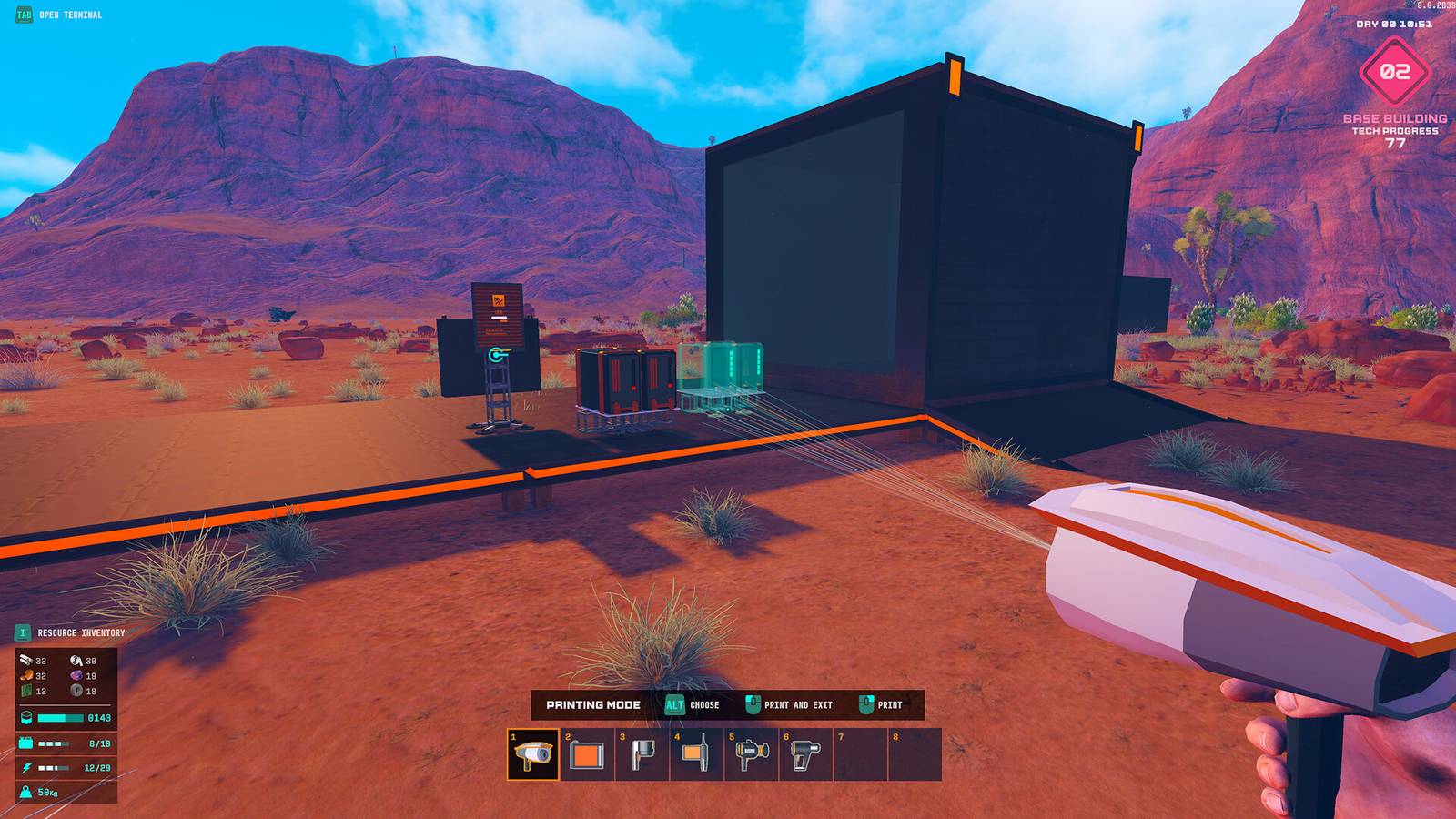
Open-world survival-crafting games have become one of Steam‘s most reliable genres, but every now and then, one comes along with a hook that’s immediately easy to understand. The Maker Way is one of those games. At first glance, it looks like Satisfactory meets LEGO-style building, combining open-world exploration, automation, resource management, and survival-crafting mechanics with an incredibly flexible machine-building system. Set to release in 2026, The Maker Way may be flying under the radar for now, but it’s shaping up to be one of the more ambitious open-world survival crafting games.
Developed by Brave Games, The Maker Way is set in a dystopian version of Arizona in 2039. Players on Steam take on the role of an engineer searching for their missing uncle while attempting to recover advanced technologies confiscated by a controlling government. That’s the narrative backdrop, but like many of the best survival-crafting games, the real appeal lies in how players interact with its world. Gathering resources, building machines, expanding bases, and uncovering new technologies all appear to be at the heart of the experience.
Best Co-Op Games On Steam To Play Right Now
From online multiplayer titles to local masterpieces, Steam has plenty of fantastic co-op games that should be played in 2026.
The Maker Way’s Features at a Glance
- Engineer a fleet of machines from a variety of parts
- Construct and connect bases across an open-world landscape
- Find and source energy, resources, and parts
- Infiltrate and/or fight through enemy bases guarded by robots and drones
The Maker Way’s Machine-Building Feels Like LEGO Meets Satisfactory
That simple description may be the easiest way to understand why The Maker Way stands out. Instead of giving players a fixed vehicle or a handful of upgrade paths, the game revolves around designing machines from individual components. Engines, mechanical parts, electronics, weapons, and other modules can all be combined into custom creations that serve different purposes throughout the game.
The immediate comparison is LEGO. Not only because players are literally snapping together plastic bricks, but because the philosophy is similar. The Maker Way appears to prioritize creativity above all else. Need a mining vehicle? Build one. Need a scouting drone? Build one. Need a heavily armed robot capable of taking on hostile government machines? Build one of those, too.
- Check Out The Maker Way on Steam
“Build creative machines, rovers, drones, or robots.”
The Maker Way‘s physics-based approach makes that creativity even more appealing. Weight distribution, energy consumption, and machine configurations all play important roles in how creations function. Instead of simply unlocking stronger equipment, players are encouraged to engineer better solutions to increasingly complex problems. According to the developer, even environmental factors such as solar and wind conditions can impact energy production, so there’s some light management game gameplay involved, too.
Scratch & Peek

Identify the cover art while scratching off as little foil as
possible.
Identify the cover art while scratching off as little foil as possible.
EasyMediumHardPermadeath
Explore an Open World Through the Machines You Build
One of the more interesting aspects of The Maker Way is that exploration and progression are connected to what players build (not so different from a LEGO MOC Build). Across its open-world Arizona setting, players will search for resources, discover new machine parts, establish energy networks, and uncover additional technologies.
New components allow for more advanced creations, which in turn open up new possibilities throughout the world. It’s a gameplay loop that feels similar to games like Satisfactory, where technological advancement constantly expands what players are capable of building and accomplishing.
The difference is that The Maker Way seems much more focused on vehicles and machines, as opposed to automation games. Instead of constructing a sprawling automated factory from a first-person perspective, players are building the tools that help them survive, explore, and fight. That fantasy extends to combat as well. Enemy facilities are protected by robots and drones, giving players opportunities to either fight directly or rely on stealthier approaches. Advanced electronics can apparently be used to infiltrate locations without being detected, providing more than one way to tackle objectives.
Base Building and Automation Are Just as Important
Of course, no survival-crafting game would be complete without base building. As players gather resources and expand their operations, which is typically of the genre, they’ll be able to construct a network of bases and outposts throughout the world. Fueling stations, research facilities, resource storage centers, charging stations, fabrication hubs, and defensive outposts all play a role in supporting a player’s growing machine empire.
This is where the LEGO comparison becomes especially fitting. The Maker Way‘s snappiness and freedom embrace the idea of interconnected systems of building, and it becomes more obvious as players build to their heart’s content. Similar to Satisfactory all the same, every new outpost appears designed to make resource gathering, research, and expansion more efficient.
The Maker Way’s Biggest Strength May Be Its Fantasy
Plenty of games let players build bases. Plenty of games let players craft vehicles. Plenty of games let players automate production and gather resources. The Maker Way‘s biggest strength may be how it combines all of those systems into a single fantasy.
Whether The Maker Way can deliver on all of those ambitions remains to be seen, but if Satisfactory-style progression, LEGO-inspired creativity, and open-world survival-crafting all sound appealing, this is definitely one Steam game worth keeping an eye on ahead of its 2026 release.