








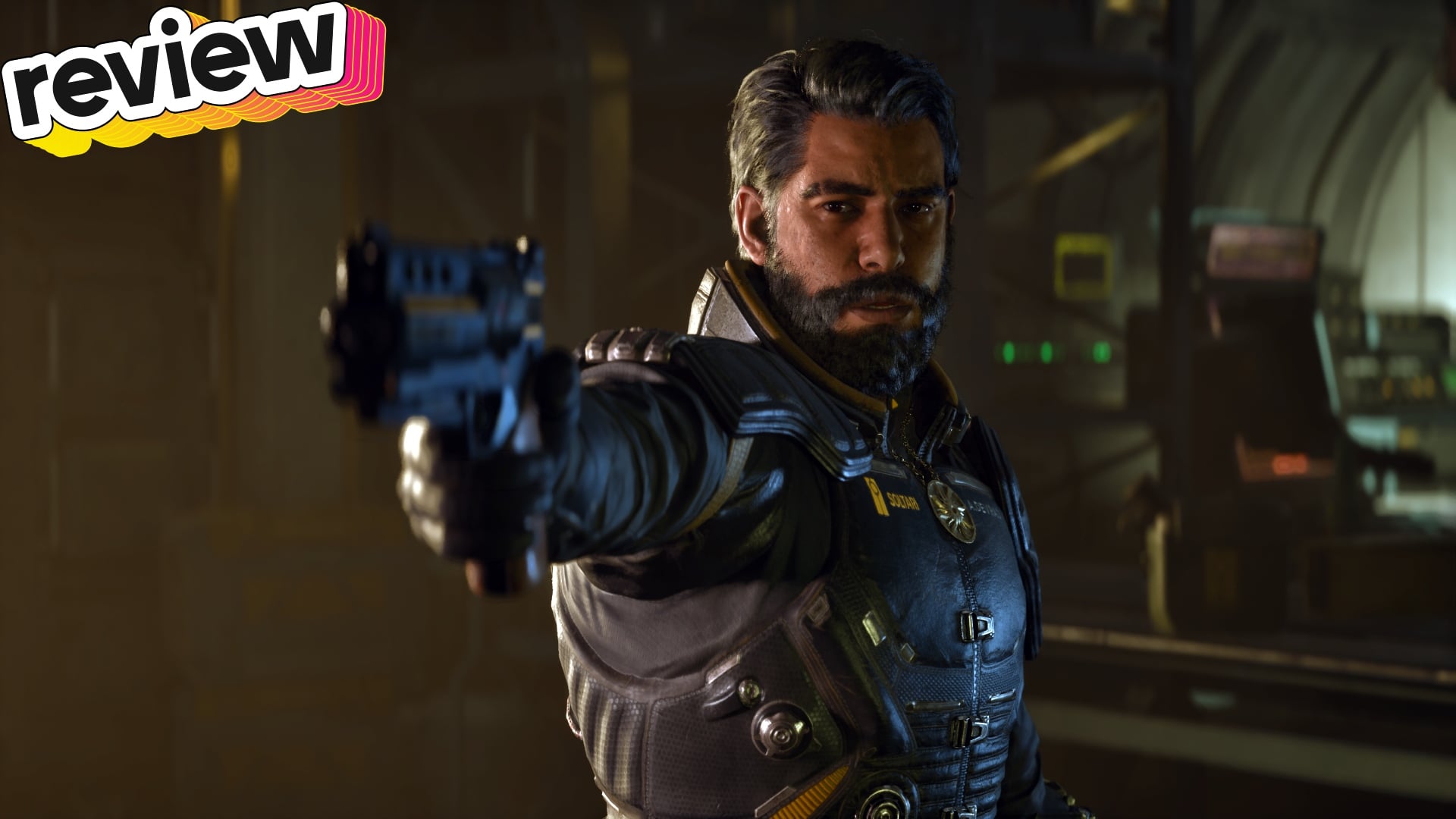
Much like the roguelike hellscape it takes place in, even thinking about Saros offers me something new every time I reflect on Housemarque’s roguelike shooter. Much like Returnal, the game’s spiritual predecessor, it revels in abstract worldbuilding and symbolism that may seem unwieldy and obtuse, but as I bash my head against the walls of its tough-as-nails challenges, I find something worth pondering on the other side. Saros continues Housemarque’s evolution from something of an arcade specialist into a maker of the kind of prestige storytelling that has become synonymous with PlayStation’s first-party output. What’s remarkable is that despite Saros solidifying Housemarque as one of PlayStation’s narrative heavy hitters, the studio’s identity has not been lost in Sony’s continued desperate chase for its next Last of Us.
Saros expands the scope of Returnal’s very singular story of one person caught in an endless, tortuous loop of devastating deaths and puts an entire ensemble cast into one instead. At least, it seems to do so on paper. Arjun Devraj, a soldier working as part of a corporation called Soltari, joins his crew on expedition to the planet Carcosa (loosely based on the fictional city of the same name featured in the King in Yellow short stories) in search of assets the corporation has deemed valuable, but its previous scouting teams have gone silent; thus it’s up to them to find out what happened and return home with the company’s spoils in hand.
What it takes to survive in a shifting world
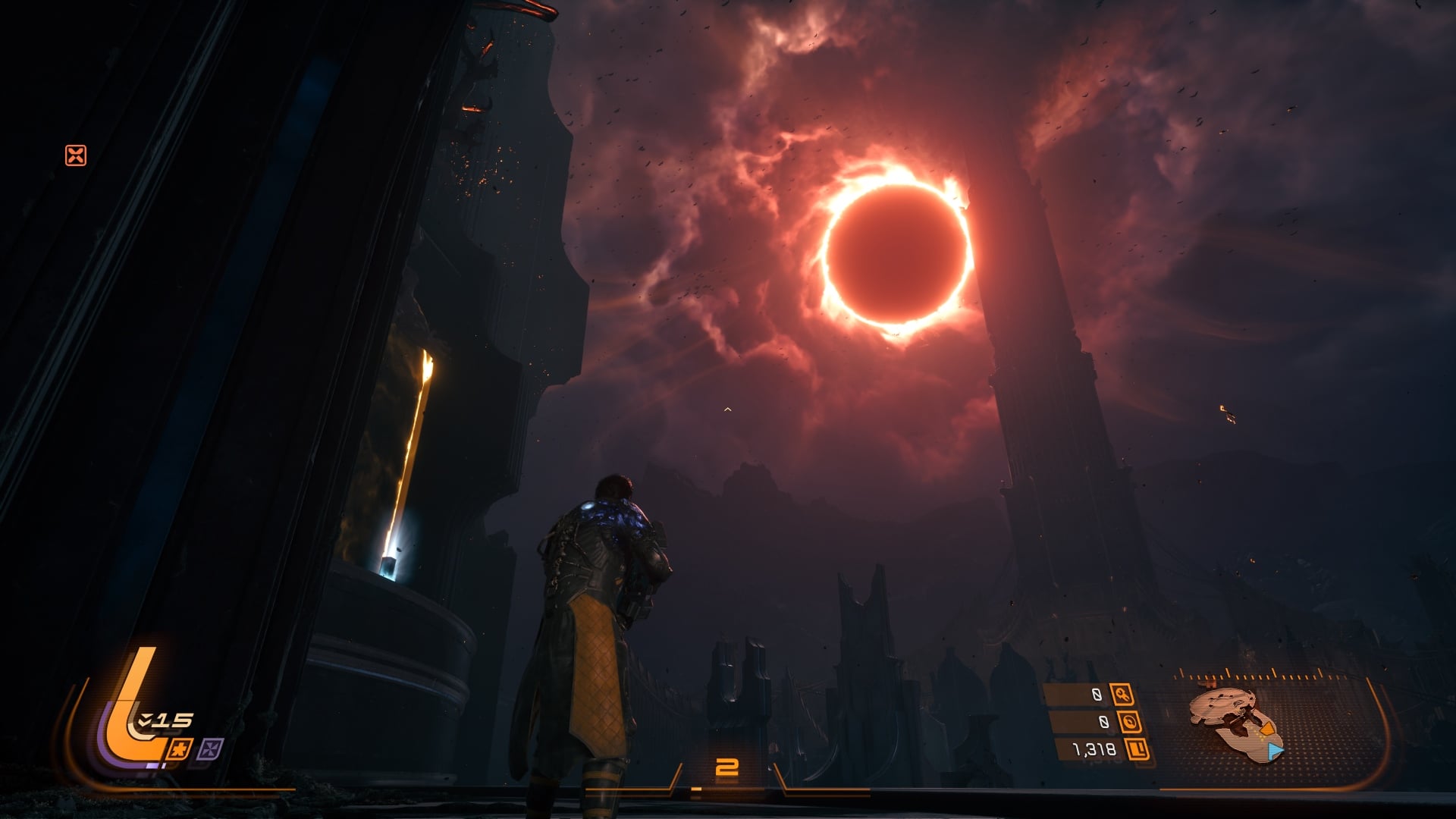
That’s the plan in the books, but Arjun, played by iZombie and The Fall of the House of Usher actor Rahul Kohli, is there for his own reasons, searching for someone who was on one of the first expeditions to Carcosa but never came home. Once he arrives, it becomes clear why. Carcosa, underneath some sort of distorted solar eclipse, is constantly reshaping itself, with new threats and obstacles awaiting every time Arjun walks out of his team’s shelter. Every time he ventures off in search of clues and a malicious monster to fight, the world shifts ever so slightly so no two runs are ever exactly the same. The only reason he’s able to experience all of them is because he keeps being revived every time he dies by some unknown force, but the world persists in the time between death and rebirth, and time moves strangely under Carcosa’s mystical sun.
The real danger of Saros isn’t the monsters Arjun fights; it’s the oppressive psychological forces weighing on each member of the Echelon IV crew as they struggle to maintain their mission and comply with the company-mandated order. As the situation escalates, members’ efforts to cling to protocol become more and more out of touch, leading to distrust sanding away at the group’s psyche until their paranoia threatens to tear them apart as the planet starts to needle into their individual minds.
Saros is presented as an ensemble show, but outside of Arjun, its cast feels mostly like sacrificial lambs, just here to illustrate the psychological warfare the crew is facing as we go out into the line of fire. Individual struggles aren’t explored in depth but rather put on display to communicate the lingering threat of psychosis Arjun faces as he repeatedly dies and is reborn. The gradual atrophy of the cast is effective in conveying the state of the world, but it doesn’t quite serve anyone else in the cast beyond Arjun and the person he’s coming to find.
Saros starts off as if it’s expanding Returnal’s introspective, cyclical story beyond the myopic bubble of its protagonist, but the facade drops fairly quickly. Everything is in service of telling you who Arjun is and what he’s facing internally and externally. The individual parts of the whole can be underwhelming and disappointing if you were hoping to really get to know a larger cast, but once I bought into Saros as a more singular character study, I found it incredibly compelling, even if it’s not what the game presents at the outset.

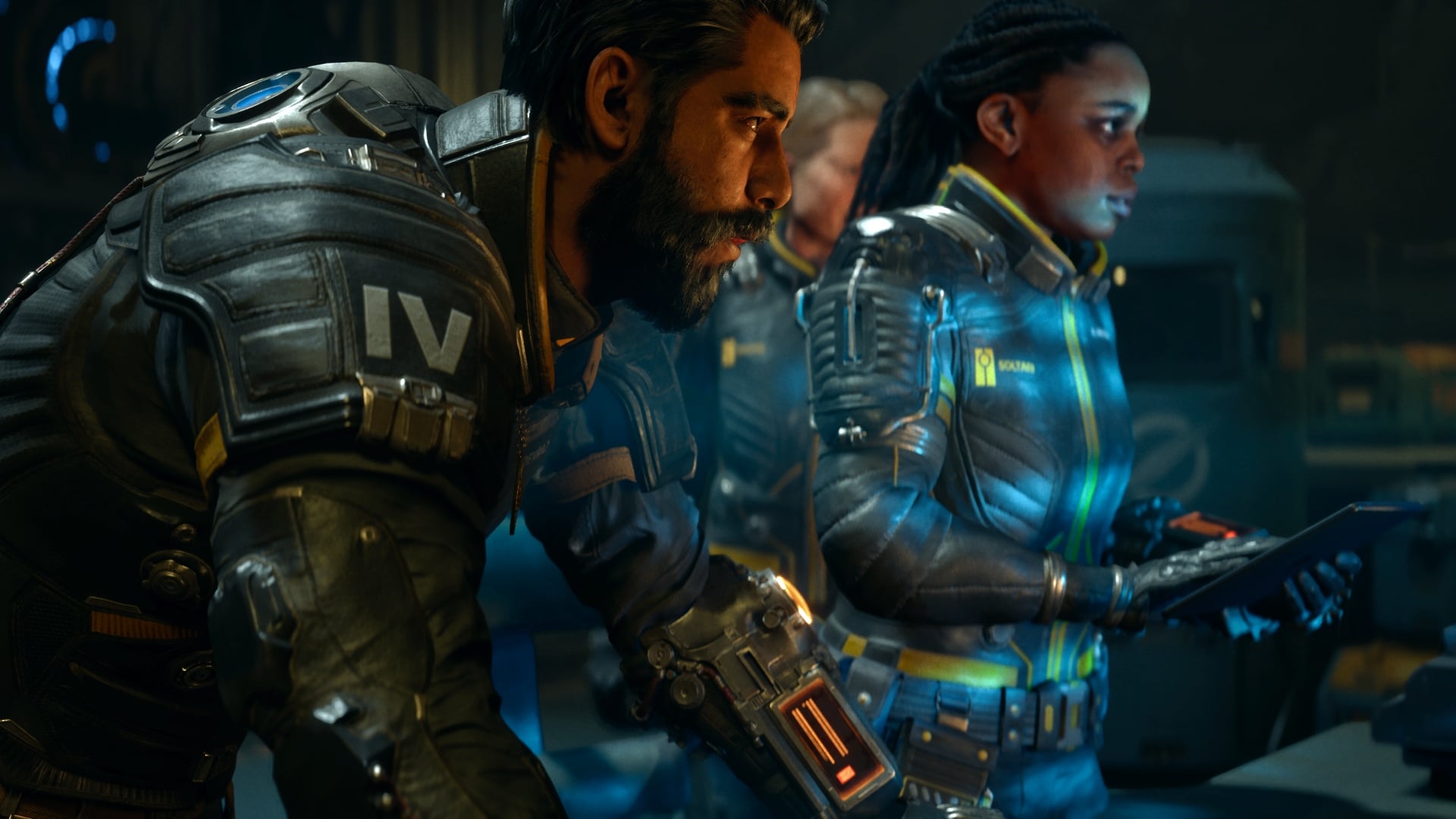
The game works best for me when it’s a mystery box with each snide remark, questionable text log, stuttering flashback, or deranged voice memo coloring in the lines of a more frightening truth. The relationships between most of its characters end up being casualties of that, but Arjun makes for a captivating centerpiece of Housemarque’s puzzle. Kohli plays everything from the character’s early restrained stoicism to his more crazed unraveling with conviction, and by the time some of Saros’ more defining twists and turns are revealed, it becomes clear the nuances of who Arjun is and who he could become were always being communicated in the performance. Whether I like the truths I learned about him or not, Arjun’s a layered protagonist worth peeling apart, and at his core is something just as challenging to reckon with as the monsters living under Carcosa’s obscured sun, which is saying a lot because this game is not easy.
Saros is just as tough as Returnal but a bit more accommodating if you found the last game intimidating or unrelenting, though if you are looking for a more true-to-form roguelike hellscape, you might be a bit underwhelmed by how helpful it can be at the start. For someone who traveled across the galaxy with a gun in hand ready for battle, Arjun is pretty frail and can only take a few hits before he’s sent tumbling down into the abyss and revived back at the Echelon base. Saros’ combination of frantic shooter and chaotic bullet hell is frenetic and demanding, but even in its sensory-overloaded confusion, every shot fired, punch swung, and dodge dashed requires precision and commitment. The tools he has at his disposal are determined by random rolls, and you have to adapt or die.
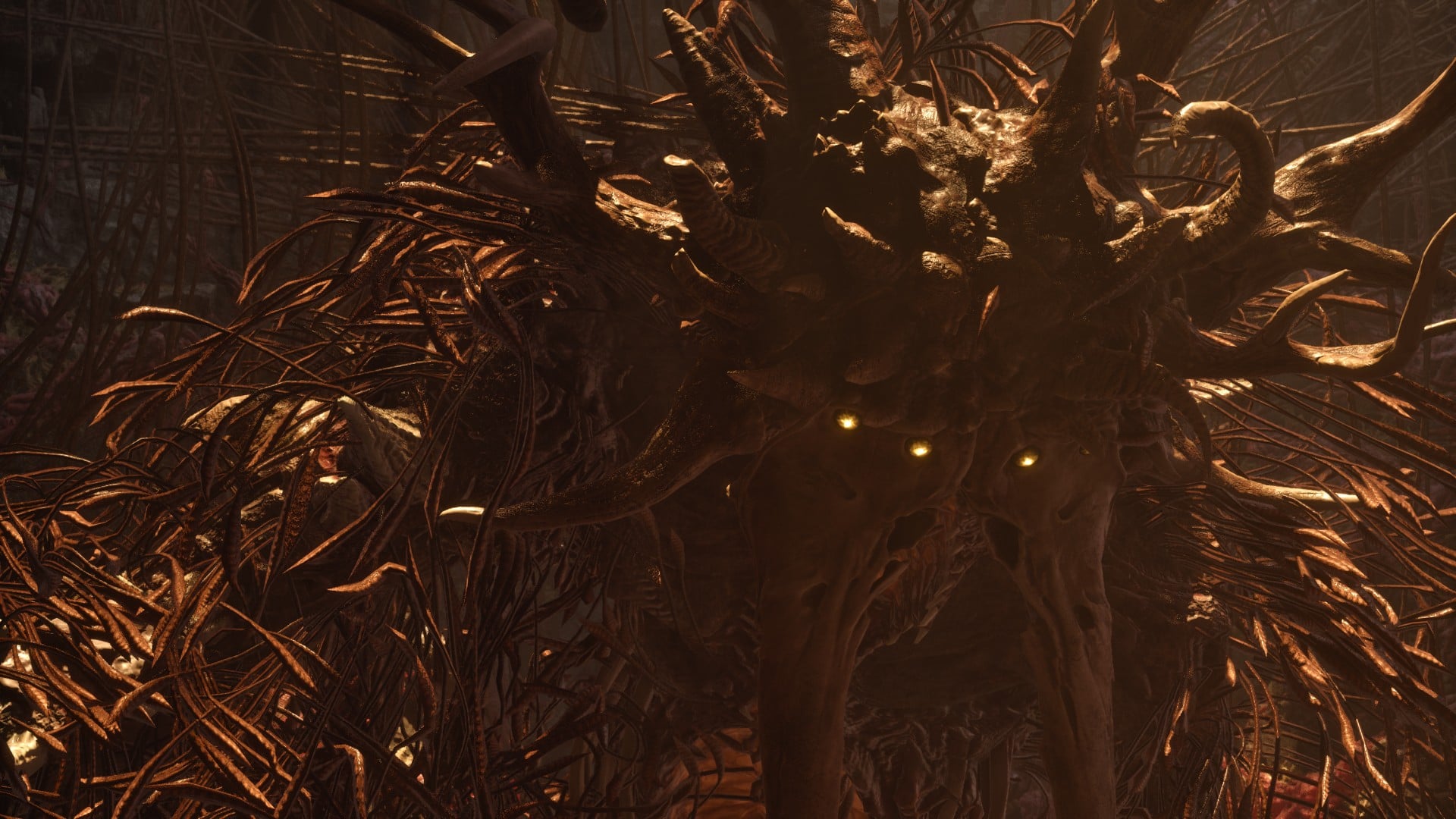
Like most roguelikes, Saros requires you to try and fail multiple times on your way to a powerful boss, each of which are incredibly memorable and challenging, requiring you to use what you’ve learned through all that failure to emerge victorious. But Saros’ dearth of healing items means that if you venture out from the safety of home base and get put through the wringer by the game’s combinations of demonic creatures and deteriorated machinery on the way, you’ll be in no shape to take on a biome’s final fight. Still, the run isn’t entirely wasted because, unlike in Returnal, the resources you take back with you when you die help you build up stronger for the next attempt.
Housemarque knows the importance of visual communication, especially for a game as visually cluttered as Saros can get, and the studio’s use of color to communicate types of incoming attacks helped me embed reactions into my muscle memory, from dodging yellow projectiles to absorbing blue ones with my shield, and parrying red ones back in the direction of my foes.The advantage of repeating runs in Saros, greater even than the benefits bestowed by any resources you may collect, is that after dying a dozen times, survival becomes habit. You can’t memorize a constantly shifting world, but you can eventually anticipate the randomized dangers and know how to react. This is the appeal of a roguelike’s time loop structure. Getting laid out over and over allows you to slowly become so accustomed to danger that responding to it becomes second nature, programmed into your mind like a fight-or-flight response. Failure is the lesson, and starting over from the beginning is the consequence.
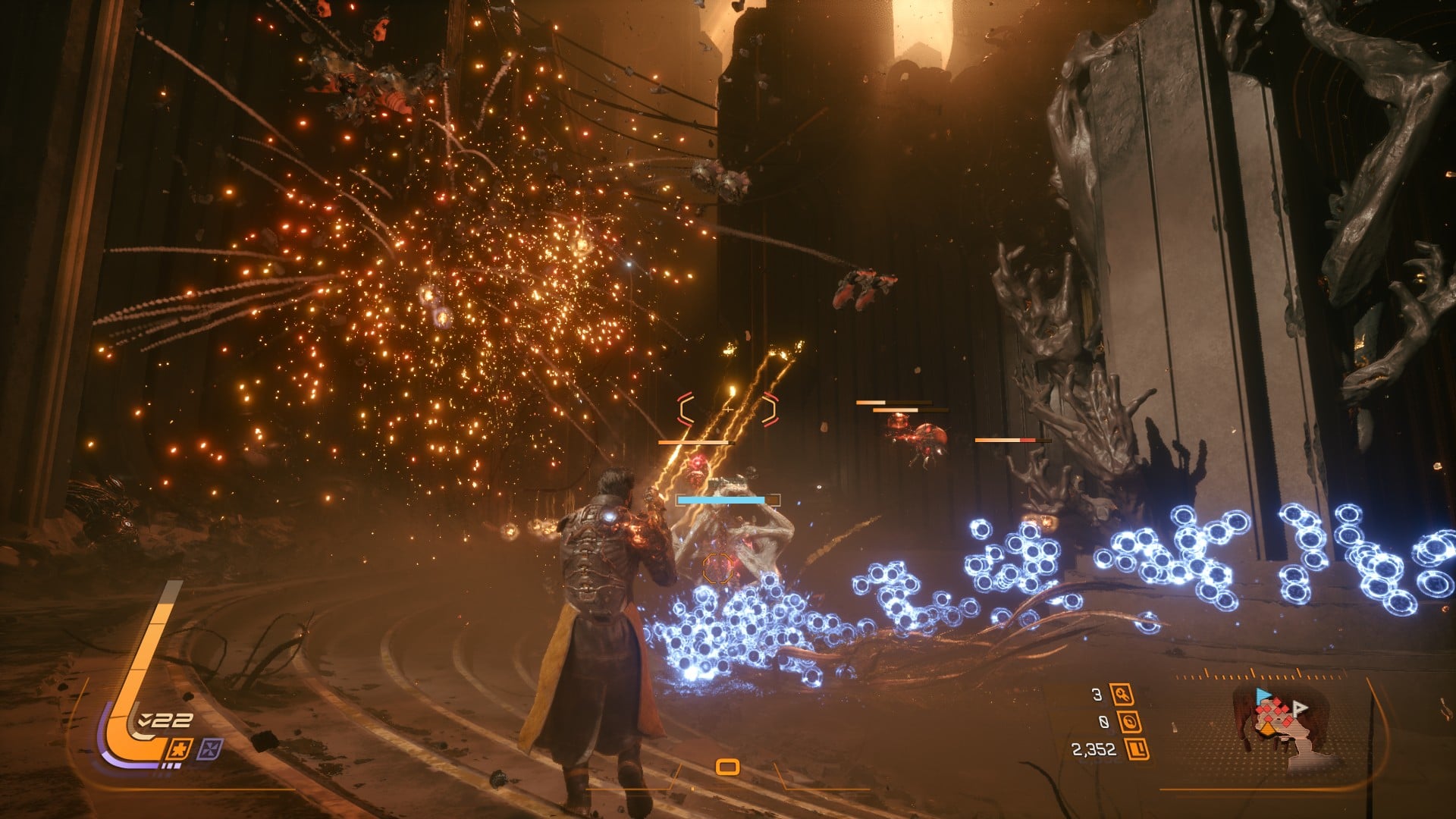
Even in some of Saros’ most strenuous segments, it feels pretty incredible to go from getting your ass handed to you to masterfully weaving through a new onslaught of foes. Saros and games like it only work if it feels like all that failure means something, and the gradual ramping-up of Arjun’s arsenal in both the microcosms of individual runs and your larger, game-long progression feels perfectly paced, to the point where even repeated losses at some of the big bosses didn’t deter me from trying again. However, as a baseline, Saros is a bit more accessible than other roguelikes with options to tailor the difficulty, but not without some give and take.
Adapt or die
Though it offers a pretty distinct challenge, Saros gives you plenty of tools to customize the ways it gets difficult without compromising its vision. Before each run you can implement modifiers that can give you an edge, but not without balancing them out with nerfs. Sure, you can decrease the amount of incoming damage, but to keep the scales balanced you’ll have to give up something, too, like how many resources you’ll maintain when you die.
Flipping these switches required me to weigh what tools and perks actually mattered to me, and which ones I’d be willing to live without. Did I need to worry about maintaining upgrades for the next run if I was barreling to the game’s final boss? Had I gotten good enough at avoiding life-siphoning corruption that I would be fine if I took on more of it each time it made contact? Small tweaks can change a lot, and Saros is surprisingly thorough in how it lets you author the dangers of a randomly-generated world. I’m glad this system is here because it not only gives folks who need a helping hand an option, but if you’re a masochist who wants to make Saros harder, you can do that to give yourself something new to overcome. I imagine we’ll eventually see someone finish full-game runs with all the trials turned on. Beating the game on its own is impressive enough, but choosing to willingly put your hand in the pain box from Dune is on another level.
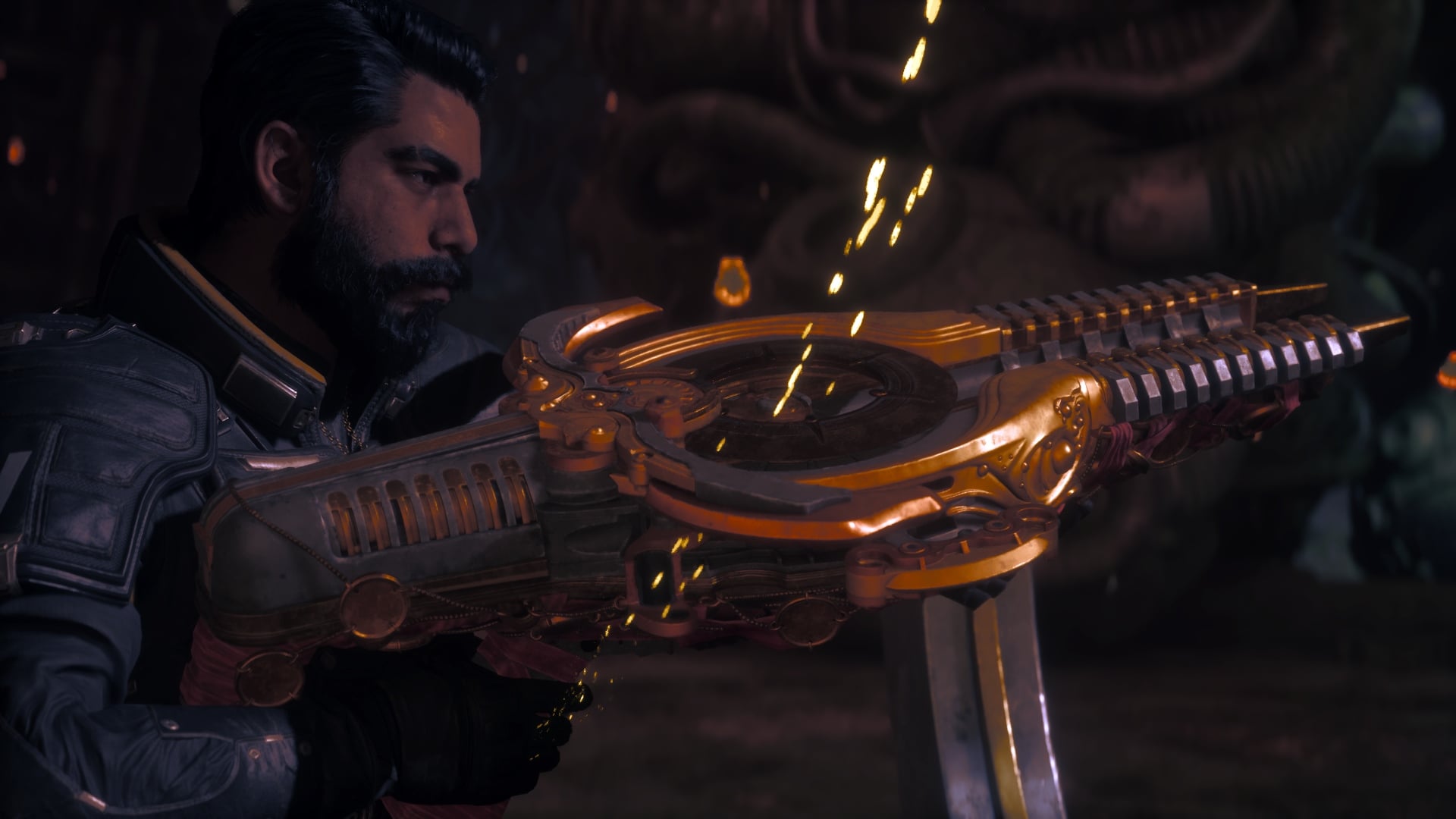
Saros oscillates from moments of almost god-like power to Arjun becoming a kind of pathetic guy depending on the tools you stumble upon. Oftentimes I’d become so accustomed to using an assault rifle equipped with an autoaim perk that if I was stuck with a pistol that hit hard but had no range, I would be on my back foot, struggling to pelt far away flying enemies with bullets that wouldn’t land. Shotguns, which are usually my go-to weapon of choice in third-person shooters, became the bane of my existence as I could never quite fit them into my dash-driven playstyle. But I had to adapt. Saros rewards experimentation and even demands it at some points, as an arsenal you grow attached to is eventually outscaled by more powerful enemies, and that constant need to flex into something you’re less comfortable with is the most persistent test of your skill Saros requires. It’s hard to go in with a plan when you can only anticipate so much of what’s coming, but no matter what loadout I stumbled upon and what build decisions I made on the fly, Saros kept me guessing and improvising as what I thought I could expect was subverted when I’d turn a corner.
That’s kind of the Saros experience, and it’s impressive how Housemarque managed to keep me on my toes until I finished my final run, even when offering safeguards that could have made me better prepared. Whether it be in the lay of its randomized land, the enemies that spawned in those unknowable paths, or the truths I found hidden away in Arjun’s mind, Saros constantly shifts itself to the point where you can never feel truly comfortable…until you’ve mastered it all and the chaos of Carcosa feels like home. There’s a lot I still want to say about Saros that this review is perhaps not the appropriate place to, but maybe I can expand further on the game’s richness and complexity in another “run” down the line.
-
BACK-OF-THE-BOX-QUOTE:
“I love banging my head against a wall until it breaks!”
-
DEVELOPER:
Housemarque
-
TYPE OF GAME:
Shooter roguelike with a sci-fi/fantasy psychological horror spin.
-
LIKED:
Tough but fair, really compelling mystery box-style narrative, lots of options to tailor the challenge, Arjun’s story is really thorny and complicated in a way I find compelling.
For now, I’ll say Housemarque’s “house style” of tough-as-nails roguelike dipped in symbolism has managed to capture lightning in a bottle twice, and in a PlayStation ecosystem where Sony threatens to homogenize all its output, this studio maintaining what makes it distinct in the company’s catalog is just as challenging a feat as anything you’ll face in the game itself. Saros is a prickly, demanding game whose hours of physical and mental carnage will make it difficult to parse for some, but I keep diving back in and finding new philosophical and mechanical challenges to overcome each time.
