



Despite the claim usually being that game journalists dish out lower scores when a game is “too hard” for them, here I am, having given Control Resonant a 9/10 in my own review of it, and yet, not only did I not find it too hard, but now I’m seeing non-journalists who are actually annoyed by the level design because it’s too confusing. What’s interesting is that, when I reviewed Control Resonant without the help of guides or general assistance from players online who were playing the game alongside me, not once did I have a single issue with the level design. Please don’t consider this me talking down to anyone who is having issues with it, because that’s not the point I’m wanting to make here. What I really want to draw attention to is the line that separates good level design from bad level design, and how it’s a bit more nuanced than difficulty, which is almost always subjective.
The debate about Control Resonant‘s level design—and it is a debate, because there are plenty of players out there who actually appreciate it—comes at a very interesting time. Marvel’s Wolverine, which also recently launched, has garnered a lot of criticism for its apparent obsession with handholding, particularly when it comes to the blue trail players can follow to reach their objective. Now, here comes Control Resonant, which really doesn’t hold your hand very much at all and instead expects you to figure things out for yourself, and it’s garnering criticism from one side of the player base for its obscure level design. It’s ironic, really, that we would beg out of one side of our mouth not to be babysat, and then out of the other for someone to hold our hands while we cross the street. I digress, however, because the point isn’t necessarily the hypocrisy so much as it is what we now seem to expect good level design to do for us.
Control Resonant’s Divisive Level Design Is Really a Debate About Handholding
While scrolling through X recently, I came across a somewhat viral post by user @ZanarGaming, claiming that Control Resonant‘s level design is “annoying,” complete with footage from what is presumably their playthrough. The footage itself shows the player attempting to navigate several gravitational shifts shortly after Dylan receives the Shift ability, and what’s interesting is that I, among many other reviewers, actually praised this ability in particular for how creative and innovative it is. I assume the reason @ZanarGaming found it annoying is that they were getting lost while using it, which I also find interesting, seeing as how the word “EXIT,” along with a directional arrow, is quite literally painted on the ground.
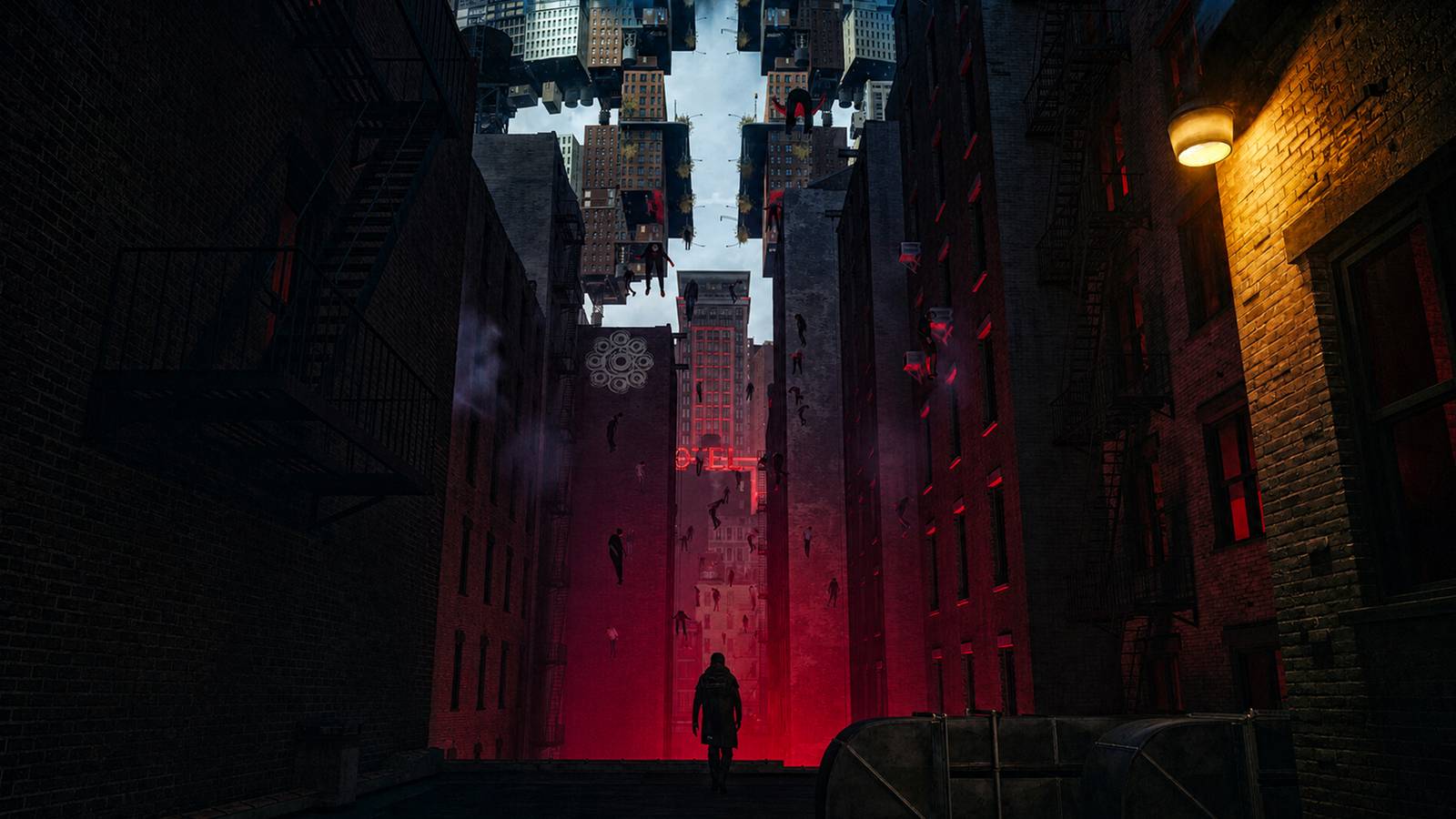
To be fair, Control Resonant‘s Gravity Anomalies, which can only be navigated using Shift, don’t follow standard map design. Because the ability actually shifts gravity, at times making paths that were once on an entirely different plane traversable right-side up, this means paths can actually lay on top of one another on a map, or they might otherwise be more complex than simply following a straight line. In the case of the footage @ZanarGaming shared, whoever was playing the game was trying to find their way out of the parking garage area that is meant to be a tutorial for the Shift ability in the first place. But because the whole purpose of Shift is to reorient gravity, a straight path forward might actually be forward, up, over, up, over, then forward again, depending on the design.
Of course, just reading that, you might think, “Okay, well, that really does sound confusing.” But when you’re actually playing it, it’s really not—at least, it’s not confusing from my perspective. And again, I have to mention the “EXIT” markings on the road, because even though Remedy did its best not to hold players’ hands, it still found creative ways to guide players as long as they’re observing their surroundings. And at some point, it has to be on the player for attempting to mindlessly run through a level rather than looking around first. If nothing else, the comments on @ZanarGaming’s post are proof that there are plenty of players out there who have had absolutely no problem with Control Resonant‘s level design, particularly when it comes to Shift and Gravity Anomalies.


Guess the games from the emojis.
Guess the games from the emojis.
Easy (120s)Medium (90s)Hard (60s)
But this is all actually the point I really want to drive home here. We have been conditioned over time to actually prefer some form of handholding, simply because our time is precious. Most players don’t want to get stuck on a level for longer than a couple of minutes because they see it as a waste of time. And yet, back in the day before the internet, we could get stuck on a level for days and not think twice about it. Ashamed as I am to admit it, I remember getting stuck on Phantom Ganon in the Forest Temple in The Legend of Zelda: Ocarina of Time. I didn’t know you were supposed to hit the orb back at him with your sword until I went to bed and had a dream about how to beat it, then woke up and tried it.
At some point, it has to be on the player for attempting to mindlessly run through a level rather than looking around first.
These days, though, when some players get stuck on something, frustration can set in almost immediately, and before long, they’ve uninstalled the game and/or put a clip of them getting stuck online to justify their complaints with the game. To my point, I’ll emphasize that the clip @ZanarGaming shared is only 44 seconds long. I’m willing to bet they actually made it out of the parking garage just a few minutes later and that 44-second clip was really just meant to make their criticism sound warranted. At the same time, if that’s not what happened, and they truly were stuck there for an extended period of time, I feel for them—especially when the solution was actually painted on the road. Maybe it’s because it wasn’t painted in yellow.
And speaking of yellow paint, that’s why I’m even bringing this up in the first place. Anytime a game uses yellow paint for signposting, people get angry, but when that paint is white and painted on the road to actually look like a natural part of the environment, people get angry. Which is better, though? Yellow paint that clearly doesn’t belong there? Or the more inconspicuous signposting that looks like a convincing part of the world?
Control Resonant Doesn’t Hide the Way Forward, It Just Doesn’t Highlight It
If you haven’t noticed, I’m no longer talking about the actual level design of Control Resonant, and that’s because it’s actually ingenious and the kind of level design open-world games need more of. Instead, I’m talking about how games choose to guide (or not to guide) players through a level, because I think that’s where a lot of this frustration is actually coming from. There’s a difference between a level being poorly designed and a level simply expecting you to pay attention to it, and Control Resonant very often falls into the latter category. Remedy isn’t hiding the way forward so much as it is refusing to put a giant glowing marker over it, and I don’t think those two things should be treated as the same problem.
To be quite honest, I wish more open-world games had Control Resonant‘s knack for level design. It’s unusual, a bit unorthodox, and straight-up bonkers at times, but not only is that very on-brand for Remedy Entertainment, it’s a breath of fresh air when what we generally get is an objective marker on a map or the ability to just fly over obstacles rather than finding creative ways around them. Control Resonant actually asks players to understand the space they’re moving through, and Shift takes that idea even further by changing what “through” even means in the first place. Walls become floors, entire rooms have to be reconsidered depending on where gravity is pulling Dylan, and suddenly reaching the other side of a parking garage can require more thought than traveling several miles across another game’s open world.
There’s a difference between a level being poorly designed and a level simply expecting you to pay attention to it, and Control Resonant very often falls into the latter category.
I also don’t think the players calling Control Resonant‘s level design annoying or poorly designed are somehow lying about their experience with it. The fact that some people are frustrated by these areas while others are calling them brilliant is exactly why the conversation is worth having in the first place. The same Gravity Anomaly that had me stopping to admire what Remedy had done might have someone else wondering where on earth they’re supposed to go next. Neither experience changes what the level itself is asking of the player, but it does show just how differently we can respond when a game decides not to make the answer immediately obvious.
For me, though, that division is all the more reason I hope Remedy doesn’t take the wrong lesson from it. I’d rather have an open-world game occasionally make me stop, look around, and figure out what it’s trying to tell me than have every path highlighted before I’ve even had a chance to search for it myself. Control Resonant‘s level design may be brilliant to some players and poor to others, but at the very least, it’s trying something that gives us something to argue about. Considering how predictable navigating an open world can sometimes become, I’ll take that over another glowing trail telling me exactly where to go.


- Released
-
September 24, 2026
- ESRB
-
Mature 17+ / Blood and Gore, Strong Language, Violence