








As someone who has been a fan of Diablo for years and has been playing Diablo 4 since day one, I’ve been eagerly awaiting what Blizzard has in store to wrap up the Age of Hatred arc, and Diablo 4: Lord of Hatred looked ready to address the majority of my wishes for the game’s next expansion. After Vessel of Hatred left me feeling like something was missing from Diablo 4, both in terms of story and endgame content, my hopes were that Lord of Hatred would give me a true capstone to Diablo 4‘s base game.
The highlights of Diablo 4: Lord of Hatred are printed right on the tin: a new story campaign set in the brand-new region of Skovos, new endgame content including War Plans and Echoing Hatred, new gameplay mechanics like Talismans and Charms along with the return of the Horadric Cube from Diablo 2, and two new classes in the form of the Paladin and Warlock. These features make Lord of Hatred quite an enticing package for a Diablo 4 fan, but fully realizing them and seamlessly blending them into the world of Diablo 4 is the true mark of a great expansion.
Lord of Hatred Unleashes Players Upon the Hauntingly Beautiful Isles of Skovos
The journey in Lord of Hatred starts even before reaching Skovos, with threats attacking the player’s ship as they approach the islands that Mephisto has corrupted. After docking in the city of Temis, the map of Skovos starts to open up and reveals stunning environments inspired by Mediterranean architecture. One of my biggest complaints with Vessel of Hatred was that Nahantu felt too environmentally similar, which is absolutely not the case with Skovos in Lord of Hatred.
Each of Skovos’s islands has an entirely different feel from the next, ranging from Mediterranean coastlines to dense forests and mountaintops, all the way to dangerous volcanoes. Compared to the map of Nahantu in Vessel of Hatred, Skovos is slightly smaller in terms of total area. However, this environmental diversity makes Skovos feel like its own mysterious world that is entirely detached from the rest of Sanctuary. Coupled with the new enemy types and haunting background music, Skovos has quickly become my favorite region in all of Diablo 4.
Lord of Hatred’s Campaign Wraps Up Diablo 4’s Story with Plenty to Offer Series Fans
I won’t go into story spoilers for Lord of Hatred’s campaign, but what I will say is that it feels written specifically for longtime Diablo fans. The story of Vessel of Hatred always felt serviceable but nothing special in my eyes, and left a lot of threads hanging for the next expansion to follow up on. Lord of Hatred is the definitive conclusion to all the plot points set up by Diablo 4‘s base game and Vessel of Hatred campaigns, and it definitely pulls out all the stops to make it as epic a finale as possible.
The plot of Lord of Hatred is much more compelling and has a greater sense of urgency than Vessel of Hatred, with higher stakes and some serious twists. However, there are a couple of moments that could be controversial among fans. While I didn’t have a problem with these moments and understand how they contribute to the narrative, others might see them as undermining the story that Vessel of Hatred sets up.
The Warlock Class Steals the Show in Lord of Hatred
For many fans, myself included, the real meat and potatoes of Lord of Hatred are the new classes the expansion adds. The Paladin has been a treat to experience over the past few seasons, but my feelings for the Paladin are nothing compared to my new love for the Warlock. In my preview of Diablo 4‘s Warlock, I stated that the Warlock has the potential to become my new favorite class, following in the footsteps of my beloved Necromancer. After experiencing the Warlock in the context of Lord of Hatred, complete with access to its full Skill Tree, I am happy to report that Diablo 4 knocked it out of the park with the class, and I can easily see it becoming one of the most powerful in the entire series.
I ran a Legion Shard Warlock that emphasized Demonology skills to summon minions of the Burning Hells into battle, and it felt like the best summoner archetype I’ve ever played in Diablo. The combination of the Command Fallen Basic Skill and Bombardment Core Skill meant I could constantly barrage enemies with exploding demons for an incredibly satisfying way to slay the servants of Mephisto. There was no greater feeling than summoning the Fiend of Abaddon with the Warlock’s Ultimate Skill and having a massive demon swing a blade in a wide radius to slice through enemy hordes.
Diablo 4’s New Skill Tree is an Acquired Taste, But Is For The Best
The Diablo 4 Skill Tree rework and level cap increase coming as a free update with Lord of Hatred’s launch are probably the most drastic changes that I experienced during my time with the expansion. Gone are the traditional passive nodes of the current Skill Tree, and in their place are new modifiers that allow players to change how specific active skills function. For example, each skill has two nodes, each with two options for players to choose from that function like the skill upgrades of the current tree, plus a final node for each skill that has the potential to alter the skill’s type in addition to changing how it behaves.

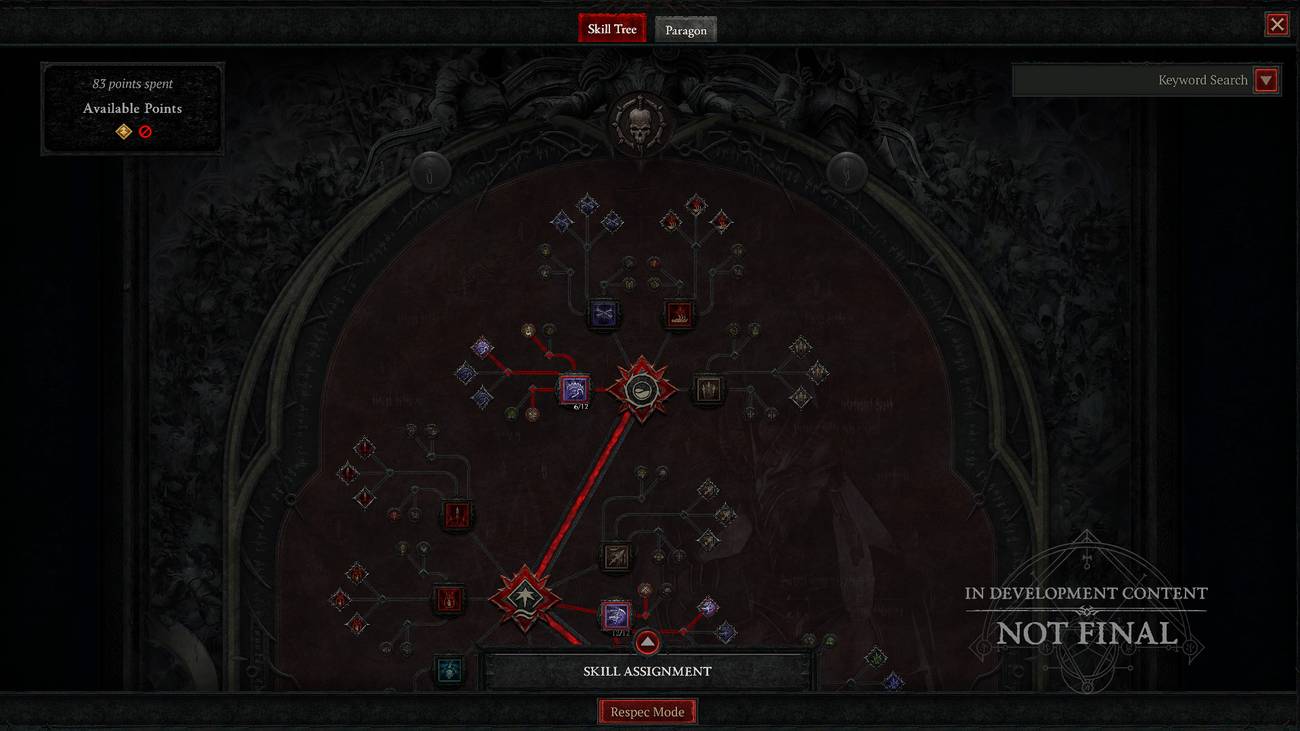
Overall, I think this change is for the best and will help diversify Diablo 4 builds going forward. More synergies will become available since skill types can be altered to benefit from Uniques that affect only one type of skill. However, it will definitely take some time to fully adjust to this new Skill Tree, and buildcrafters will have to approach the process in a whole new way.
I was also able to look at the Skill Trees for other Diablo 4 classes during this review period, and I think there will likely be a shift in the meta viability of some formerly underpowered builds when Lord of Hatred launches.

The new Talisman and Charms mechanic essentially acts as a replacement for passives in Diablo 4: Lord of Hatred. Players can socket charms into the Talisman to receive passive effects from them, and using Set Charms allows players to achieve Set Bonuses. These Set Bonuses appear to have class-specific effects, so they will likely become the go-to Charms for most of the game’s meta builds.
The Horadric Cube is a Game-Changer in Lord of Hatred

Aside from the new classes, I think the Horadric Cube is the most impactful addition to Diablo 4 in Lord of Hatred. Having access to this feature really streamlines the gear upgrading process, since the Horadric Cube allows everything from adding and re-rolling affixes on a piece of gear to straight-up transmuting it into a higher quality. As a result, I think this feature will be a massive improvement to Diablo 4‘s constant itemization issues, making it so that any piece of gear can potentially be useful.
To this end, Common items suddenly have an actual use outside the very early hours of a new character, since they are the only type of gear that can be transmuted into a Unique using the Horadric Cube. Another example of the Horadric Cube’s improved itemization came when I found a Magic quality Ancestral Amulet, which normally would have been useless since a Legendary or Unique Amulet has more affixes. However, I was able to add affixes to this Amulet using the Horadric Cube to transmute it into a Legendary that could have actually been usable on my build.
Diablo 4’s Endgame Has Never Felt Better in Lord of Hatred
I was very impressed with how streamlined Diablo 4‘s endgame has become with the additions of Lord of Hatred. War Plans condense these activities into an overarching system that goes beyond the meta progression of obtaining Uniques and Mythic alongside Rune farming, to create a tangible progression system via its unlockable modifiers. As players participate in any of the endgame activities included in War Plans, they will contribute toward leveling them up and unlocking points that can be used to upgrade these activities with various modifiers, such as buffing Bartuc and the Fell Council in Infernal Hordes in exchange for more drops when defeating them.
The endgame offers an even greater challenge in Lord of Hatred with the addition of Torment 12 as the max Torment difficulty level in Diablo 4. These new Torment tiers are tied directly to levels of The Pit of the Artificer, giving players an even greater reason to push into the farthest reaches of the Pit. Echoing Hatred is another challenging event that offers increasingly useful rewards the more waves that players can survive. I reached wave 48 as my peak when testing this activity, and I feel like the rewards were nice, but gameplay-wise, it’s not very different from Infernal Hordes.

Fishing was a feature that really surprised me during my time with Lord of Hatred. As soon as I was given the quest to unlock it, I immediately got distracted from my quest to stop Mephisto’s corruption of Skovos and dedicated my time to finding as many new fish as I could. As someone with an insatiable urge to collect things, this mechanic was right up my alley.
I thoroughly enjoyed my time with Lord of Hatred and think it goes a long way towards improving the Diablo 4 experience as a whole. While I could nitpick a few issues here and there, the package in its entirety is an impressive expansion that offers tons of welcome features and challenges to keep Diablo 4 players engaged in endgame content for hundreds of hours more. I can easily see Lord of Hatred becoming one of the most beloved expansions in the Diablo franchise.
Diablo 4: Lord of Hatred launches on April 28 for PC, PlayStation, and Xbox consoles. GameRant was provided with access to a pre-release PC build for review.