

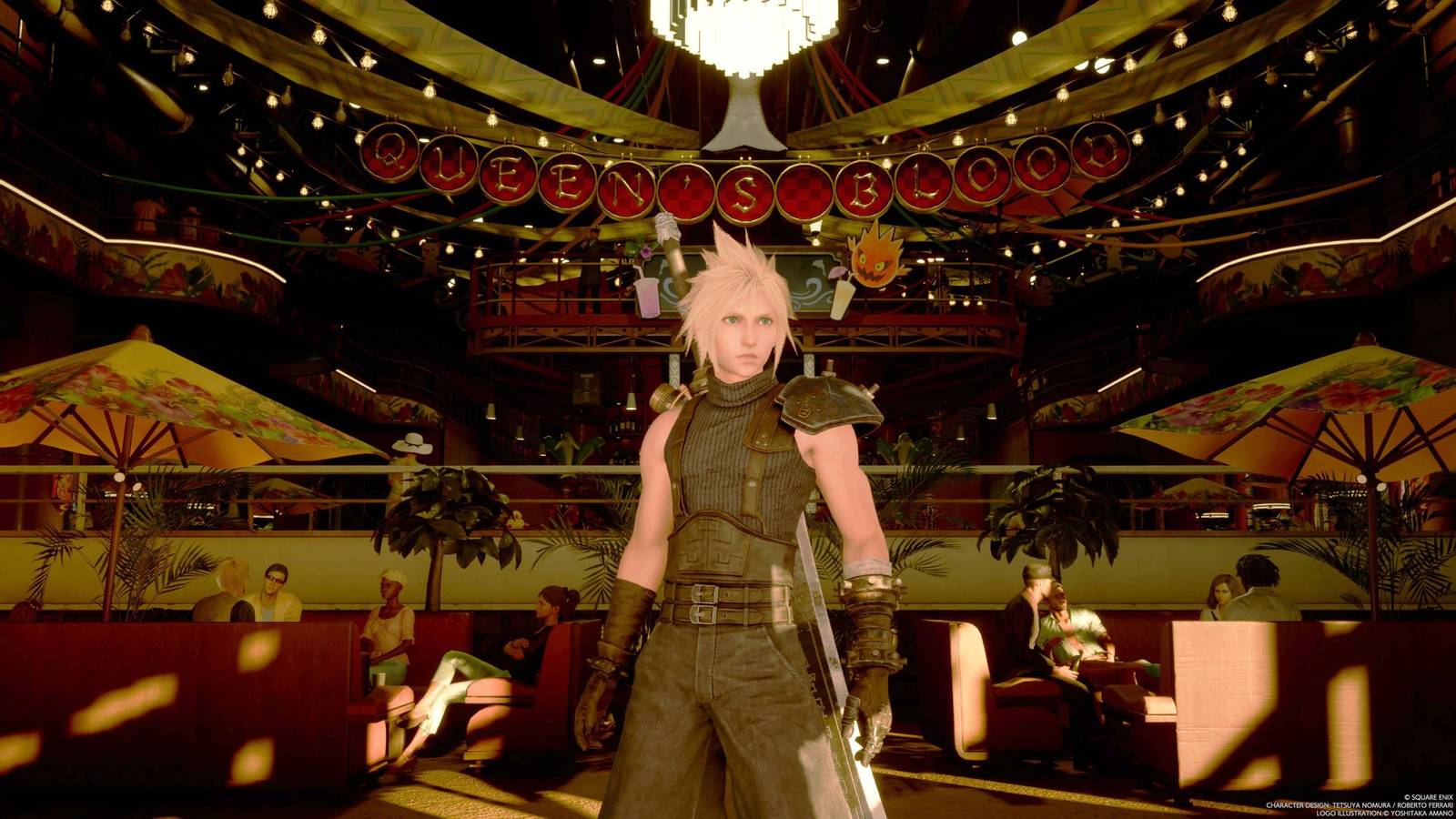



Queen’s Blood was among the most pleasant surprises of Final Fantasy 7 Rebirth, so I’m thrilled that it will be making a comeback in next year’sFinal Fantasy 7 Revelation. The Gwent-esque, in-universe card game serves as a shockingly addictiveside activity inRebirth, andFinal Fantasy 7 Revelation aims to make it a bit more fleshed out and better-integrated.
The appeal of Queen’s Blood is, in a sense, an encapsulation of the appeal of Final Fantasy 7 Rebirth as a whole. Yes, the original FF7, as well as the remake trilogy, is about high-drama, cool-looking swordsmen, and on-the-nose environmental commentary, but these games are just as concerned with frivolity as with these more melodramatic concepts. In the case of Revelation, this philosophy manifests in myriad side activities and minigames, the most beloved of which being the aforementioned Queen’s Blood, a lane-based deck builder that wasn’t in the original FF7. Queen’s Blood’s tightly designed mechanics, clever card rules, and heart-pumping, jazz-infused theme song made it unforgettable, and it sounds like it’s going to be even better in Final Fantasy 7 Revelation.
Final Fantasy 7 Revelation Will Tweak Mini-Games, Including Queen’s Blood
In a revelatory (no pun intended) interview with automaton-media, Final Fantasy 7 Revelation director Naoki Hamaguchi outlined the development team’s goals with this third and final entry in the remake project. With Revelation being the conclusion of Cloud and Co.’s story, Hamaguchi noted that “resolve” and “choice” would be main themes of the narrative, reflected in the game’s structure through “sections in [Revelation] where players’ choices are so crucial that they can alter not only how they progress through the game, but even the direction of the storytelling itself.”


Rearrange the movies into the correct US release order.
Sign in to claim your place on
the leaderboard!
As for how this affects mini-games like Queen’s Blood, Hamaguchi says that Revelation will be fundamentally different from the “bubble wrap” nature of Rebirth, a game that was “packed with content, and no matter what order players tackled it in, there were no disadvantages.” Revelation is a game that’s more concerned with intentionality and choice, and that’s buttressed by greater transparency in terms of mini-games and rewards. According to Hamaguchi: “We’ve made it immediately obvious what you’ll get from participating [in a given mini-game]. For example, you’ll know if an activity rewards Materia, items to buff your character, or something unrelated to battle, like character skins.”
Despite putting an emphasis on player choice, Hamaguchi has been very clear that Final Fantasy 7 Revelation will only have one ending.
Hamaguchi also makes it clear that the at-times overwhelming amount of content seen in Rebirth isn’t necessarily going anywhere in Revelation. Instead, the team wants to “minimize frustration” in relation to mini-games, making them easier to understand and more explicitly optional, so that “players don’t feel disadvantaged if they choose to skip them.” Reward economy plays a big role here, and Hamaguchi indicates that mini-game rewards will be more closely connected to the nature of the mini-games themselves: combat-oriented mini-games will grant combat progression rewards like Materia or gear, while non-battle-oriented mini-games grant non-battle-related rewards.
This is mostly how Queen’s Blood works in Final Fantasy 7 Rebirth, although the game doesn’t make this immediately clear. For my part, I got pretty deep into Revelation’s Queen’s Blood questline before realizing that it basically only rewards you with more Queen’s Blood cards. The big exception here is the Queen’s Blood tournament on the Shinra-8 cruise ship, a story mission that effectively forces you to play the card game in exchange for narrative and gear rewards (you can win a pair of Assess Materia earrings if you become tournament champion). For someone like me, who was obssessed with Queen’s Blood by this point, this was no problem, but I can see how this mandatory beat, coupled with the obfuscation of Queen’s Blood rewards more broadly, would frustrate other players.
Final Fantasy 7 Revelation’s Mini-Games Sound Like a Solid Compromise
In a separate interview with GamesRadar, Hamaguchi said that the raucous support for the original Queen’s Blood gave Square Enix “no other option” but to include the mini-game once again in Revelation. However, he also makes it clear that the team wants to experiment and make Final Fantasy 7 Revelation a different gameplay experience from its predecessor. For Queen’s Blood, this means the aforementioned transparency about rewards, in addition to a new side story centered on Red XIII, who revealed himself to be a passionate Queen’s Blood player in the previous game. There will also be “new rules and mechanics” for the card game, but Hamaguchi doesn’t get more specific than that.
Shaking things up is generally good, in my opinion, and while Queen’s Blood is already near-perfect, there’s always room for improvement. Better implementing the card game into the Final Fantasy 7 universe through a good side story, while also making it an explicitly, entirely optional activity for those who don’t care about it, seems like the right tack. Hopefully, this philosophy will make all of Final Fantasy 7 Revelation’s mini-games better, while still addressing the pacing issues that mini-games spurred in its predecessor.


- Released
-
April 8, 2027
- Prequel(s)
-
Final Fantasy VII Remake, Final Fantasy VII Rebirth