





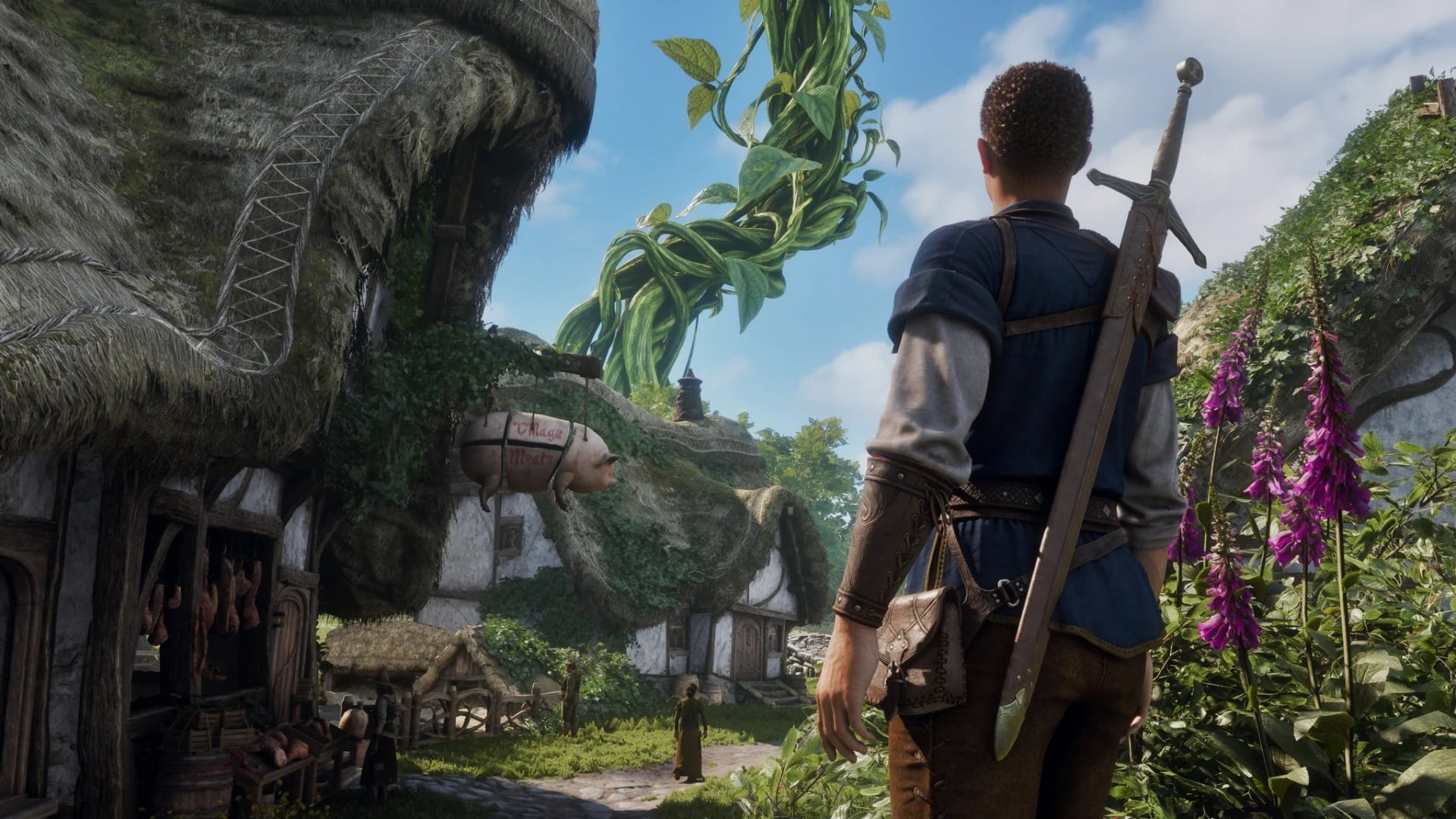
Fable’s combat has whipped up a storm of controversy after gameplay footage shared by Playground Games makes it look, well, underwhelming.
At roughly the 15-minute mark, the player fights a lumbering giant who seems to soak up hit after hit while barely reacting.
That clip doesn’t tell the whole story, however. After playing a full, combat-heavy quest myself, I’m happy to say fighting is far better than it appears in that single, misleading encounter.
The quest is called “Mud and Death,” and takes place around the middle of the game. At this point, you’ve got plenty of weapons at your disposal, such as a sword, bow, and warhammer, and a bevy of magic powers, including fireballs, lightning, and levitation. All of it can be used to reduce hordes of skeletons to quivering piles of bone in vastly different ways.
In this quest we’re paired with an AI-controlled Humphrey (played by Matt King), the washed-up leader of the Hero’s Guild, who leads us into a haunted mine packed with supernatural threats. They’re the ideal fodder for experimentation. During the quest I suspended enemies in the air, spawned phantom daggers that seek out stragglers, flung enemies back with force, and summoned lightning bolts to chain-damage groups. If that previously mentioned gameplay clip looked unreactive, this acted as a direct counterpoint.
Fable’s combat. 🤔 pic.twitter.com/rf61zn7e7q
— James (@JamiesAct) August 26, 2026
“The dismemberment, in particular, is something that’s great,” says Will Kennedy, associate game director at Playground Games. “It’s great for showing off the precision shots that you can do with the bow, and you can shoot them in the head and they become headless, and then you fire them into the air because they can’t see you. You can shoot them in the legs and knock them over and they continue crawling toward you, and that sets them up for ground kills.”
There are plenty of combo possibilities. I used the teleportation spell to pop up behind enemies standing near ledges, then pushed them into the abyss. Others I levitated, then used the lull in action to charge and unleash a fireball, resulting in a fierce explosion.
Not only did I play as a spellcaster, able to slash enemies and summon magic, but I tried the next run as a bowmaster who rapidly shoots arrows with machine-gun speed. It highlights the damage system, which hurts foes more depending on where you hit them.
“They have randomized armor parts on some of them,” says Kennedy, “which means that ranged attacks won’t work on those enemies, but the parts that are exposed to ranged attacks will work. So if you have the skill and the ability to see that, then you can use it. Smashing through them and dismembering them with the hammer is really great.”
It’s not just skeletons who I faced, though. It turns out they’re possessed by wraiths, who bring their own challenge. Each time you take down a skeleton, you need to then pursue and destroy the pale green spirit within as it flies out of its former host and searches for a new one. Here, it’s better to use projectiles and hit from distance before it settles inside its next boney body.
The quest’s final challenge, however, is the toughest. Emerging out of the cave and into a foggy swamp, we faced down a boss: the Lantern Keeper. It’s a towering phantom with the angular head of a 19th-century street lamp. After dodging its flame breath attacks, I peppered that head with arrows, hitting the target with a satisfying smash.
This diversity in combat is why the devs showcased this quest specifically. “We wanted to pick something that would give you one of the best experiences you could get when you pick up the controller for the first time,” says Kennedy. “And I think one of the things you get to see is the way you can have different loadouts, which can give you different experiences. And you get a taste of the power you can build throughout the game as well.”
Nonetheless, it was an unusual choice. This mission is a rare instanced one, meaning you can’t return to it once completed.
“There are some locations in the game that you play on the golden line that you can only go to once, but we make sure that there aren’t any features or content there that you’ll miss and then won’t be able to pick up later.”
I would have preferred to play a more open mission that let me loose in that incredibly detailed world. Fable is, after all, a sprawling fantasy RPG with a huge fairytale sandbox ripe for exploration. This demo was not that. It was a linear run through a dark cave against a gauntlet of enemies.
It showed none of the game’s signature moral choices or charming NPC interactions. That, however, may have been a masterstroke. In focusing on the one element of the game that’s drawing controversy, people’s fears can be put to bed. Combat is fantastic, enemies are reactive, and character builds are diverse.
The demo was an unconventional choice, both in tone and content, but it reaffirmed my hype for the game. If even its lesser Fable-y bits are great, just how good will its proper Fable-y bits be?
“You think about the fairy tale part of the tone we have in Fable games,” says Kennedy. “That’s got a lot of light-heartedness too, but it’s also capable of contrast as well. And we actually think that whenever you get that dark contrast, it’s all the more powerful for it.”