


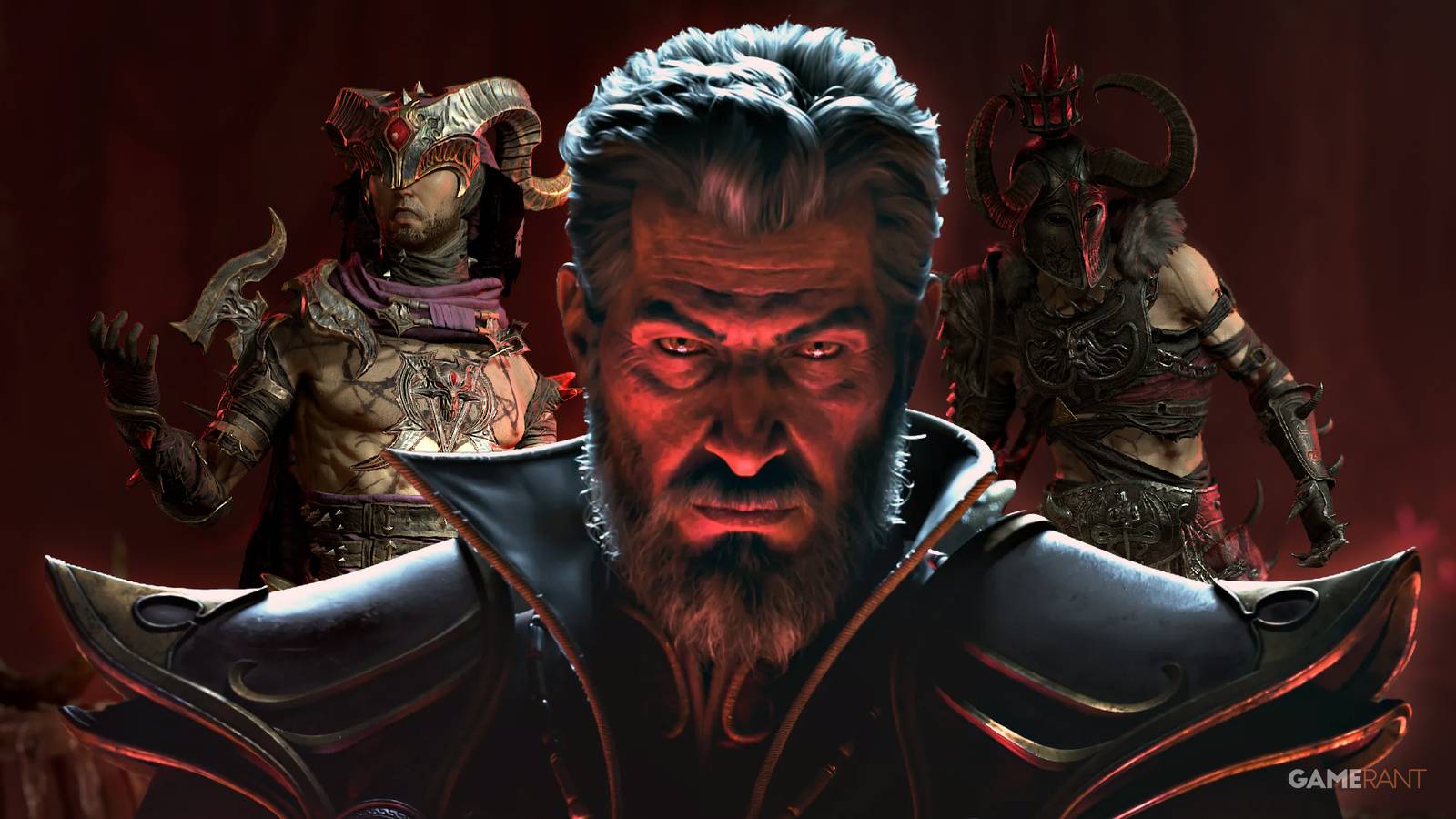
With the Lord of Hatred expansion set to release next month, Diablo 4 will see just the second instance of the Warlock class in the series. Currently, Diablo fans can experience the Warlock in Diablo 2: Resurrected‘s Reign of the Warlock DLC, but this version of the class looks quite different from the one that will be joining Diablo 4 in the upcoming Lord of Hatred DLC. Despite the differences between the gameplay of these two different iterations of the Warlock, there is still some common ground that D2R and Diablo 4 players will likely notice when checking out the class in both games.
Right off the bat, there are some obvious differences that need to be accounted for, since Diablo 4 and Diablo 2: Resurrected are two similar but very different games. Diablo 4 has a much more expansive skill tree, and it’s getting even bigger in Lord of Hatred, so the Warlock has far more skill options here than in D2R. Additionally, Diablo 4 is a much faster-paced game than Diablo 2, so the Warlock’s abilities will need to reflect this difference in game speed.
The Warlock is also coming to Diablo Immortal in June 2026.
The Major Differences Between the Warlock in Diablo 4 and Diablo 2: Resurrected
In both Diablo 4 and Diablo 2: Resurrected, the Warlock leans into the summoner archetype, summoning demons to do their bidding in battle. What’s more is that the Warlock can also channel arcane arts to deal a variety of magic-based attacks that support its summoner gameplay. How the class goes about pairing these two play styles differs across the Diablo franchise, but there are still some commonalities that make the Warlock feel like a cohesive class regardless of the Diablo game it appears in.
Rearrange the covers into the correct US release order.

Rearrange the covers into the correct US release order.
Easy (5)Medium (7)Hard (10)
Diablo 4’s Warlock Emphasizes the Soul Shard Mechanic
- Legion — Summon Ae’gron
- Vanguard — Summon Abodian
- Mastermind — Summon Laalish
- Ritualist — Summon Vollach
A core part of the Warlock kit in Diablo 4 that is completely absent in Diablo 2: Resurrected is the Souls Shard mechanic. This mechanic allows the Warlock to select one of four Soul Shards containing a demon that they can summon, and largely forms the basis for the class’s build archetypes. The Legion Soul Shard focuses on summoning demons as fodder for the slaughter. The Vanguard Soul Shard emphasizes the Warlock’s Demonform, where players can transform into a demon themselves. The Mastermind Soul Shard lets the Warlock control the battle from the shadows, while the Ritualist Soul Shard empowers the Warlock and weakens enemies with sigils and ancient rites.
Diablo 2: Resurrected’s Warlock Can Bind Any Demon in the Game

The Warlock of Diablo 2: Resurrected doesn’t have the same Soul Shard mechanic as the class’s Diablo 4 counterpart. Instead, Diablo 2: Resurrected Warlocks get the unique ability to Bind and control any demon in the game as a companion. Each Bound demon in D2R comes with its own advantages, offering the player potential buffs if they find one with a unique affix. The Warlock can also Consume their Bound demons to gain bonus effects.
Skills Shared Between Diablo 4 and Diablo 2: Resurrected’s Warlocks

There aren’t a ton of overlapping skills between Diablo 4‘s Warlock and Diablo 2: Resurrected‘s version, but there are a couple of noticeable inclusions. Apocalypse is one of the Warlock’s most iconic skills, which creates a massive pentagram of fire to deal huge AoE damage within a wide radius. In Diablo 2: Resurrected, Apocalypse is a Level 30 skill on the Chaos tree, but in Diablo 4, Apocalypse is one of the class’s Ultimate skills. While not exactly the same as in D2R, Diablo 4‘s Warlock has access to several Sigil skills, including Sigil of Chaos, Sigil of Subversion, and Sigil of Summons.
How the Lore of the Warlock Compares Across the Diablo Series
Lore-wise, the Warlock is somewhat different between Diablo 4 and Diablo 2, but there is still a clear throughline connecting the versions of the class. In Diablo 2, the Warlock is a scholar of the ancient Vizjerei summoners who used the demons of the Burning Hells for their own devices. However, the summoning of demons led to Sanctuary’s discovery by the Burning Hells, ultimately resulting in the Sin War that devastated Sanctuary and caused the Vizjerei to abandon the practice of demon summoning. Now, the Warlock of Diablo 2 has resumed the lost Vizjerei art of demon summoning, delving into the practice as part of a scholarly pursuit.
In contrast, the Warlock of Diablo 4 is born out of this demon-summoning revival that began with the Warlock of Diablo 2. Warlocks are now viewed as outlaws, remnants of the forbidden Vizjerei clan practitioners. Unlike in Diablo 2, Diablo 4‘s Warlock has seemingly gone mad from their close contact with demonic forces, causing them to hunger for more power and subjugate demons no matter the cost to their physical or mental state. Across both games, the Warlock’s identity is built on a foundation of Will, Demonology, Hellfire, Shadow, and Martial Weaponry, which underpin most of their skills. Despite their mechanical differences, Diablo 2: Resurrected and Diablo 4 establish a clear lineage for the Warlock that combines the controversial Vizjerei history and a thirst for the power that only the arcane arts can provide.

- Released
-
June 5, 2023
- ESRB
-
Mature 17+ / Blood and Gore, Intense Violence, Language, In-Game Purchases, Users Interact