



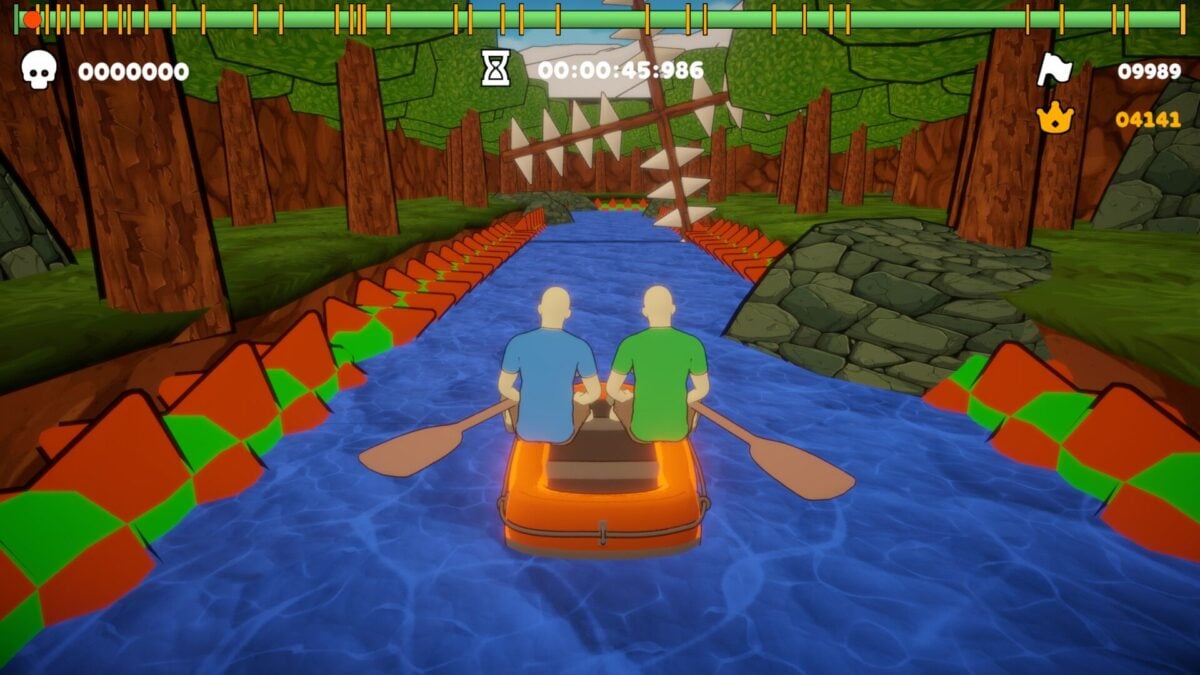
23-year-old solo game dev Zoroarts has created something of a break-out hit on Steam. Paddle Paddle Paddle, the designer’s second game (following 2023’s Makis Adventure), is a short third-person boat-paddling adventure played either solo or in co-op. And by the developer’s own report, it’s sold a very impressive 270,000 copies in its first year of release. However, 55,000 of these have been refunded via Steam’s no-questions policy, because the game can be completed in under two hours.
Valve’s refund policy on Steam is extremely consumer friendly. If you’ve owned a game for less than 14 days and played it for under two hours, then you can just get your money back without any further complications. As a player, this is great—spend $60 on a game, discover you absolutely hate it, and so long as you haven’t played it for a significant length of time, you can get a refund. However, if you’re a developer who’s made a game that’s shorter than two hours, it can suck.
“This should not be possible @Steam,” Zoroarts wrote on X about this specific aspect of the system. “Would be cool if you could finally do something about your refund policy.” He explains that he’s received dozens of reviews from players expressing how much they enjoyed the game but who refunded it anyway, adding that he’s received a “21% refund rate even though the reviews are 90% very positive.”
This should not be possible @Steam
Would be cool if you could finally do something about your refund policy… Got dozens of reviews like that and 21% refund rate even though the Reviews are 90% very positive…
Thats over 55,000 Refunds btw… pic.twitter.com/fSiuHjGRnD
— Zoroarts 🦈 Paddle Paddle Paddle OUT NOW (@Zoroarts) July 5, 2026
Paddle Paddle Paddle wasn’t intended to be shorter than two hours. Zoroarts, who makes clear to Kotaku that he’s very pro Valve’s player-friendly refund policy as a rule, had aimed for closer to three-and-a-half hours, and reports that the chaotic paddling sim takes many players about this long to complete. However, it’s also proven very popular among speedrunners and those who mainline games that are said to be extra-challenging, so it’s drawing in crowds who are racing through the game and hitting credits within the refund period. 55,000 of them, in fact.
The game costs only $5 at full price, and has routinely been on sale at $3 for large sections of the past year, making it all the more peculiar that people don’t think their positive experience was worth the price of a Starbucks coffee, not least when the game has 89-percent positive reviews on Steam. At an average price of $4, after Steam’s fee, that’s $154,000 in lost income (of which we can assume a significant amount goes to publisher Assemble.)
It does raise an important question for Valve, given how the policy so clearly discriminates against developers of short games. Although a solution is not obvious, we’ve reached out to Valve to ask if it’s a matter they’ve considered. Zoroarts’ suggestion is that expected playtimes could be displayed on the store page for a game, and then when that’s shown to be under two hours, “too short” could be removed as a refund reason.
Re: Funds
We reached out to Zoroarts, aka Mateo Covic, who stressed how in favor he is of Steam’s refund policy when it comes to games that are “broken, misleading, or simply not what they expected,” but has specific concerns about the consumer’s ability to exploit this policy for short games. “I have received multiple reviews along the lines of, ‘Great game! Finished it in under two hours and refunded,’” Covic told Kotaku. “Seeing that as a solo game developer can be a strange feeling because, on one hand, the player enjoyed the experience, but on the other hand, they intentionally chose not to pay for it.”
Others went even further, the developer says, telling him that a game under two hours shouldn’t have to be paid for, and even calling him “greedy.” “I’m just a solo dev trying to make a living creating small, affordable games,” he adds. Acknowledging his delight at the game’s success, Covic continues that people really don’t understand how many fees get paid before any money reaches a developer. He laid out the details for Paddle Paddle Paddle:
- Over 270,000 copies sold
- $4.99 base price, although most sales happen during discounts at around $2–3
- About $826,000 gross revenue (including VAT, DLC, and bundles)
- About $605,000 after refunds, chargebacks, and taxes
- About $250,000 after Steam’s cut, publisher share, currency conversion
Then a very large chunk of that goes to tax, which in Germany are at 42 percent for everything over €70,000. And of the original total, $158,000 has been lost to refunds.
“That’s obviously still an incredible amount of money for a 23-year-old solo dev and for a game that took around four months to develop,” he notes, adding, “I know this outcome is far from normal in indie development. I got extremely lucky that a lot of streamers picked up the game.”
Covic again underlines his discomfort with making too much fuss here. “Refunds are absolutely a player’s right,” he tells us, “so I don’t really feel comfortable complaining about them and removing them. I just want people to enjoy my games. It can simply sting a little when someone publicly celebrates refunding a game they genuinely enjoyed.” He notes he somewhat regrets the original post on X, because “I never intended to create negativity or bad vibes,” and makes clear that “the last year has been the best year of my life.” On top of the game’s financial success, Covic has been recognized with awards in Germany, had the game featured on local news, and was listed in Forbes’ 30 Under 30 Europe list for 2026, “which still feels completely surreal.”
Updated: 07/06/2026, 11:15 a.m. ET: Updated the post to add Covic’s comments.
