



Without a doubt, two of my favorite franchises of all time are Black & White and Fable, both of which were created by Peter Molyneux, founder of Lionhead Studios. As a god game, Black & White gave me more freedom than any gaming experience I had prior, and the satisfying progression, fulfilling experimental gameplay, and memorable humor (off-color for the 14-year-old that I was) all left an impression on me that I haven’t seen replicated since the sequel launched in 2012.
Fable felt similar in a lot of ways, where my choices seemed to actually mean something, and I was forced to live with the consequences. But the world itself also felt unlike anything else—reactive, charming, and alive—and, like Black & White, there hasn’t been anything like it since. So, imagine my excitement when I learned of what would be Peter Molyneux’s last game and a glorious mashup of what I consider to be his two greatest ideas: Masters of Albion.
If it didn’t already look like it from afar, Masters of Albion truly is what would happen if the original Fable (not even Fable 2 or 3) got the Black & White treatment. It’s essentially a nostalgic conglomerate of everything that made those two franchises unique, and it makes for an experience that players simply cannot find anywhere else. Unfortunately, while it does modernize Black & White gameplay to an extent, it still feels trapped in the past. Sometimes, that kind of recipe can work, but in Masters of Albion‘s case, it creates a kind of frustration that’s hard to ignore once you get past its honeymoon phase. It was never necessary for the concept to evolve, but the execution needed to, and it simply hasn’t evolved enough. That being said, it’s launching in Early Access first, so there is still a chance for it to resolve some of its most irritating growing pains.
Masters of Albion Is Already Solid for Black & White, Fable Fans
As a longtime Black & White and Fable fan, my first steps in Masters of Albion were relatively painless, as it felt like coming home, regardless of how long it’s been. The gameplay, the music, the visuals, and the overall tone were so immediately familiar that I was quickly convinced this would be a hit among fans like me. However, for those who have never played Black & White or a god game in general, that same familiarity may come across less as a welcome return and more as a lack of direction, especially since Masters of Albion leans heavily on player freedom and experimentation without always clearly guiding what you should be doing next.
But before getting anymore into the biggest pain points of my time with Masters of Albion, it’s important to acknowledge up front that this game is most likely to immediately appeal to players like me, who grew up with Black & White and the original Fable. Many of the iconic features from those games are still present here, like the ability to grab NPCs and toss them across the screen or being able to kick chickens. There are even plenty of callbacks to Black & White in the game, from similar puzzles to the famous boat song sung by pirates in need of wood, as well as familiar Fable mechanics like the vulgar, insulting gargoyles—called “Grotesques” in Masters of Albion.
Masters of Albion Expands on Black & White’s Gameplay in a Meaningful Way
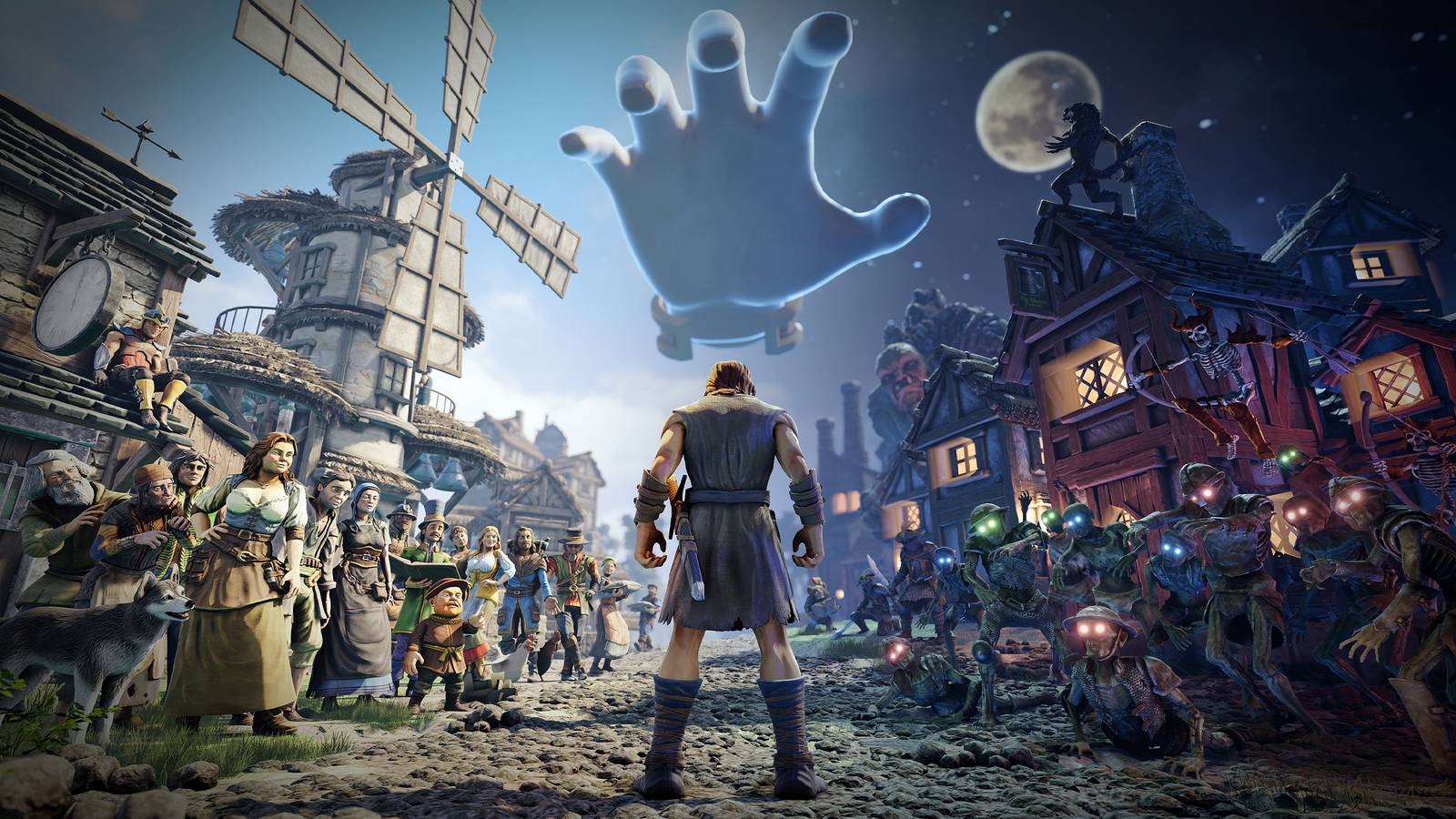
However, despite the obvious similarities, there are plenty of ways Masters of Albion takes the Black & White formula and expands on it with fresh gameplay mechanics, many of which are connected to the Fable universe. Players begin the game by stumbling upon a throne that they are inadvertently possessed by, after which they control a giant hand they can perform a variety of tasks with, beginning with cleaning up and rebuilding Oakridge, their first settlement. Once Oakridge has been rebuilt, they can then hire workers to manage different operations within the town—namely farming, milling, and production.

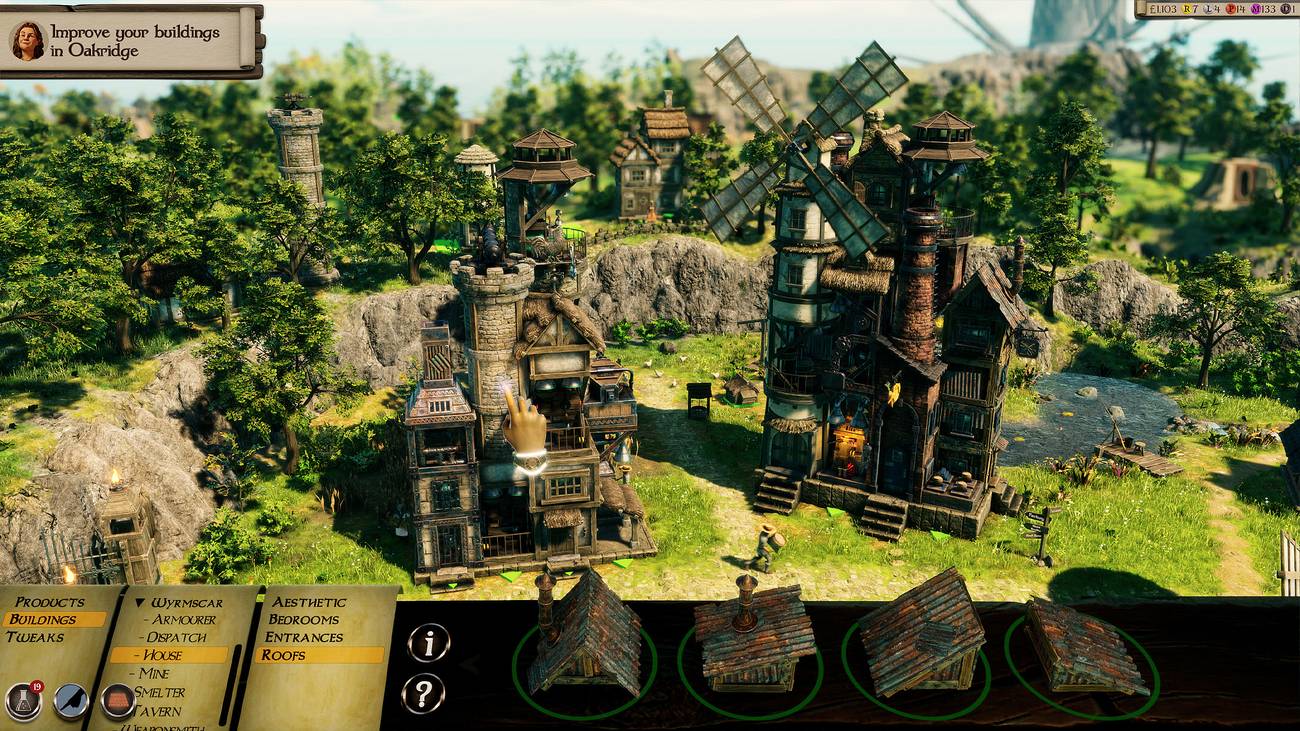
As the game progresses via its story, so too does the player’s influence and, in turn, the territory they are allowed to manipulate. During my roughly 17 hours with the game, I eventually unlocked three different settlements, each with their own unique contributions apart from food, like metal and cloth. But nothing progresses in Masters of Albion without a few night raids, which see players defending their towns and the workers in them from hordes of monsters using magic powers like lightning and fire from their hand and any Heroes they’ve recruited along the way.
As a longtime Black & White and Fable fan, my first steps in Masters of Albion were relatively painless, as it felt like coming home, regardless of how long it’s been.
One of the more intriguing aspects of Masters of Albion‘s gameplay is found in how money is made. The purpose of hiring workers is, of course, to eventually produce something worth selling, but while the initial gathering and refining tasks like farming, mining, smelting, and milling are automatically taken care of, production requires more involvement from players. Specifically, upon receiving an order for a certain item, players are responsible for assembling that item and ensuring it’s the right quality and type to please customers. This is where the game lets you get a bit creative, though if you actually want to make money off the order, you need to do what it says.

Completing orders rewards money if they’re done well, but also reputation with Masers of Albion‘s different factions. As your reputation with a faction increases and progresses to higher tiers, you can unlock bonuses like increased order size, increased Favours, and increased sales price. Money and Favours are largely spent on skill unlocks and upgrades, of which there are many, but there are other uses for them throughout the game’s story as well.
And speaking of creativity, towns are fully customizable, in that you can change how buildings are structured, where they’re located, and even how they appear using paint. After several hours of familiarizing myself with Masters of Albion‘s core gameplay loop, I spent quite a bit of time actually making my buildings look good, and I walked away feeling like I had taken true ownership of each settlement and made it my own.

Masters of Albion already captures the magic that made Black & White and Fable so memorable in the first place, delivering a nostalgic yet engaging experience. Its evolving settlement-building system, hands-on production mechanics, and emphasis on player creativity give a strong sense of ownership, while its tone, humor, and recognizable features make it a true spiritual successor. Even beyond nostalgia, there’s a clear effort to expand on those original ideas, offering enough depth and flexibility to make shaping each town feel rewarding in a way that stands out in today’s landscape.
Masters of Albion Still Has a Lot of Growing to Do in Early Access
However, for almost every positive in Masters of Albion, there is currently an unfortunate, glaring negative. I played the game for less than 20 hours before the story wouldn’t advance any further, and during that time, there were moments where I felt like I could play forever, and just as many moments where I felt like I’d rather step away for a bit and take a breather. It’s fun and hilarious at times, but it can be equally infuriating. Many of these issues can be resolved with some quality-of-life tweaks, but they’re nonetheless present in Masters of Albion‘s current state.

For starters, Masters of Albion has a character guide that assists players in learning the ropes, but it simultaneously neglects to hold their hand when it seemingly matters most. I appreciate the lack of handholding in some ways, and it even reminds me of my time playing Black & White when I had no idea what I was doing and I could simply experiment. But sometimes, Masters of Albion is so unclear about how to do what it wants me to do that it kills any momentum I had left in the tank.
For almost every positive in Masters of Albion, there is currently an unfortunate, glaring negative.
One of the biggest pain points right now is its standout order system, but particularly when it comes to the hints the game gives you about what to make. Rather than telling you exactly what you need to make, orders in Masters of Albion only give you hints, but they’re currently so obscure that it’s a bit of a stretch to call them “hints.” “Be bold, be unlike other weapons,” one read. There were many times I found myself trying to achieve optimal results through trial and error rather than actually considering the hint, once again driving momentum down the drain. There were other instances where I wasn’t even able to make what an order required without unlocking the appropriate recipe bundles in the game’s skill tree, but the problem there is that Masters of Albion doesn’t tell you exactly what those bundles contain.
Something else I struggled to get behind is the difficulty of night raids in the game. Because these aren’t optional—as the only way to progress the story is to do them—they are far more challenging than they need to be this early in the game. Enemies are exceedingly spongy, and Heroes, unless they are kitted out in some great gear, are puny against them. I eventually saved up enough money and resources to equip them all with impenetrable armor and gave them powerful weapons as well, which helped. Still, for things to be this difficult this early in the game doesn’t really make sense in the grand scheme of things.
Because of that difficulty, Masters of Albion can feel unnecessarily grindy at times, as players wait for orders to be completed just so they can replenish their funds and purchase better skills and equipment for Heroes. It is possible to speed up processes manually, but that requires you to hold your hand on one building, which, again, kills momentum, because you’re just sitting in one spot essentially doing nothing while your resources stack up before moving them to the next building and doing the same thing all over again.

Then there is just a general jank to the game that’s difficult to ignore. Picking up anything in Masters of Albion frequently feels like a chore, bringing back memories of vanilla Crimson Desert in a heartbeat. There were many times all I wanted to do was move resources from one building to the next, only for it to either not register or pick up an NPC instead. And NPCs are another story, as they currently get hung up rather easily on terrain, objects, and other NPCs, sometimes halting entire processes.
Rather than telling you exactly what you need to make, orders in Masters of Albion only give you hints, but they’re currently so obscure that it’s a bit of a stretch to call them “hints.”
The ability to possess my Hero and other NPCs is fun, but there are a lot of problems with this aspect of gameplay as well. Firstly, Heroes can’t jump, and while I understand they can’t in the original Fable either, that’s one thing that probably would have been okay to change. Just like NPCs, I found my Hero would often get caught on terrain, forcing me to de-possess them and then manually move them. I understand why barriers to the next zone might exist, but I think I would take invisible walls over the inability to bypass simple geometrical nuances by jumping.

Secondly, third-person combat via possessed Hero is painfully simplistic in its current state, and somehow feels worse than it did in the original Fable. I found that I was constantly fighting the camera almost as much as the enemies in front of me, as well as Masters of Albion‘s automatic targeting system, which saw my Hero attacking enemies I wasn’t even aiming at. The blocking/parrying system is another animal entirely, as it currently feels pointless to use due to some severe timing and registry issues. If Hero combat just felt cleaner and more responsive, I wouldn’t mind the simplicity.
Finally, Masters of Albion currently runs poorly in many ways. I have a stout PC gaming rig, and I still encountered plenty of stuttering issues and drops in frame rate, especially in third-person mode. I’m rarely bothered by performance unless it’s game-breaking, but in this case, it was just enough that it’s worth mentioning, especially as it gets in the way of gameplay that already tends to feel sluggish.
Masters of Albion Is a Throwback That Needs to Move Forward

At its best, Masters of Albion feels like a direct extension of what made Black & White and Fable so special, especially for someone who grew up with those games. It’s immediately familiar in a way that works in its favor, from its tone and humor to the freedom it gives players to experiment and figure things out on their own. That foundation is backed up by gameplay mechanics that actually give you something to do with that freedom, whether it’s building up settlements, managing resources, or getting hands-on with production in a way that makes you feel involved in how everything functions. When it clicks, there’s a real sense that you’re shaping something that belongs to you.




- Released
-
April 22, 2026
- Developer(s)
-
22Cans
- Publisher(s)
-
22Cans
- Number of Players
-
Single-player