








I love roguelikes, simply for the fact that I find their risk-reward loop immensely satisfying. However, I haven’t played too many deckbuilding roguelikes, not because they don’t interest me, but because my backlog generally has me drifting toward something else instead. And yet, after spending over an hour with Shroom and Gloom‘s demo on Steam, it’s officially on the list of games I plan to prioritize this September—which is saying a lot already, considering how stacked this month really is. To be quite honest, I could have invested a lot more time into Shroom and Gloom‘s demo, as it’s incredibly generous with what it offers, and I simply couldn’t get enough of what I played. While I haven’t played the full game just yet since it launches on September 10, 2026, I can confidently say that if it’s anything like the demo, it will be, without a doubt, one of the best roguelike deckbuilders out there. I’m certain of it.
Shroom and Gloom separates itself from your traditional roguelike deckbuilder in many ways, but its standout feature is that it plays more like a first-person 3D dungeon crawler with a roguelike deckbuilding loop built in, which makes it far more immersive than most of the games I’ve played in the genre. That’s far from its only distinguishing characteristic, though. In fact, it’s probably more accurate to call it a roguelike double-deckbuilder because you get to manage two decks throughout the game. More on that later, but I’ll say right out of the gate that it makes building your decks all the more rewarding, considering each deck is used for completely different purposes. Throw in one of the most captivating art styles I’ve ever seen in a game like this, as well as an unforgettable atmosphere, some sharp humor, and just the right amount of weirdness, and Shroom the Gloom becomes what I can’t help but label one of the most promising indie titles I’ve played on Steam in a long time.
Check Out Shroom and Gloom’s Demo on Steam
Before I even launched the demo for Shroom and Gloom, I was already intrigued by the fact that this short little taste of the game alone had already managed to achieve an Overwhelmingly Positive rating on Steam. For a roguelike deckbuilder, that’s already pretty significant, though the genre’s fanbase has grown tremendously over the last few years. But the reason that’s such a big deal is because, at some point, I feel like it’s all the same. I mean… how much can you actually do with this formula that makes it considerably different from any other game in the genre? As it turns out, I think Shroom and Gloom may have found a little niche to carve itself into, and I can’t wait for all the other games that will likely draw inspiration from it if it succeeds.
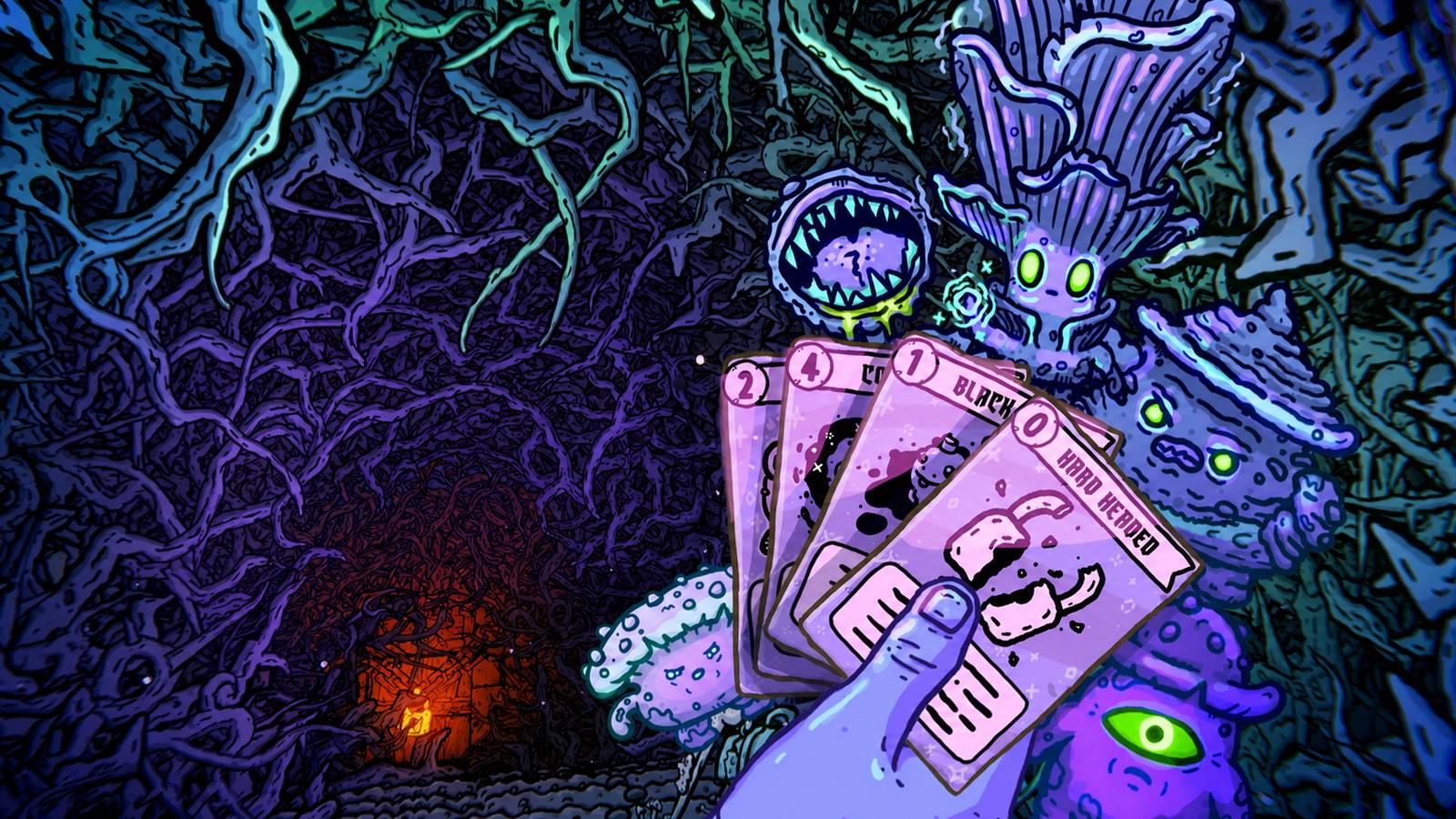
For me, that opinion started forming as soon as I started a new run in the demo. I was dropped into this dark yet colorful world, where I could see my hand in front of me holding up a piece of paper with a solitary “W” on it, clearly telling me to… walk? This is something I wasn’t yet familiar with in the realm of roguelike deckbuilders, so I just stood there motionless for a second, even attempting to click on the paper thinking it would do something. But when I finally hit the W key on my keyboard and started moving, the beautiful, strange environment before me began unraveling, and I was instantly smitten with Shroom and Gloom.
I think Shroom and Gloom may have found a little niche to carve itself into, and I can’t wait for all the other games that will likely draw inspiration from it if it succeeds.
Moving forward just a little more, I found a shovel wedged into the ground, so I picked it up and it became a card. Then, just ahead, a black “X” appeared on the ground, and since, as they say, “X marks the spot,” I clicked and dragged my shovel card to that spot, unearthing a key card that I could use on the locked door in front of me. Walking through the door, I entered a dark stairwell that led me deep into an even darker room, where cards for a rusted hammer and a matchstick appeared in my hands.
With the matchstick, I lit a torch in front of me that I could barely see, and the room lit up. The rusted hammer, on the other hand, I could use to break the lock on yet another locked door. On the other side, another stairwell, but one where the bones of a poor soul who had lost their way clutched a backpack that contained the first few cards of my Explore deck. But beyond the locked door in front of me, which I would unlock with a key I found in the backpack, lay my first battle with Shroom and Gloom‘s strange (but also kind of adorable) enemies, where my entirely separate combat deck appeared in my hands. At that point, I had realized just how special this game is, and I wanted to keep going, wherever it would take me.
Shroom and Gloom’s Double-Deckbuilding Makes Its Roguelike Loop Doubly Satisfying
Without a doubt, one of Shroom and Gloom‘s best qualities is its double-deckbuilding loop, particularly with how seamlessly it works with its first-person dungeon crawling experience. Essentially, you have one deck that is used for camp and exploration and a separate deck that is used for combat. The Explore deck is what you’ll have in your hands while you’re making your way through the dungeon, and its cards can be used to interact with the world, modify other cards, and unlock new weapons and abilities. Then, when you walk into a room with enemies, that deck disappears and your Combat deck takes its place. Once the fight is over, you’re right back to exploring again, and it doesn’t take long before you’re bouncing between both decks so often that they start to feel like two halves of the same loop.
The Explore deck is probably what surprised me the most, simply because I expected most of the actual deckbuilding to happen in combat. Instead, Shroom and Gloom gives you cards for things you would normally just do with the press of a button in any other first-person dungeon crawler. That shovel I mentioned earlier is one example, since I could use it to dig up whatever was buried beneath those black Xs I found along the way, but there are plenty of other ways these cards come into play as you move deeper into the dungeon. Better yet, exploration is also where you can find opportunities to improve the cards you already have, so I’m not simply walking from one battle to another while waiting for the “real” game to start again. I’m still building my run in between fights, only now I’m doing it while physically moving through this strange underground world and wondering what might be behind the next door.
Shroom and Gloom’s Combat Is All About Ridiculous Cards and Eating Your Enemies
Then there are the battles themselves, which are where Shroom and Gloom starts showing just how ridiculous it is willing to let things get. Like most deckbuilders, each turn gives you a hand of cards to work with, and you’re trying to figure out the best way to use what you’ve been dealt before handing things over to the enemy. But the real fun comes from what happens to those cards as the run progresses, because Shroom and Gloom lets you continue growing and modifying them until something that started out fairly harmless can become absolutely absurd. During my time with the demo, I was already starting to see how quickly one good card could turn into the centerpiece of an entire build, and once that starts happening, every opportunity to improve it becomes increasingly hard to pass up.

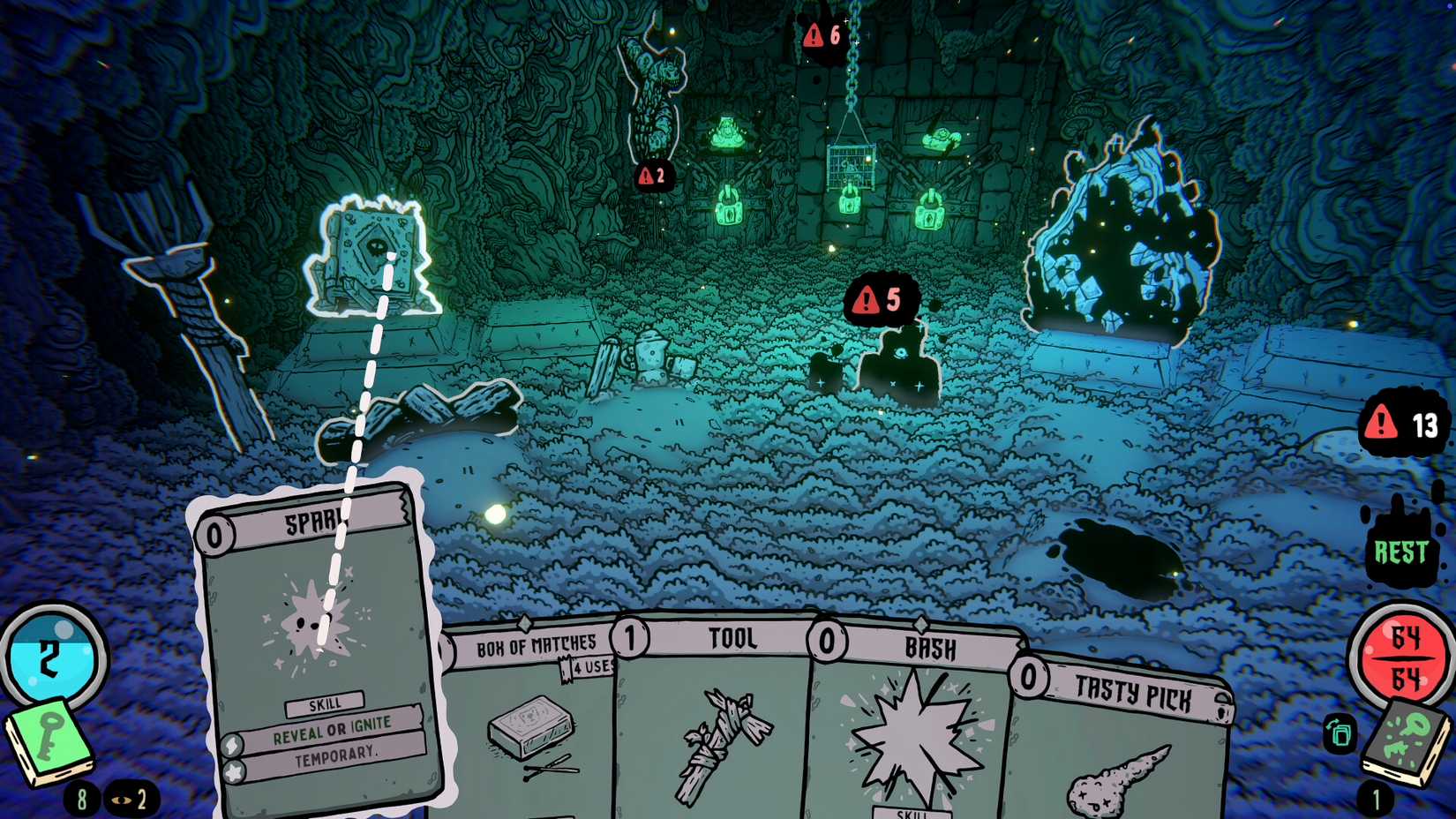
Shroom and Gloom also has a pretty hilarious solution for staying alive that fits this entire game far better than a traditional healing potion ever could. Rather than relying heavily on blocking damage, you’re encouraged to cook and eat the mushrooms trying to kill you. Depending on the cards you have, you can season them, roast them, and eventually gobble them up to recover lost health. You can even toss roasted enemies into a pot and turn them into soup, which can provide additional benefits. Again, this is a game where I had already used a shovel card to dig up a key and a matchstick card to light a torch, so when I was encouraged to start preparing my enemies for dinner, I was more than happy to go along with it.
Without a doubt, one of Shroom and Gloom‘s best qualities is its double-deckbuilding loop, particularly with how seamlessly it works with its first-person dungeon crawling experience.
And this is basically how a run keeps pulling you forward. You’ll make your way deeper into the dungeon, use your Explore deck to deal with whatever you find along the way, stumble into another battle, build up your Combat deck, and then head right back out to see what else is waiting for you. Meanwhile, both decks are constantly changing as you find new cards and improve the ones you already have, so there was almost always something I wanted to do before I stopped playing. Maybe I wanted to see what was through one more door. Maybe I had just improved a card and wanted to see what it could do in the next fight. Or maybe I had found the beginnings of some stupidly powerful combo and wanted to know just how far I could take it before the run came crashing down.
Of course, it eventually will come crashing down because this is still a roguelike, and dying means starting over. But even then, the demo has Foresight cards that can shape future runs, which gives you another reason to jump back in rather than feeling like everything you just did was wasted. And considering the demo alone has 26 handcrafted tunnels to fight your way through, I constantly felt like there was still something I hadn’t seen yet. I originally went into Shroom and Gloom expecting to play long enough to understand what it was all about, capture some footage, and move on. Instead, I kept telling myself I would stop after the next fight, then the next room, then the next upgrade, until I finally looked at the clock and realized more than an hour had just vanished. That, to me, is when you know it’s a good roguelike.
But if Shroom and Gloom‘s full release can keep building on what its demo already does this well, I have a feeling I’m going to lose a lot more than an hour to it when it launches on September 10, 2026. There are still plenty of cards I haven’t seen, combinations I haven’t tried, and probably more bizarre ways to interact with its weird world than I’m even aware of yet, which is more than enough to have me counting down the days. September is already packed with games I want to play, but Shroom and Gloom has somehow worked its way near the top of that list, and after what I played in the demo, I don’t see it getting knocked down anytime soon.