



Nintendo’s Legend of Zelda 40th anniversary Direct finally arrived, giving us a rather extensive look at the highly anticipated Ocarina of Time remake for Switch 2, and I, for one, am absolutely thrilled with what I saw. The Legend of Zelda is my all-time favorite franchise, and Ocarina of Time is a game that stuck with me during my formative years as an awkward 11-year-old kid just trying to make his way through the 6th grade, so this day has been a long time coming for me. But during today’s presentation, when my vision wasn’t obscured by the salty, stinging tears in my eyes, my internal debate about whether the Ocarina of Time remake should take things in the direction of its open-world cousin, Breath of the Wild, was settled, as Nintendo had just proven it could make the original game feel bigger without losing itself in the process.
It’s a fine line to walk, to be sure, and it’s one Nintendo undoubtedly had to consider during the initial stages of Ocarina of Time‘s development. They knew they were remaking one of the most beloved games of all time, and thus, they would need to remain faithful where it mattered. However, they also knew it would need to appeal to modern audiences, whose palates have now become accustomed to much larger experiences. This is especially true after Breath of the Wild introduced a massive number of new players to the series (including my own wife), who have been craving a similar experience since the release of its sequel, Tears of the Kingdom, in 2023. But based on what was shown during Zelda‘s dedicated 40th anniversary Direct, I’d say they managed to strike that balance, because it looks like the proverbial box, if you will, is still intact, only it has been expanded just enough to toe the line.
Ocarina of Time Just Got Bigger Without Going Fully Open World

Once series producer Eiji Aonuma mentioned during the Ocarina of Time presentation that there were loading screens separating major areas, that alone confirmed this remake would not be adopting the Breath of the Wild-style open world Zelda‘s newer fans were familiar with. Loading screens between areas, in and of themselves, automatically disqualify a game from technically being open world, and many players might assume that makes a game inherently smaller. And yet, everything I saw during the presentation made it feel like the original had somehow managed to grow without eliminating its borders, starting with Kokiri Forest.

Put the consoles in the correct order.
Kokiri Forest, as I suspected, was the first area shown during the presentation, and when I wasn’t too busy being blown away by how incredibly detailed everything is now, I quickly noticed how much larger it actually felt. Many of the structures and NPCs I remember from the original Ocarina of Time were still mostly in their usual places, but the entire area looked like it had grown at least two or three times, and it was already a fairly sizable starting zone in the original N64 release. Of course, Nintendo didn’t show off too much of the area as a whole, but that was still a glimpse into its careful balance between faithfulness and evolution with the Ocarina of Time remake.

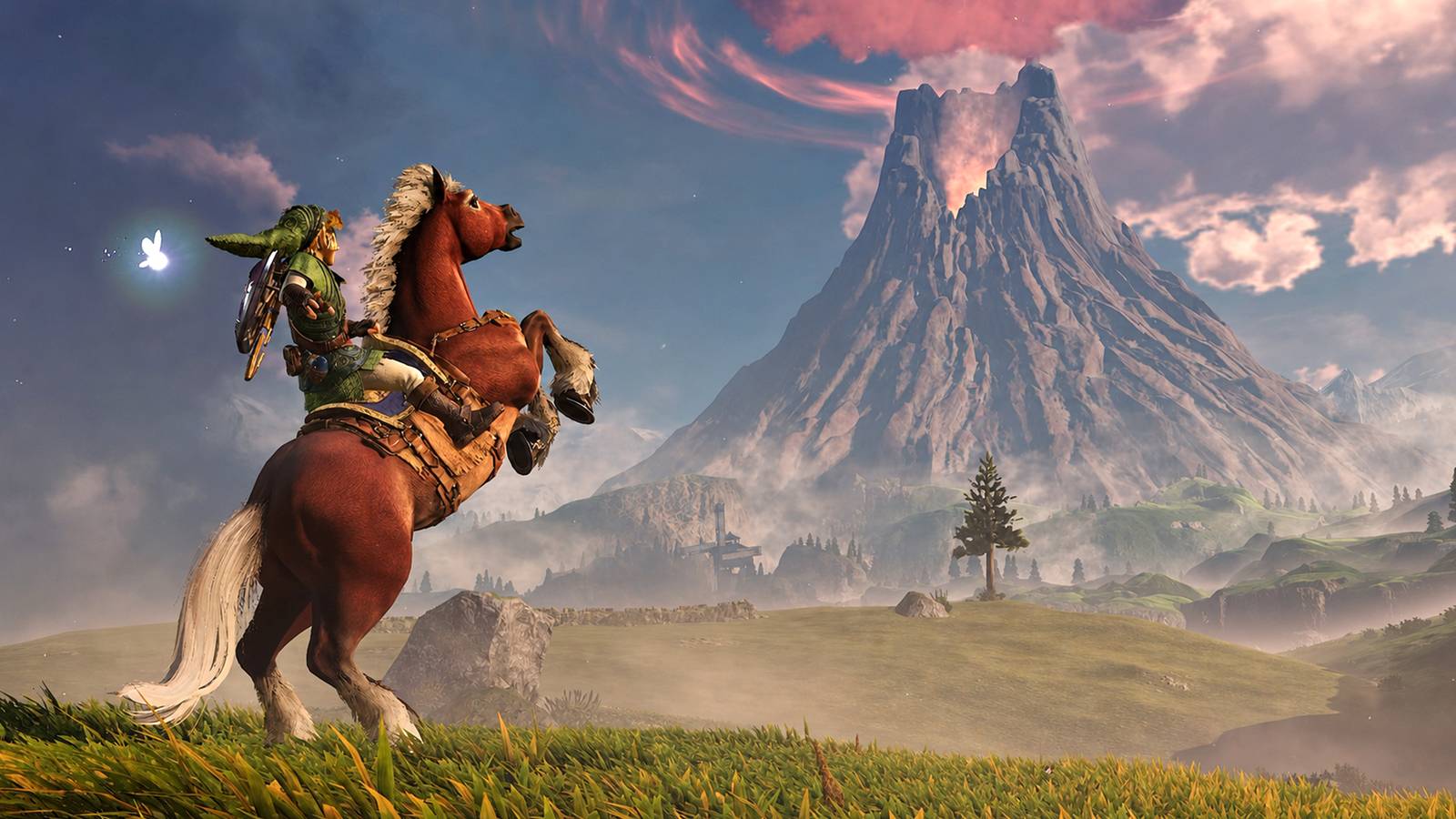
Then came Hyrule Field, which was already massive in the original Ocarina of Time, but the increased draw distance and wider field of view—thanks to the Switch 2’s unprecedented power—made the whole world feel significantly larger. Before, you could absolutely see Death Mountain in the distance, as well as Hyrule Castle itself, but those things in the distance now looked even further away, which gave Nintendo room to add environmental details it couldn’t add before. Shots of Link running through Hyrule Field or riding on Epona’s back in the latest trailer for Ocarina of Time then showcased that draw distance even more, as even the furthest locations could be seen ahead, and they still had incredible detail.
A Free Camera Makes Hyrule Feel Much Bigger Than Before
The biggest surprise, however, was Hyrule Castle Town. In the original Ocarina of Time, the camera was fixed in Hyrule Castle Town, and players had a very small area to move around in. Sure, there were plenty of things to do, like playing mini-games or visiting the shop, but as far as the area itself goes, it was fairly insignificant from a square footage standpoint. In the Ocarina of Time remake on Switch 2, though, not only can the camera now be manipulated freely, but Nintendo even added some back alleys to the area to give players more room to move around in it.
And speaking of the camera, that’s actually one of the best tools the Ocarina of Time remake has to make itself feel bigger than the original. Now that I can freely move the camera around and see everything around me without any restrictions, the spaces themselves immediately feel less confined, even if their actual boundaries haven’t changed all that much. I can look down streets that were previously hidden from me at any certain point, take in more of Kokiri Forest at once, and actually appreciate the full scale of locations that the N64’s fixed camera angles and technical limitations could only suggest.
Then came Hyrule Field, which was already massive in the original Ocarina of Time, but the increased draw distance and wider field of view made the whole world feel significantly larger.
Combine that with the remake’s wider environments, longer drawlines, added paths, and significantly greater level of detail, and Ocarina of Time just feels much larger overall without Nintendo having to tear down every wall separating one part of Hyrule from another. That’s ultimately what I wanted from this remake anyway. I didn’t need to be able to walk from Kokiri Forest to Death Mountain without ever seeing a loading screen. I just wanted the Hyrule I remember to finally look and feel as big as it did in my head when I was 11 years old.
And after seeing the Ocarina of Time remake in action, I’m convinced Nintendo made the right call by stopping there. Breath of the Wild proved that Zelda can work brilliantly as a massive open-world game, but that doesn’t mean every Zelda game suddenly has to become one. Part of what makes Ocarina of Time what it is comes from the way Hyrule is divided into distinct places, each with its own identity, pacing, and sense of discovery, and turning all of that into one enormous uninterrupted map could have changed far more than Nintendo needed to change. Instead, this remake seems to be taking the Hyrule that was already there and giving it the space, detail, and perspective the original hardware couldn’t. Somehow, that’s making a game I know almost by heart feel bigger again, and Nintendo didn’t need an open world like Breath of the Wild to pull it off.

- Released
-
November 5, 2026
- ESRB
-
Everyone 10+ / Animated Blood, Fantasy Violence
- Developer(s)
-
Nintendo
- Publisher(s)
-
Nintendo