




If you ask anyone who’s spent real time in an MMO raid group what the worst role to main is, healer always wins by a landslide. Not because the class design is bad, as healers are often some of the most mechanically rich archetypes in the game and can provide a huge amount of value to virtually any setup, but because the job comes with all the responsibility and none of the control. That specific, deeply relatable misery is the entire premise of one of Steam’s best-reviewed games of the last few months: Master Healer Kale with useless party. Taking the concept of a healer struggling to keep the whole party alive, you get to be the real difference maker in a variety of dungeons and boss battles that feel very akin to those in a much larger game.
What the game really aces is the feeling of trying your absolute hardest to sustain the health bars of a larger group, yet still failing due to the incompetency of the team. You can execute a perfect rotation and still watch your party wipe because the tank pulled two packs instead of one, or the DPS stood in the fire for too long, or another one of your melees decided to forgo their set role, but whatever the problem, when the group dies, the healer always gets blamed. On the flip side, if you manage to make it all the way to the end of a tough raid through the skin of your teeth, then nobody notices the buffs and peeling that the healer was providing from the backline. It’s thankless work by design, and it’s been that way since the industry’s earliest days, and continues to exist in every genre from MOBAs to classic MMORPGs, and now in Master Healer Kale with useless party on Steam, you get to experience that same feeling, only with far more satisfaction in the end.
Master Healer Kale with useless party Knows Exactly the Pains of Being a Support

It doesn’t matter what game genre you look at, healers are always the punching bag. Supports being bullied or cast aside has been a phenomenon since the earliest raid guilds in EverQuest and World of Warcraft. Despite people discovering that healer queues were always shorter than DPS queues, nobody wanted the job of cleaning up everyone else’s mistakes with no acknowledgment, and even when later games tried to soften the role, like in Final Fantasy XIV where healers have actual damage rotations to make the class feel proactive rather than purely reactive, the core dynamic never really went away. You are, structurally, the only person in the group whose failure is immediately and visibly fatal to someone else, which means that if a warrior messes up and dies, the finger is still being firmly pointed in your direction.
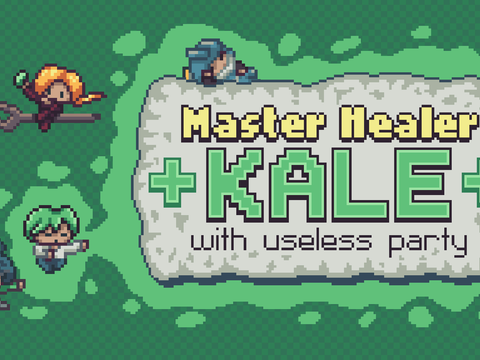
Master Healer Kale doesn’t try to fix that dynamic; it leans into it as comedy. The “useless party” isn’t a mean-spirited comment like it is in so many other RPGs, but the joke the entire game is built around. You play Kale, tasked with keeping a party alive on its quest to take down a Demon King, and your teammates are, to put it lightly, a liability. The tank is perpetually asleep at the wheel, the archer is a green newbie who can’t be trusted to aim, and the party’s mage is talented but insufferable, none of whom are going to save themselves, and all of them are, at some point, going to do something that puts your entire run at risk.
Master Healer Kale’s Incremental Nature Perfectly Captures the Power of Healing
Under the hood, it’s an incremental game, and that design choice turns out to be one of its smartest. You’re not manually timing every heal in real time so much as building out and optimizing a skill tree with more than 200 upgrades, 18 active spells split between healing and support, and stat investments that ripple across the sixteen-plus dungeons. It’s the loop of an MMO healer’s UI that incorporates elements like watching health bars and deciding whether to save a cooldown or burn it now, compressed into something you can chip away at in short sessions.
What makes the game really land, though, is how accurately it channels a piece of MMO history that’s rarely the subject of the games themselves. Healer burnout and frustration have been a topic of debate for decades, and no matter what skill level your party is or how complex the raid may be, there is always a sense of tension surrounding who is making the real mistakes when things go south. Master Healer Kale understands this all too well and removes all the uncertainty by making the healer the main character, who has all the tools and skills to compensate for teammates who will never learn to dodge. Also, the more satirical nature plays into the idea that the game is fully aware of what it’s parodying, and that self-awareness is a big part of why it’s resonating with so many long-time MMO fans.
When it comes to the actual translation of that player love, judging by the nearly 2,000 Overwhelmingly Positive reviews, a rare feat for a small, four-hour indie release with no marketing push behind it, the game has clearly captured the hearts of countless support players who may finally feel as though their efforts are being recognized. Reviewers keep circling back to that exact idea of validation, as, instead of asking you to endure it, you are the sole reason the party is able to take down monstrous Treants and Demons across the land through the power of healing alone. It isn’t about becoming a multi-classing carry with healing as an add-on, but a classic RPG support who is more than happy to sustain their team through the pain, no matter how bleak it gets.
At under $5 and a fairly short run-time, Master Healer Kale with useless party isn’t trying to be anyone’s next hundred-hour RPG. What it’s doing instead is smaller and, in its own way, more focused, turning two decades of a very specific, very real gaming frustration into a tight, funny, mechanically satisfying tribute that virtually any player, healer or not, can relate to and enjoy. If you’ve ever healed a group that refused to pull back or give you a moment to recover, then you already know exactly what this game is about and should certainly give it a try.
Master Healer Kale with useless party launched on Steam on July 2, 2026 to Overwhelmingly Positive reviews.