



By this point, the PlayStation 3’s run ended more than a decade ago, but its legacy lives on through its many, many masterpieces. Everybody played The Last of Us, MGS 4, Resistance, Infamous, and LittleBigPlanet back in the day, but not every PS3 game was as fortunate. Some of the console’s best releases slipped by unnoticed, becoming little more than footnotes in the PS3’s story.
Even though it doesn’t have the greatest overall library, the PS3 might be my favorite console of all time, and most of that love stems from hidden gems that completely blew away any expectations (also, Dark Souls). These forgotten PS3 games deserve not only to be remembered but also to be celebrated and discovered.
OK, I admit, the title might be a slight exaggeration in the case of some of these games, and I’m sure some folks remember these games. Still, they deserved way more.
Majin and the Forsaken Kingdom Is The PS3’s Ico
And Like Ico, Majin Didn’t Sell Well
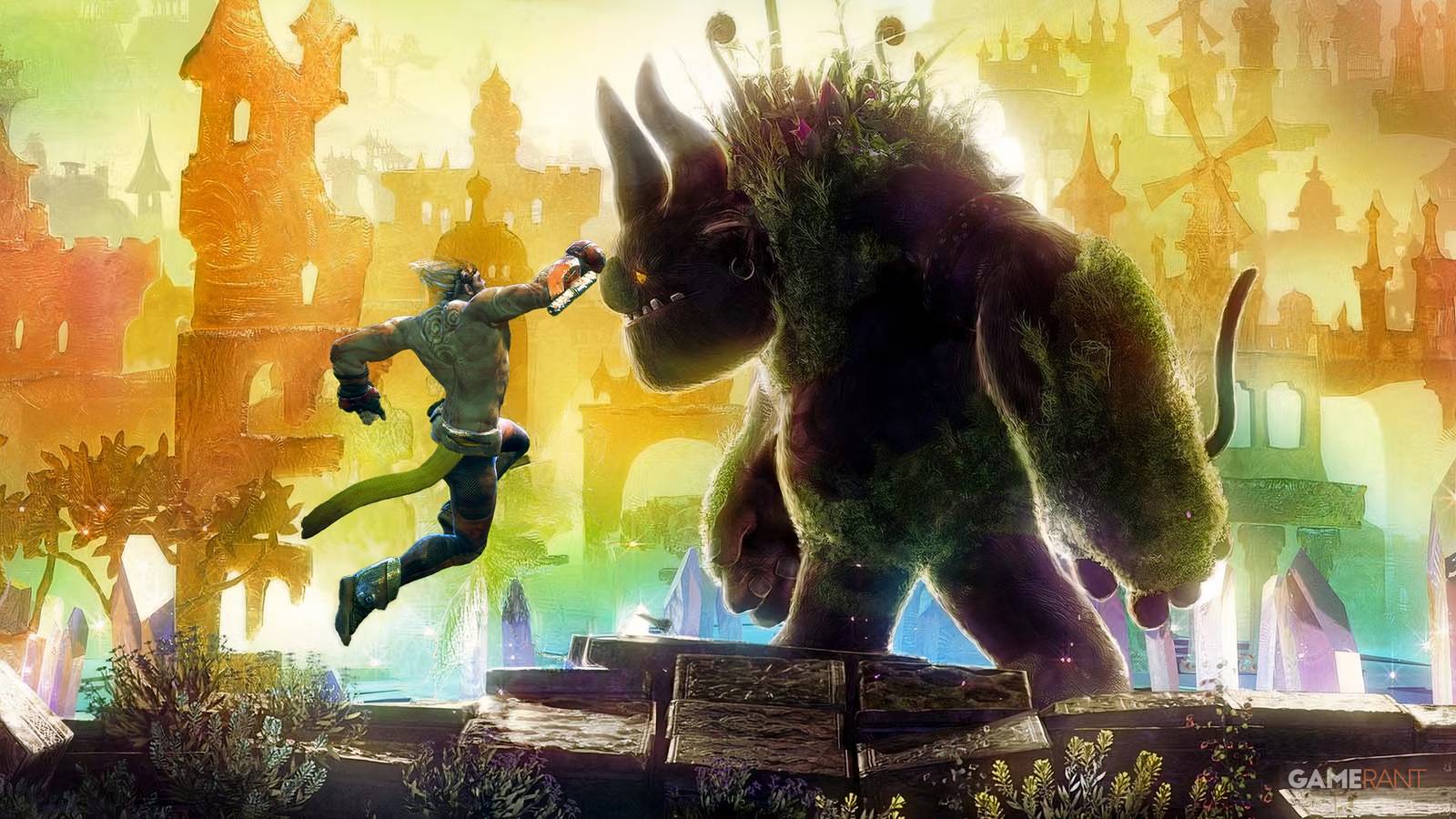
Maybe my memories paint this gem in a more positive light than it deserves, but Majin and the Forsaken Kingdom is one of my favorite PS3 games. Admittedly, I went into it with exactly no expectations, which certainly made it easier to look over its occasional jank and rougher moments. However, as far as Ico-wannabe games are concerned, Majin and the Forsaken Kingdom does it better than most and can sit alongside SCE Japan’s beloved masterpiece.
A buddy adventure that pairs a thief with a gentle forest guardian, the game primarily focuses on puzzles that require coordinating between the two characters. Combat is fairly simplistic, but it fares well when you approach most scenarios and especially boss fights as extensions of the puzzle system. With its vibrant aesthetic and story revolving around the budding friendship between a human and a spirit, Majin and the Forsaken Kingdom feels like a playable Studio Ghibli film, a statement I do not make lightly.
2010 was right in the midst of the gritty cover-shooter boom, leaving little room for colorful, fairy-tale-esque games not connected to established names.
3D Dot Game Heroes Is The PS3’s Classic Zelda Game
It Hasn’t Been Immortalized Like One, Though

There is no such thing as “too many Zelda clones,” and we don’t really get many of them anyway. 3D Dot Game Heroes is among the most blatant attempts to copy Nintendo’s top-down playbook, yet it’s injected with enough unique personality to ultimately carve out its own brand of goodness.
The premise was fantastic, taking place in a kingdom that had recently transitioned from 2D to 3D, resulting in an impressive voxel aesthetic. 3D Dot Game Heroes mostly plays like your standard top-down action-adventure game, albeit with an awesome twist regarding your weapon of choice: the sword. At full health, the sword extends to the point of basically covering the full screen, letting you wreck enemies and environments with a single sweep.
Although it sold pretty well in the United States, 3D Dot Game Heroes is the definition of a cult classic that has largely been forgotten nowadays, largely due to its PS3 exclusivity. This is one game that could really use a remaster.
Puppeteer Saw Off The PS3 With A Stage Show
The Forgotten Swan Song

- Developed by Japan Studio
- Incredible presentation
- Released just two months before the PS4
The Last of Us is regarded as the PS3’s Swan Song, but Puppeteer arguably fits that role better. Not only did it debut right at the very end of the console’s lifespan, but Japan Studio was the definitive PlayStation developer. Even though it mostly played like a side-scroller, Puppeteer boasted visuals that could rival any AAA project of the era, along with a theater motif that instantly set it apart from the crowd.
Although not the first game to use a stage play as a framing device, Puppeteer commits entirely to the premise, convincingly selling the idea that everything we see is a show. Along with rock-solid platforming mechanics, the game introduces a couple of fun gameplay ideas, such as swappable heads that serve as your HP and offer a few different effects.
Honestly, Puppeteer was destined to flop. By September 2013, the cultural zeitgeist had shifted away from the PS3 and onto the PS4, and many folks were already mentally in the next generation.
Folklore Was One Of The First Great PS3 Games
And One Of The First Flops
The PS3 took a long time to justify its existence, and it wasn’t until a few years into its lifespan that it began to build a worthwhile library. Resistance: Fall of Man and Heavenly Sword are typically regarded as the console’s best early releases, but Folklore actually predates both of them, at least in Japan. In North America, it came out between those two games, but it didn’t come close to earning the same reputation (despite Heavenly Sword being a notorious commercial disappointment).
An action RPG and creature-collector, Folklore lets you capture fairytale-esque monsters that can be assigned to your face buttons and used in real-time combat. While it probably could have used a touch more depth, the battle system serves as a fun evolution of the monster-taming formula, and it isn’t any worse than, for example, Ni No Kuni‘s combat. The game even made use of the PS3’s Sixaxis motion controls, making it one of the few to do anything with that technology.
Folklore had a good dual-world premise, solid visuals for the era, beautiful environments, and combat that could easily have served as the foundation for sequels. Like Majin and the Forsaken Kingdom, Folklore is stuck on the PS3, a forgotten delight that will probably never see the light of day through a remaster.
Personally, Folklore was the first game that made me not regret dropping too much money on a PS3. Once I was ready to move past the console, Folklore was still among my favorite RPGs.
Enslaved: Odyssey to the West Is One Of The Best PS3 Games
The Ninja Theory Curse

Unfortunately, we cannot have an underrated/overlooked/nobody-played article without mentioning Ninja Theory, as nearly all the developer’s games struggled to find an audience. I have already mentioned Heavenly Sword, and the team’s next project followed suit, falling short of expectations. Although both games are nowadays treated as cult classics, they came and went during their original runs, earning praise and love but not necessarily widespread attention.
As much as I love Heavenly Sword‘s combat, Enslaved: Odyssey to the West is Ninja Theory’s best game, except for maybe Hellblade. Written by Alex Garland and retelling Journey to the West, the story features one of the best duos from this era, with the brutish Monkey being forced to aid the resourceful Trip. Going from enemies to more than friends, these two have stellar rapport AND combine brilliantly in the actual gameplay.
Post-apocalyptic games were popular during the PS3 era, but they presented wildly different (and more depressing) worlds than Enslaved‘s stunning greenery. The reviews were overall very positive, but the game struggled to get going on launch, and it would take a long while for its legacy to be secured. At least Enslaved is not trapped on the PS3.