




Pinball. The real game of kings. Truly timeless, their design sensibilities date back centuries. Modernized for game halls in the 1930s, these machines have had repeated boom periods. This includes the ‘90s, when they sold the most, and now, as ‘90s kids are get nostalgic and prop up barcades.
They also build on each other’s traditions, especially game design. Modes, multipliers, multi-balls, stacking different kinds of progression to make the most of your jackpots and bonuses. It makes for a complex engagement between rulesets, hand eye coordination and mechanical engineering, but it can also flummox new players. While suggesting you “hit whatever’s flashing” or “stop doing both flippers at the same time” is decent adhoc advice, there are machines that can actually help newcomers practice for more serious play.
Yes, Addams Family pinball is everywhere but it’s unforgiving. Yes, the new Pokémon machine would make a logical entry point if it wasn’t for that nasty left orbit. Here are five pinball games with simpler, well communicated rule sets, are easier to find in the wild and aren’t as punishing on you or your pocket change.
5) High Speed (Williams, 1986) / The Getaway: High Speed II (Williams, 1992)
A Steve Ritchie classic, High Speed follows your noble quest to humiliate cops with a Lambo. To start your street chase, you need to advance the stoplight from “green” to “red” through a selection of very clearly labelled targets. Once you do, lob the ball up the left ramp to kick off a multiball, pursuing the jackpot (one of the earlier machines to marry multiballs and the big prize together).
High Speed is fast, tough but fair. Ritchie loves a ball that feels like a bullet. This game is digestible without dulling its bite. Its 1992 sequel, The Getaway, has a nearly identical layout and rule set, but with the addition of an LCD display, new modes and an eternally amusing magnetically charged ramp loop that just whips that friggin’ ball in circles.
4) Scared Stiff (Midway, 1996)
Going to speak from experience here. Little me at the downtown Sega Playdium (before it was turned into a disgraced nightlife mogul’s pleasure palace) dedicated whole afternoons to perfecting this one. The best of Elvira’s three pinball machines, Scared Stiff has a pared down design, singularly focused rules, but tons of ghoulish delights.
You need to help Elvira fill up the Stiff-O-Meter by challenging the six creeps around the playfield. Zap “The Monster’s Lab” with the pop bumpers, tame “The Boney Beast” with the left ramp, aggravate the creature in the large crate up the middle. Once defeated, a white-knuckle mode is unlocked to gradually fill Elvira’s meter. Clearly marked stakes, it’s a great way to familiarize yourself with basic pinball structure. Crossing off smaller “modes” to unlock the “wizard mode” to pursue the biggest jackpots.
3) Pin*Bot (Williams, 1986)
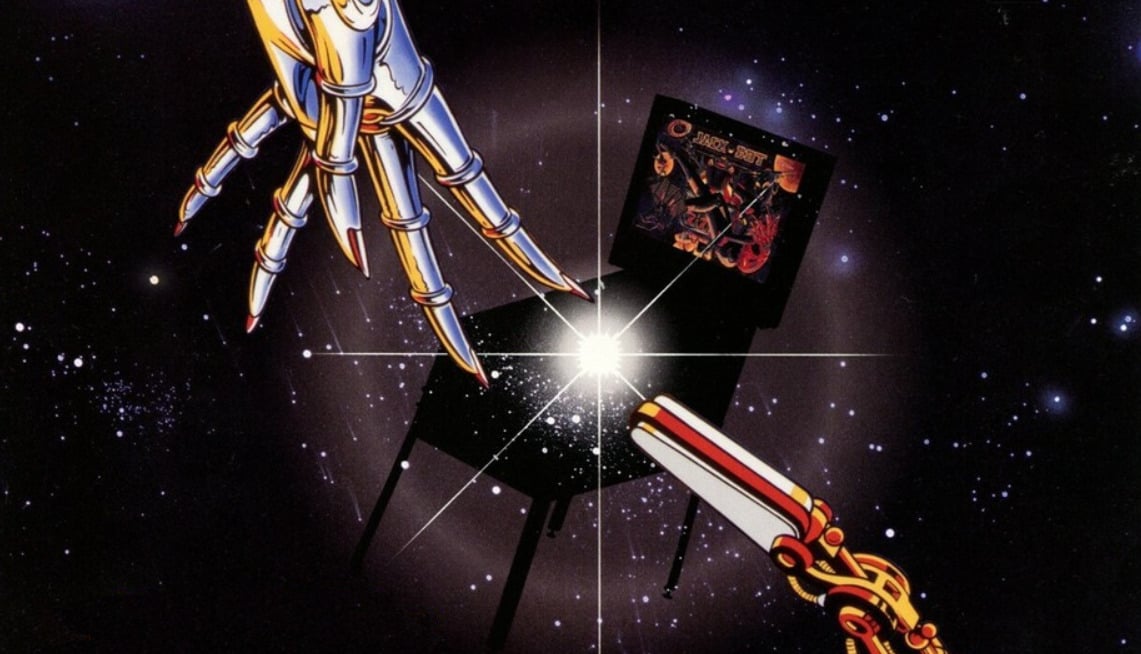
Created by Midway’s in-house weird guy Python Anghelo and inspired by a poem of his own fever dream, Pin*Bot is a sci-fi table with a lot of whimsy. Highly inventive without being over-alienating, with classic design sensibilities and plenty of space to maneuver (in comparison to, say, Funhouse).
In Pin*Bot you explore the galaxy and complete the titular arcade android. Most of the game centers around filling out a grid of lights in the middle of the board by striking matching targets on the right and top. Doing so open’s Pin*Bot’s visor. Lock two balls in its eye sockets to begin a multiball mode for a frenzy of points. It also has a very amusing and easy to decipher skill-shot, a cone-shaped ramp to test your accuracy on the plunger.
2) World Cup Soccer (Midway, 1994) / NBA Fastbreak (Williams, 1997)
Want to know a really good way to familiarize yourself with a new game? Mirror a more popular one! World Cup Soccer is regarded as one of the friendlier machines out there. Commemorating the 1994 US Cup and its cartoon dog mascot “Striker,” you progress by challenging different countries and traveling between host cities. Each event has slightly different rules but mostly revolve around getting the ball past the goalie near the top.
A similar but much stranger machine is NBA Fastbreak. Truly unique, instead of having a traditional score, the only points in Fastbreak are the shots you sink into the net in the middle. Weaving around the competition with a network of ramps, dunking and nailing three pointers, it’s a fast-paced and easy to pick up machine. If you’re really lucky you’ll find two of them placed side-by-side, unlocking an exclusive simultaneous multiplayer mode that’s broken down into timed periods. Ball life instead of ball’s life.
1) Medieval Madness (Williams, 1997)
Some consider it the greatest pinball machine, but to my mind what makes Medieval Madness exceptional is how seamlessly it works as an entry point without sacrificing any excitement. A Brian Eddy and Lyman Sheats joint, Madness boils down the fundamentals into a well-communicated and symmetrical table, all tied together with a giant castle prop that explodes. Plus, Tina Fey’s first acting credit (the damsel).
In Medieval Madness you are out to destroy the King of Payne, knocking out his dukes and earls in your warpath. To take down a castle, you need to rile up the people. Win jousts, launch catapults, slay dragons, best trolls and riot. There are only a few ramps, orbits and targets, and each are associated with one of these “madnesses.” Hit any of them three times to unlock Multiball Madness, your chance to take out a royal. You can coast through the game with your most comfortable shots, but the more madnesses you stock up on before multiball, the more balls, jackpoints and big points will be available.
It’s an elegant, uncomplicated system that offers something for rookies to rule over, but escalates into something very savory for experienced players as well. It’s a style of game that was common for Eddy and Sheats (Attack from Mars and Monster Bash are excellent for similar reasons), but Medieval Madness is far and away the best choice for first-timers.