








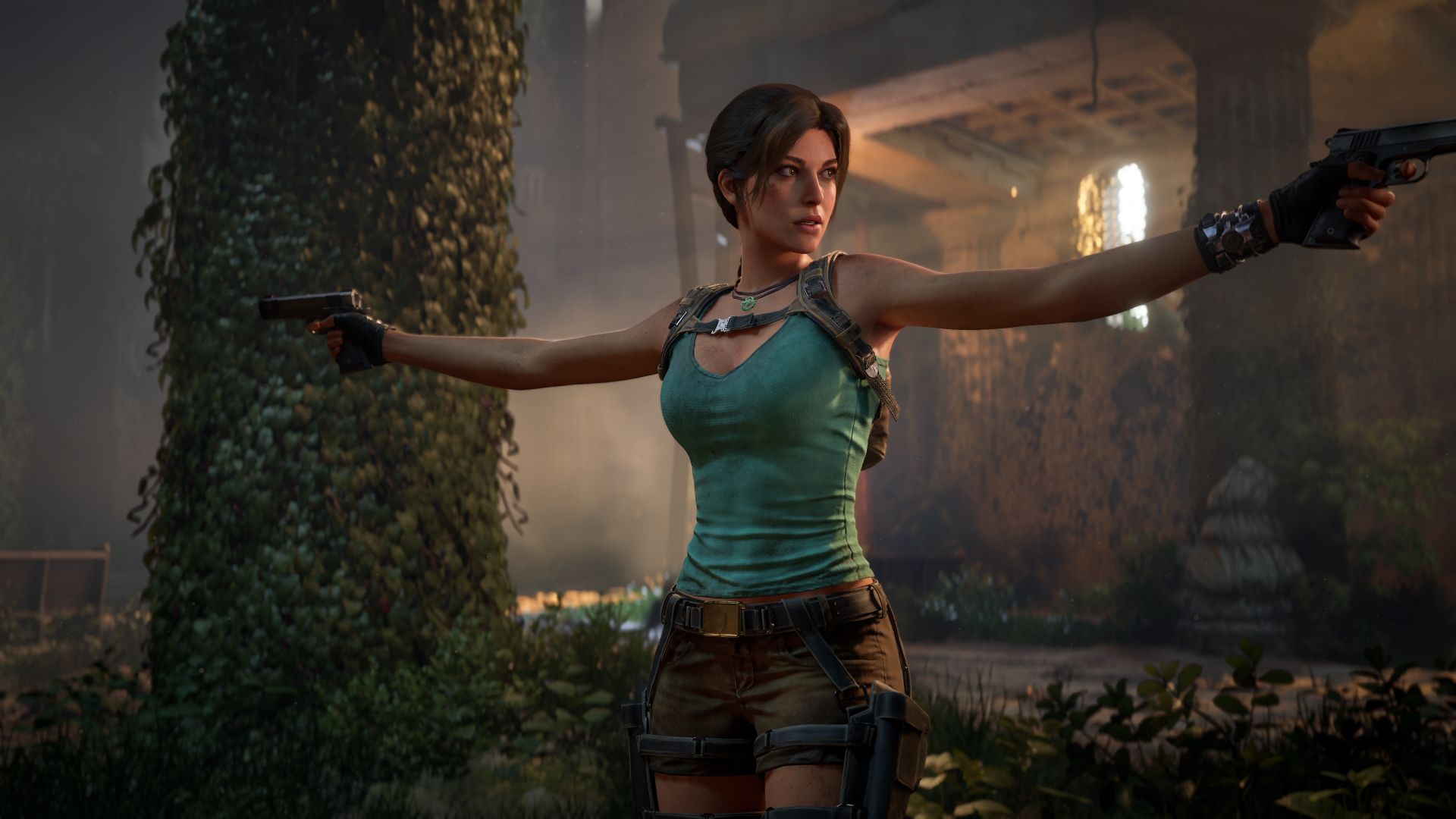
We are getting grimly used to seeing game developers attempt to justify their use of generative AI in production, usually after the fact as supposed “placeholder” assets are found in finished games, and more recently with the pre-release damage control we’ve seen around Crazy Taxi World Tour and Tomb Raider: Legacy of Atlantis. One of these justifications was recorded in a video by Game Informer at Summer Game Fest. It shows how talking points in pre-baked statements quickly fall apart under the scrutiny of a live conversation, revealing something game journalists frequently experience but is very rarely caught on camera.
Following the Steam disclosure that Crystal Dynamics’ remake of the first Tomb Raider adventure involved the use of genAI tools, pretty much every gaming outlet with feet on the ground at Summer Game Fest put a simple question to the developer: why? As you can see from articles that went up on June 11, senior developer Jeff Adams was given a specific line to say in response every single time he was asked. Game Informer, however, recorded this line being delivered and the surprising thing that happened when someone dared to ask a follow-up question.
“At Crystal Dynamics, we see AI as a tool that can help our team get to right answers faster,” says Adams when asked why Legacy of Atlantis could possibly have needed to use the plagiarism machines on a series the studio has been making without such tools for many years. He continues, “So say in early level development we have an idea for an object, but we’re not sure whether or not we want to take the dev time to build it: We can use a generative AI tool to help us visualize that object in the world, and if it works we’ll then move it to our traditional pipeline. From there the team will concept it, they’ll build it, and we’ll make sure that all the finished content in the final game is human crafted.”
He finishes up with the line Crystal Dynamics PR were clearly hoping most sites would include: “It’s really important for us that our team have the tools to make the highest quality experience possible; our fans deserve nothing less than that.”
It’s a boilerplate reply, designed to sound like it’s addressing the question but ultimately talking around it, and finishing off with a declaration of “Therefore we’re making our fans happy.” In such circumstances, it’s standard journalistic procedure to follow up, to see if it’s possible to get an actual answer to the question, or to press further to see if the given response really holds up. This is what GI does in the video above: “And so when you drag that generative piece into the engine, does it have scripts attached to it? Or is it more-so an environmental art tool in that procedure?” In other words, “Is it really as simple as saying you did the modern equivalent of cut out pictures from magazines, or are you actually using AI to code these assets and then replacing the art later?” You can immediately see Adams start to get uncomfortable.
This is no criticism of experience director Jeff Adams! He’s been put in a shitty situation with a scripted response to a tough question, and has most likely been told not to deviate from the party line. The question, which I suspect he wants to clarify as it wasn’t entirely clear, causes the PR rep to catch his attention and stop him from answering, before the spokesperson jumps in and very firmly says there won’t be any further response. It’s such a strong reaction to such an innocent question, but anyone who’s interviewed developers of unreleased games before will have experienced it countless times.
Stick to the plan
Game demos and interviews are often heavily scripted, leading to frustrating experiences for journalists looking for interesting, original quotes and personal reactions from developers. It demands an effort to push past the prepared responses in search of something unique that they can write and that their audience will find worth reading. Even the most positive questions—”This aspect of the footage was so interesting! Can you tell us a bit more about what inspired that choice?”—can have a previously silent person PR rep leaping out of their chair to explain that it’s time for the interview to end, or pointedly ask for the topic to change.
Anything that doesn’t match the planned strategy for this “wave” of the “campaign” must be nipped in the bud, because the press are viewed as a means to get out promotional materials according to the carefully scheduled plan. When it’s about damage limitation, as is the case in CD’s AI debacle, it’s even more heavily policed.
“I think we’ve said all we want to say about it now,” is such an aggressive response from the PR rep in the room. It potentially leaves the GI reporter feeling like they need to apologize for even asking such an innocuous question and chastised for this indiscretion, a perception that may be underlined by what comes next. “Once the game comes out and everyone can see how amazing it is, we’d probably be more comfortable…I think in this early moment I just…I wouldn’t want us to, like, start talking about that.”
Presumably we also shouldn’t ask about the financial impact of the cuts from Amazon until we know “how amazing” the game is. Or whether this use of AI has played any part in the studio having had four rounds of redundancies in a single year? Both questions I’d have wanted to ask were I in the room, and questions that would have similarly prompted the PR reps to act and ensure they not be answered, with the intention that such topics would be left out of any preview article I’d have written about the game. It’s their job to do this, and to them the games press is, like AI, a tool to help their team.
That’s something Game Informer has calmly reflected in releasing this video footage.
