



There may not be many PlayStation exclusives in the PS5 generation (only around 10 or so), but there used to be a lot more for each of Sony’s home consoles. We’re talking in the dozens, if not the hundreds. Many of those games became console classics, inseperable from the system where they originally appeared, even if they were ported to later-generation systems afterwards.
However, with all those exclusives, some of the great ones will inevitably fall through the cracks. That was the unfortunate fate of these PlayStation exclusives. Yet despite their sales numbers, these are all great games that still hold up today. If you’re looking for a forgotten masterpiece that can bring you back to the days of abundant PlayStation exclusives, these are the games to check out.
Scratch & Peek
Identify the cover art while scratching off as little foil as
possible.
Resogun
The Last Gasp Of The Shmup

Resogun

8/10
- Released
-
November 15, 2013


Even though it was also released on the PS Vita, Resogun was marketed as a launch title for the PlayStation 4. Launching alongside big-name titles like Assassin’s Creed 4: Black Flag, Call of Duty: Ghosts, and Battlefield 4, along with smaller indie darlings like Contrast, Resogun was an interesting inclusion in the PS4’s early library. The shoot ’em up (shmup) genre had already lost its early-years popularity, and Resogun felt like an attempt to recapture some of that glory while introducing some innovation for the shiny modern console generation.
Sadly, of all the PS4’s launch titles, this one fell flat, and undeservedly so. As far as shmups go, this really is a modern standout. Developed by Housemarque, it takes an interesting side-scrolling perspective that works really well for introducing newcomers to the genre, but provides a ridiculously high skill ceiling for genre veterans or those who just want to master the game’s systems. There’s not much of a story to speak of, but the gameplay speaks for itself, offering tense, satisfying scenarios that burn bright and don’t overstay their welcome.
Resistance 3
The “Halo Killer” That Never Got Enough Credit

Even before the public got their hands on the first game, Insomniac’s Resistance series was seen as PlayStation’s bid for their own Halo-esque first-person shooter. The resemblances were too numerous to ignore: a formidable alien threat, strange sci-fi weaponry, and pulse-pounding set pieces. While the first two games were fairly well received (albeit not to Halo levels), things dropped off significantly with Resistance 3.
The crazy part is that, unless you really love the world-ending stakes of the first two games, Resistance 3 is the best game in the series. It has the best arsenal of weapons (including some really creative, Insomniac-coded guns), the biggest set pieces, and the most personal story of the bunch. That personal element does reduce the scope of the narrative a little bit, but it also means you connect with the characters a lot more. The Resistance series just lost its momentum between 2008 and 2001, and Resistance 3 was the unfortunate victim.
Fat Princess
Innovative Multiplayer Ideas Left Unappreciated

There has never been another game like Fat Princess. Take Capture the Flag, add in a roster of character classes, a bunch of cake, and some bombs, and that’s essentially the gist of this criminally overlooked multiplayer experiment, but the complete package really is greater than the sum of its parts. It’s hard to say who this game was for, which is probably why it didn’t do very well, but boy was it ever fun.
Your “flag,” in this case, is your princess, held captive in the enemy’s castle. You’re also holding their princess captive, but this stalemate won’t last long. You and your team charge across one of eight brilliantly creative maps, trying to rescue your princess. Along the way, you’ll find hats that denote your class, featuring everything from rangers and warriors to dark mages. Combat is surprisingly bloody for the art style, and items like bombs only amplify that feature. The real twist, though, is playing defense. You need to physically carry your princess back to your castle, so to slow you down, the other team will feed her a bunch of cake, which makes her fat. The fatter she is, the slower you move while carrying her. Fat Princess really is a hidden gem from the PS3 days. It’s not an easy game to play today, but the servers are still functioning if you can get your hands on a copy.
Gravity Rush
Still The Best Flying Mechanic In Gaming
As far as underrated PlayStation classics go, few are more beloved than Gravity Rush. Created by Keiichiro Toyama (the mind behind Silent Hill, of all things), this superhero JRPG stars Kat, an amnesiac girl who discovers that she has the power to control gravity (with the help of Dusty, her cat).
In the era of the MCU and superhero TV, Kat’s origin story isn’t anything new, but it’s still done well and will have you rooting for her as a protagonist. The real draw here, though, is the gravity powers. Gravity Rush is built around a system that lets you control the direction gravity pulls you. Make it pull you upwards, and you fly up into the air. To the side, and you’ll soar across the horizon. You get the idea. It takes a bit of getting used to, but once it clicks, this is truly one of the greatest flying mechanics ever put into a video game. You’ll be amazed at how much control you have in the air, and it makes combat a blast, even if the enemies are fairly generic. Originally a PS Vita exclusive, Gravity Rush was remastered for modern home consoles in 2015, which is the best version to play today.
3D Dot Game Heroes
A Pitch-Perfect Zelda-Like With Some Wild Ideas

From previews to reviews, 3D Dot Game Heroes was presented as a Zelda-like, taking the formula for Nintendo’s iconic franchise and effectively adopting it 1-to-1 for PlayStation systems. Is that an accurate description? In many ways, yes, but 3D Dot Game Heroes has so much more going for it. This game proudly wears its influences on its sleeve, but it also satirizes them mercilessly.
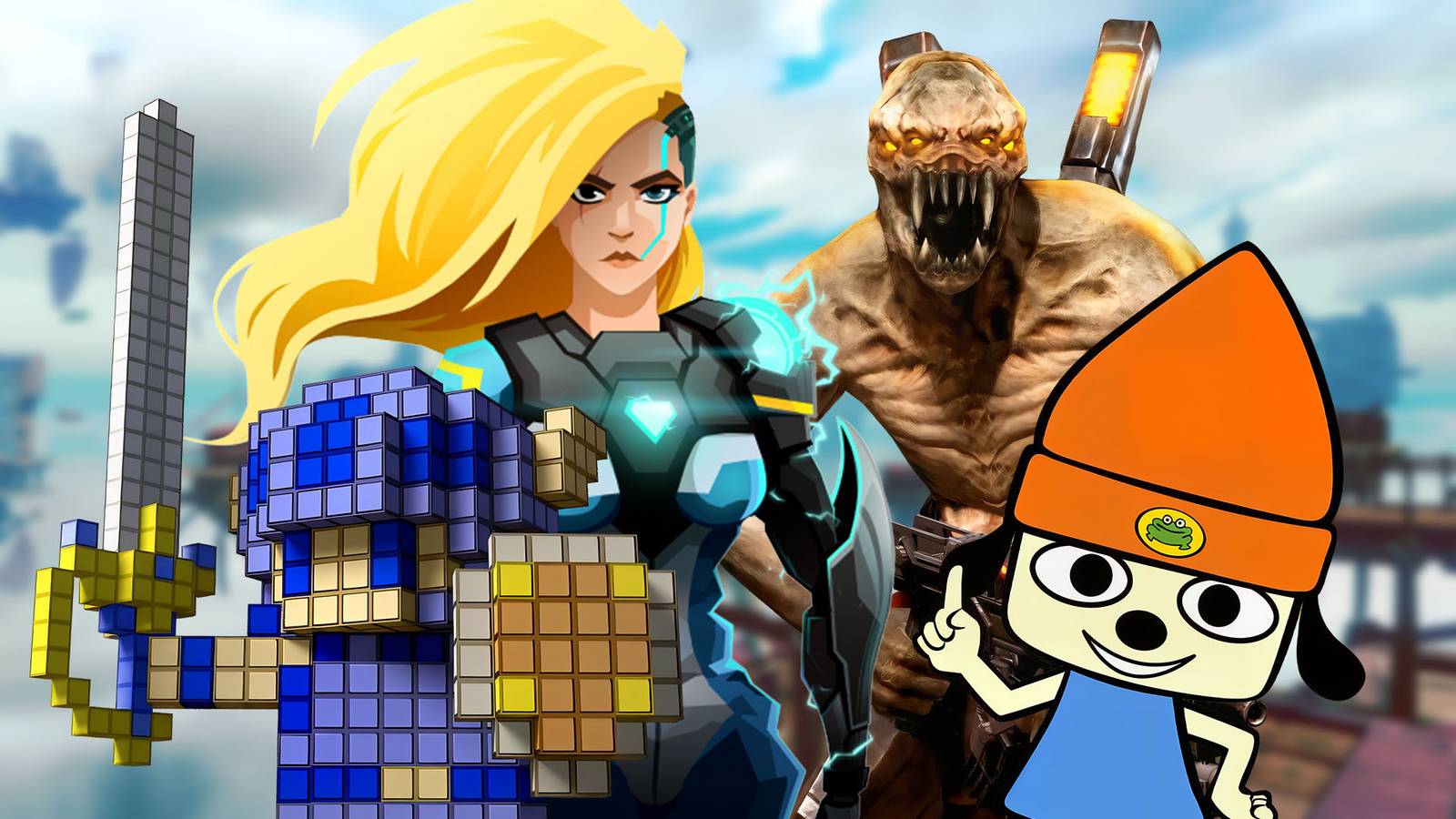
Yes, there are the staples like a hookshot, bombs, an open world that gradually expands as you acquire new items from dungeons, and so on. But 3D Dot Game Heroes is very aware that it’s familiar, and it also pokes fun at all the games that inspired it, and even some that didn’t. Combat is fast and challenging, and the overworld is full of secrets to discover. This isn’t a game for those who want a Zelda game on PlayStation; it’s a game for Zelda fans, and video game fans in general. Did the game’s title and obvious inspirations turn many players away? Probably, but unfortunately, they missed out on a love letter to gaming that almost anyone, from any generation, can enjoy.
PaRappa The Rapper
Most People Know The Name, But Few Know The Game

Rhythm games are a niche, but they’re also a staple in the gaming industry. Dance Dance Revolution was a, well, revolution, extending beyond arcades and home consoles and becoming a physical challenge above all else. Guitar Hero dominated the late-2000s era and provided some of the most iconic gaming moments of the era (there’s a reason why “Through the Fire and Flames” is still so recognizable today). Yet the game that started it all and pioneered what we know as “rhythm” gaming was none other than PaRappa the Rapper. This game was really only a big hit in Japan, where it sold over 1 million copies. However, it barely cleared 200k sales in the West over its first six years, which hurt its international reputation.
The titular Parappa is on a quest to win the heart of his childhood crush, Sunny Funny, and what better way to do it than to rap battle? While the gameplay is pretty simple, there is a certain knack to timing button presses to the beat. But it’s the quirky aesthetic—with 3D backgrounds and 2D characters walking around like paper cutouts—that makes this game so timeless, and yes, it is still fun. PaRappa the Rapper was remastered for the PSP, and later for the PS4 and modern consoles, but if you have access to a PS1, that’s still the best way to experience it.
Velocity 2X
The PS Vita Masterpiece That Never Caught On

We’re making a bit of an exception here. Velocity 2X was also released for the Xbox One, Nintendo Switch, and PC, but those ports were published by Activision, Sierra Entertainment, and Curve Digital well after the game’s initial launch. Originally, this was a PS4 and PS Vita exclusive, and it was criminally unappreciated at the time. Hell, it still is. Part top-down shooter, part 2D side-scroller, with a hint of Metroid thrown in for fun, Velocity 2X is the kind of game that takes over your brain and won’t let go until every level is completed.
Velocity 2X is a game about speed: moving quickly, fighting quickly, and completing levels quickly, all as flawlessly as possible. Split between top-down levels in your teleporting ship and 2D action platformer levels when you’re outside of it, your goal is to complete each mission, collect each rescue pod hidden within, and defeat every enemy, all in as little time and with as few mistakes as possible. Smooth controls make that perfectly attainable. Velocity 2X is officially a sequel to 2012’s Velocity, but it stands perfectly on its own and is one of the most satisfying shmups on PlayStation consoles.
Folklore
An Innovative RPG With A Forgettable Name

Boasting a surreal blend of Alice in Wonderland, Castlevania, and Alan Wake, Folklore is easily one of the PS3’s most overlooked action RPGs. Released in 2007, early in the console’s life cycle, Folklore has the unfortunate distinction of both having a very unremarkable title and launching in one of the busiest and best years in video game history. When competing with legends like BioShock, Super Mario Galaxy, Mass Effect, and Valve’s Orange Box, Folklore never stood a chance.
One-part visual novel and two-part action RPG, Folklore follows Ellen and Keats as they investigate a series of murders in the village of Doolin. Eventually, these characters slip into the Netherealms, a collection of surreal worlds that house Folks, the game’s enemies. This is where combat comes in, and while it starts out like a typical action RPG, by defeating Folks you unlock their combat abilities, which you can then assign to the PS3’s face buttons. This allows for a lot of really interesting experimentation options, especially as battles grow more complex as the game goes along. Folklore is one of those games that’s just stuffed with brilliantly creative ideas, but sadly, in a banner year like 2007, it never broke through in the way it deserved.
Starhawk
A Badass Sci-Fi Shooter That Flew Under The Radar

Who doesn’t love a good space western? Even better if it has some cheesy one-liners and transforming spaceships, right? Well, that’s exactly what Starhawk provides (literally, that’s the entire concept), but somehow, it went entirely overlooked in 2012. The narrative may not be much to celebrate, but when a game embraces its concept this well and provides this many options for creativity in the middle of a battle, the lore behind the battle stops mattering quite as much.
Despite being a spiritual successor to Warhawk, Starhawk features a blend of third-person shooting, air combat, and RTS elements. In the heat of battle (or at any point, really), you can call in buildings that crash down from the sky. These can act as cover, resupply stations, and more. Meanwhile, the titular Hawks can transform between multiple forms, including airships, hoverbikes, and plenty of other options. While there is a single-player campaign (and it’s pretty fun), the main attraction is the multiplayer, where your knowledge of which structures offer which benefits and how to use them effectively is put to the test. Given its lackluster performance, Starhawk’s servers were shut down in 2018. However, a small team of passionate fans got them back up and running last year. If you’re interested in checking out Starhawk, there’s no better time to do so.