






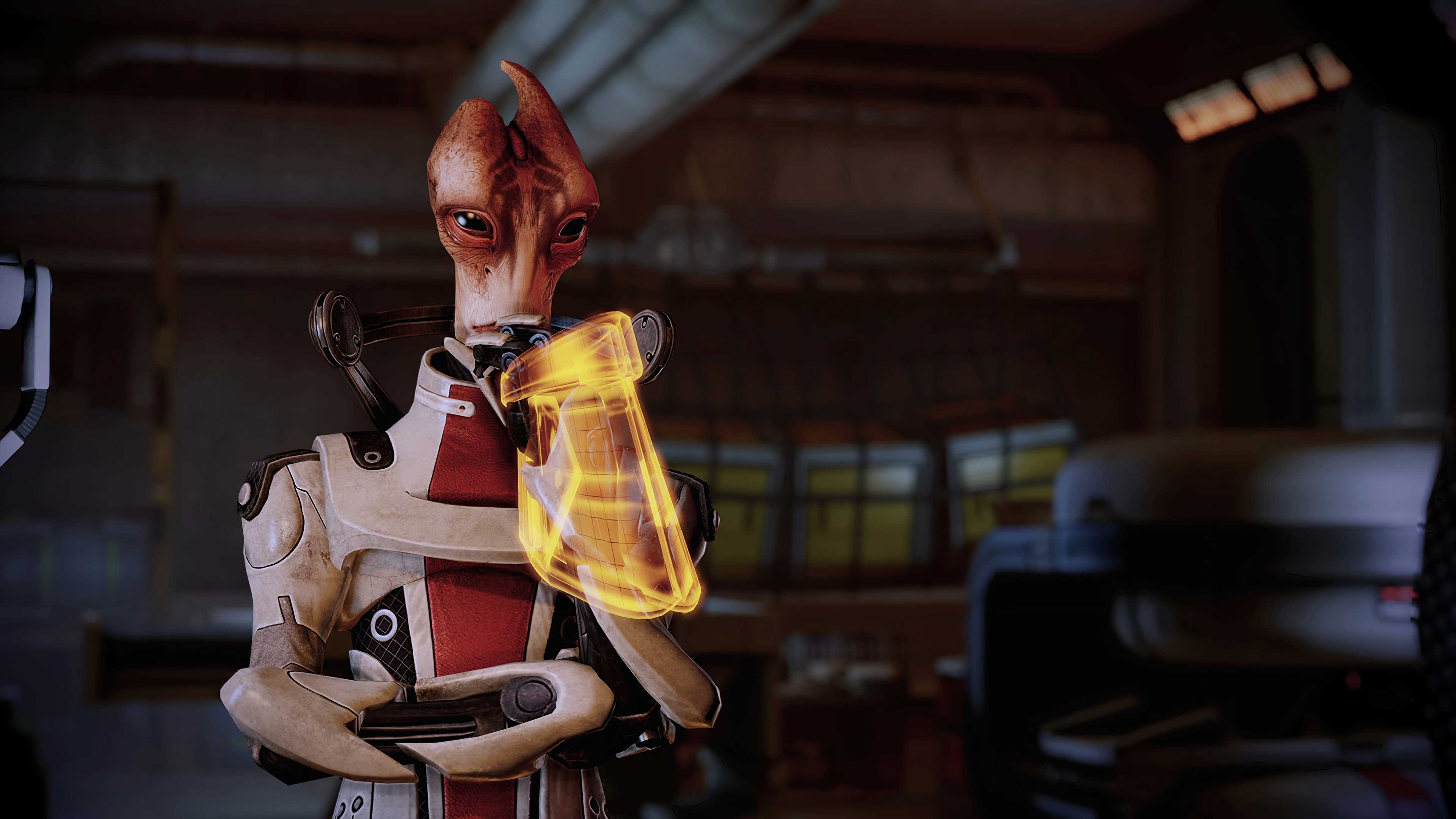
Mass Effect 5 is probably the most hotly anticipated single-player game that EA has, and yet, there’s a growing chance it will never see the light of day. As someone who considers himself a super fan of the original Mass Effect trilogy, it’s heartbreaking to admit, but a cancelation is looking more and more likely.
There are a few good reasons to fear for Mass Effect 5‘s future. For one thing, BioWare’s output has been on a steady decline for at least a decade: Mass Effect Andromeda and Anthem, while not without their fans, were critically and commercially panned, and Dragon Age: The Veilguard didn’t fare much better. Gone are the days of Mass Effect 2 and Dragon Age: Origins, when BioWare was basically untouchable. We also haven’t gotten so much as a proper trailer for Mass Effect 5, despite it being announced via a teaser nearly six years ago. A new development at EA, which owns BioWare, threatens to radically recontextualize these shortcomings, to the great detriment of the storied studio.
EA’s Saudi Buyout Isn’t Doing Mass Effect 5 Any Favors
-
 Image via BioWare
 -
 Image via BioWare
 -
In August 2026, the purchase of Electronic Arts by the Saudi Arabian investment fund Public Investment Fund (PIF) was finalized. The firms Silver Lake and Affinity Partners, the latter owned by President Trump’s son-in-law Jared Kushner, also participated in the purchase, gaining minority holdings in the publisher. At $55-billion USD, it was the largest leveraged buyout in history.
There’s a lot to dig into here. Even if we set aside the reputations, political alignments, and perceived ethics of those like Kushner and Saudi Prince Mohammed bin Salman, there’s reason to believe that EA is about to be greatly “optimized” for profitability. Again, this was the greatest leveraged buyout of all time: a leveraged buyout is when an investment firm acquires a great deal of debt in order to purchase a company. This debt is then transferred to the company being acquired, as it is the entity expected to pay it off, so to speak.
In the case of the EA deal, this means an increase in debt from roughly $1.5-billion to roughly $20-billion, a sum that will accrue nearly $2-billion in interest per year. If EA wants to stay afloat, drastic cost-cutting measures will likely need to be implemented, and the hit-and-miss BioWare must be getting eyed for the chopping block.
Mass Effect 5 Might Not Save BioWare
Not for nothing, but Emmanuel Rosier, former senior manager at EA and current Director of Market Intelligence at analysis firm Newzoo, recently spoke with PC Gamer about his doubts regarding BioWare:
“They’ve been struggling as a studio, as a brand have been struggling in recent years, and I don’t know if they will keep funding that one. I think that’s the biggest question mark for me.”
He would go on to essentially say that anything is possible, but maintained a bleak outlook:
“I’ve worked many years with BioWare, sometimes it can stretch for years and years until something comes. I think everything can happen at this moment. They can pull the plug very, very easily. And if the new investor, they don’t have that many feelings about the history of the portfolio, they will take the most financially sound decision most probably.”
That pretty much sums it up: EA, now aligned with private equity, is going to prioritize “the most financially sound decision” moving forward. The company has certainly done this before—anyone who has played one of EA’s microtransaction-ridden games can attest to that—but that might be just the beginning. The company never had the incentive of $20-billion in debt.
Like before the purchase, EA will probably continue to prioritize its sports games, especially EA Sports FC (formerly FIFA), which is immensely, globally profitable. Development costs for a studio like BioWare, which hasn’t released a proper hit in over ten years, will probably not be deemed “financially sound.” The circumstances of this deal, EA’s own history, and the fact that Rosier seems confident in EA’s ability to “pull the plug” on ME5 this late in the game, all point to the company being more risk-averse moving forward. Right now, as painful as it is to say, funding a big BioWare RPG is a big risk.
If BioWare Dies, So Does EA’s Soul
I don’t mean to sound dramatic, but the end of BioWare would also probably mean the end of Electronic Arts as we know it. Simply by looking at EA’s release portfolio and comparing it to a decade or two ago, it becomes clear that its focus has shifted away from the artistic emphasis that is apparently its namesake. It has long since slowed its rate of single-player releases, while top-selling multiplayer and GaaS properties like Battlefield, Madden, and FIFA seem to be launched and supported as usual.
Right now, as painful as it is to say, funding a big BioWare RPG is a big risk.
Even at their best, these properties do precious little to move the gaming medium forward, and serve as prime examples of what happens when you treat games like disposable products rather than works of art. You may have been able to say that Battlefield was once innovative and revolutionary, but today, it is just another multiplayer FPS franchise, albeit a fairly good one. And Madden and FIFA are so far removed from the concept of boundary-pushing that their respective releases are hardly distinguishable from one another.

But they make billions of dollars annually, figures that BioWare, even at the height of its success, could only dream of achieving with such regularity. If you cast aside concerns like the legacy of such an important studio, the years of work already poured in to Mass Effect 5, the artistic integrity of a video game company and of gaming as a whole, and the livelihoods of hundreds of developers, artists, and producers, then it makes perfect sense to close BioWare.
I highly doubt that EA’s leadership, much less the company’s new owners, will have any trouble setting aside such concerns when evaluating BioWare as an asset. It might be logical, but ditching BioWare would amount to a symbolic surrender from EA, an admission that it doesn’t care about powerful, meaningful, or emotionally resonant gaming experiences, just financially sound decisions.