

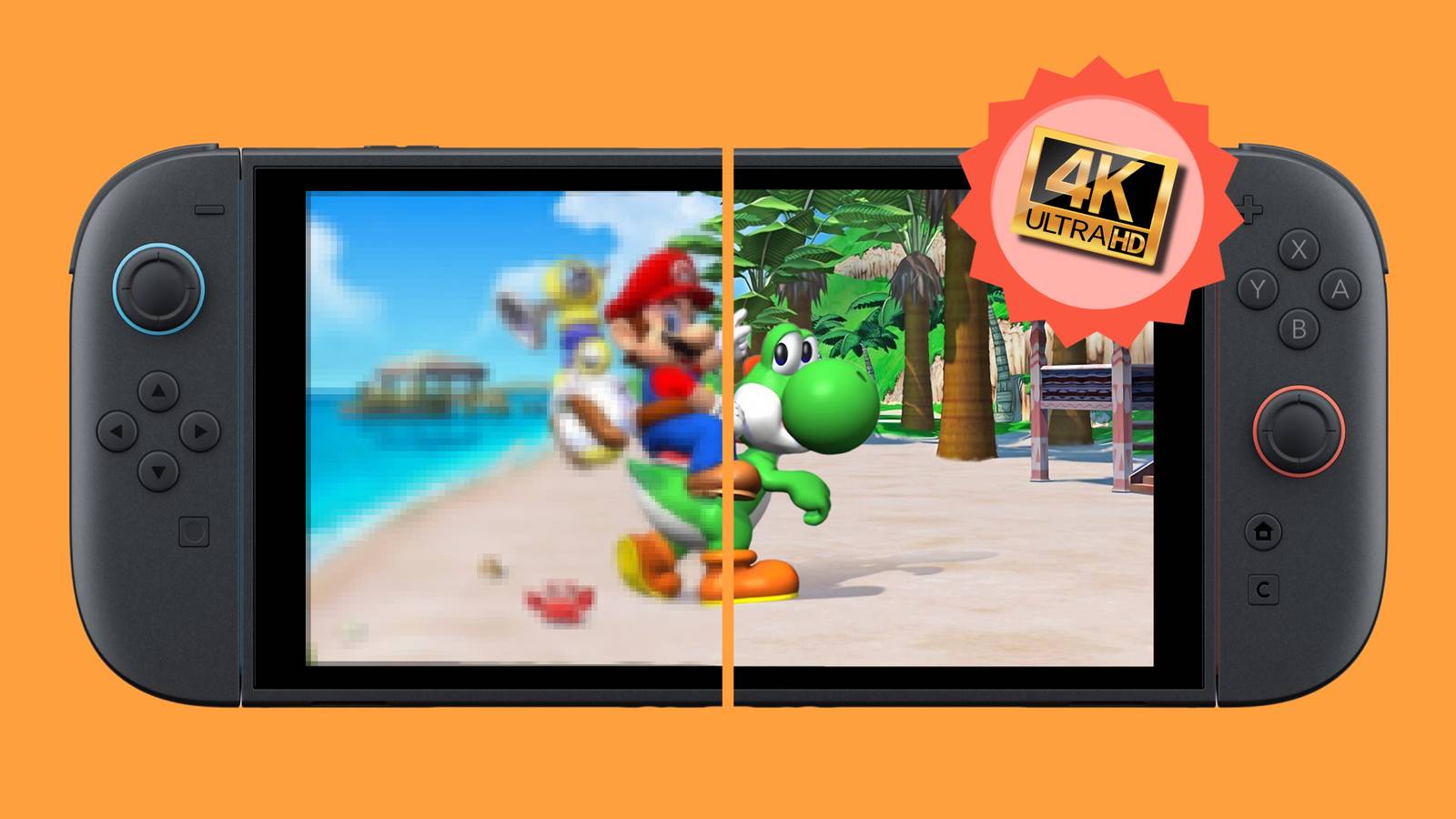
Super Mario Sunshine is officially coming to the Switch 2 via the GameCube Nintendo Classics app on August 13. That’s great news on paper, but right now, the title hasn’t been remastered, remade, or generally improved at all for the occasion, while it also requires a Nintendo Switch Online + Expansion Pack subscription. All that being said, I can’t help but feel that a game of Super Mario Sunshine‘s stature deserved better.
After all, Super Mario Sunshine is a historically load-bearing game; Yoshiaki Koizumi, who directed Sunshine in 2002 and Super Mario Galaxy in 2007, has even said outright that the latter game could not exist without the former. So the fact that it is being rewarded with a subscription-locked emulator release in the same eleven months that Galaxy got a paid remaster and a billion-dollar movie certainly feels a bit off-kilter. Especially when players received a tangibly better version of the experience in 2020.
What the Switch 2 Version of Super Mario Sunshine Actually Offers
To be clear, the GameCube Classics app is a decent piece of work on its own terms; it has suspend points, per-game button remapping, a CRT screen mode, region selection, and online and local multiplayer with GameChat support. The image is also cleaner than a GameCube hooked up to a modern television, which is a low bar, sure—but it’s cleared comfortably. The thing is, the list of what the GameCube app isn’t doing for Super Mario Sunshine is a bit longer.
Who’s That Character?

Identify the silhouettes before time runs out.
For starters, this version of Sunshine sits behind the Switch 2-specific version of the Expansion Pack subscription tier, and so far, widescreen support has been handled per game, surfacing only in titles that shipped with a 16:9 option (which Sunshine did not). So the version of Super Mario Sunshine arriving on August 13 will consistently cost players money and very likely look the same as it did in 2002, only upscaled in a 4:3 window with borders on either side. Sunshine, as I see it, deserves a better effort—and what’s more, Nintendo has proven itself capable of that—it already did more six years ago.
3D All-Stars Did Super Mario Sunshine Better
Back in 2020, Super Mario 3D All-Stars gave Sunshine a full 16:9 presentation for the first time in the game’s history, running at 1080p docked on the original Switch, with upscaled textures and cutscenes and a handful of longstanding bugs cleaned up. Digital Foundry even judged Sunshine the biggest beneficiary of that collection, noting that the wider frame and sharper distant detail made its sprawling levels far easier to read. But that version had a six-month print run, left the eShop on March 31, 2021, and has never come back.
Galaxy Runs on Sunshine’s Learned Lessons

The disservice of this release and the shelving of All-Stars stings, because in terms of the Mario canon, Sunshine was Koizumi’s first turn as director, a role he shared with Kenta Usui under producers Shigeru Miyamoto and Takashi Tezuka. For years, the accepted belief held that Galaxy was the true sequel to Super Mario 64 and that Sunshine was a detour; a tropical spin-off with a water gun bolted on. Koizumi has traced that reading back to Miyamoto—who said as much publicly—but it’s not one that Koizumi shares.
Yoshiaki Koizumi, who directed Sunshine in 2002 and Super Mario Galaxy in 2007, has even said outright that the latter game could not exist without the former.
Speaking to Wired in December 2007, weeks after Galaxy shipped, he put Sunshine squarely in the same line of descent and explained why. “You really can’t have Galaxy without all of the things we learned from Sunshine,” Koizumi said. His term for the shared idea is hakoniwa—a miniature garden, a landscape in a box that shows you different things depending on where you stand. Sunshine‘s Isle Delfino was built on that principle in 2002, with Koizumi chasing a setting that felt more believable than Mario 64‘s floating dioramas—and Galaxy applies the same thinking, just with a wildly different physics budget.

Koizumi’s account of the problem of the day: a stage with several objectives and several routes to them is punishing to build, because those routes obstruct each other and untangling them eats enormous effort before anyone even discusses whether the thing is actually fun to play. The work he did solving that across Sunshine‘s multi-path levels eventually evolved into Galaxy‘s zone system, a stripped-down version assembled from modular planets with flight paths between them that let the team shuffle pieces to tune difficulty and keep routes from colliding. Galaxy is more linear than Mario 64 because Sunshine had taught Nintendo exactly where a sense of sprawl breaks.
Even Sunshine’s Worst Reviews Made Galaxy Better
Sunshine‘s camera is the thing everyone remembers, though, and not because of any particular fondness. Contemporary reviews were broadly enthusiastic, but complaints clustered hard around the camera, the Yoshi and FLUDD gimmicks, voice acting, and difficulty spikes like the Pachinko machine. Looking back, these criticisms are generally earned.
In 2007, Koizumi told a Montreal Games Summit audience that 3D action design comes down to three problems: depth perception, players getting lost, and motion sickness. Sunshine and Ocarina of Time both handed camera control to the player, and he concluded that doing so made the overall control scheme too complex. His verdict was that the decision split the potential audience, and it may have been the moment some players decided the 3D games were not for them.
Of course, Galaxy‘s spherical worlds provided a fix to that. A sphere has no walls to turn around at, which removes the camera swing that disorients people, and Galaxy‘s planet camera tracks Mario across a surface without large movements. The stated goal for the entire project was a game people could play without ever having to think about the camera.
How FLUDD’s Spray Became Galaxy’s Spin
Additionally, stomping a Goomba requires judging depth on a flat screen, which Koizumi identified early as one of 3D’s cruelest demands on a player. Sunshine‘s answer was to let Mario deal with enemies via FLUDD, hosing them down in an attack that lands whether you have read the distance correctly or not. Galaxy‘s spin is, in a sense, a direct continuation of that, given it achieves the same solution via the Wii Remote.
Nintendo Can Do Better, and Should Have
-

-
 Image via Nintendo
 -
 via Nintendo
As I see it, all of these direct links between Sunshine and Galaxy mean that Sunshine deserves more, and it is frustrating, because Nintendo is not some company that has forgotten how to revive its back catalog. Paper Mario: The Thousand-Year Door, a GameCube RPG from 2004, was rebuilt for Switch in May 2024 and had sold 2.10 million copies by the following March, outselling the original outright. Super Mario Galaxy + Super Mario Galaxy 2 followed in October 2025 with updated textures, new storybook content, control options, and a free Switch 2 patch adding 4K.
As I see it, all of these direct links between Sunshine and Galaxy mean that Sunshine deserves more, and it is frustrating, because Nintendo is not some company that has forgotten how to revive its back catalog.
The contrast here is staggering, especially given that Galaxy has had a very good couple of years. It got a remaster bundle, the 4K update, and The Super Mario Galaxy Movie, which opened on April 1 and became the first film of 2026 to pass a billion dollars worldwide. Yet the game its own director credits as the foundation for all of it gets an emulator entry and a subscription paywall.

I understand, of course, that emulation is preservation. Making Sunshine available to anyone with a subscription is a move that’s more accessible than the current standard of a delisted collection going for triple digits on eBay. But I don’t think it’s necessary to congratulate Nintendo or feel particularly grateful about that, given the move to delist the game for the sake of preserving how “special” an anniversary was is what made this a frustrating reality in the first.
At the end of the day, I’m not asking for Super Mario Sunshine 2, or even a ground-up remake with new levels and a modernized moveset (though these options are certainly welcome). I’m saying that the version Nintendo already built—which runs at 16:9 with sharpened textures and has its worst bugs patched out—should’ve been the standard to beat. Nintendo did most of the hard work in 2020 anyway, so it seems strange that it looks like it might come up short of that effort.


- Released
-
August 26, 2002
- ESRB
-
E For Everyone due to Comic Mischief
- Developer(s)
-
Nintendo EAD
- Publisher(s)
-
Nintendo