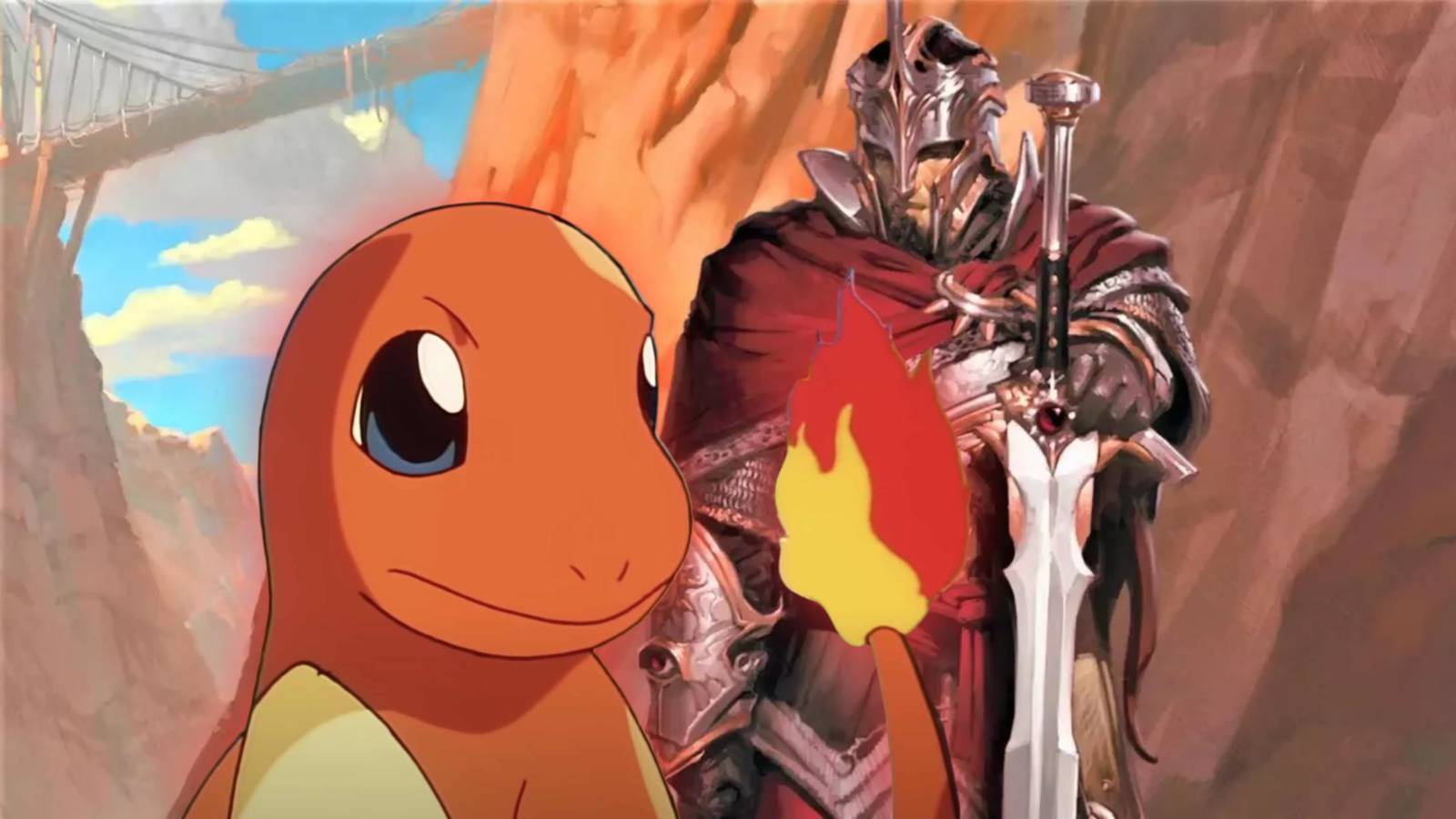
A Pokemon fan and skilled artist turns starters from Generation 1 through 3 into Dungeon and Dragons classes, each with their own weapons and abilities. Though Pokemon as a series has never crossed over with Dungeons and Dragons or any other tabletop RPGs, the potential is huge, as shown by these fan-made starters turned into DnD classes. One could argue that Pokemon Mystery Dungeon games are the perfect Dungeons and Dragons crossover already, but it has been a long time since the series produced another game.
Pokemon Mystery Dungeon: Rescue Team DX takes the best of Red and Blue Rescue Team from 2005, and while it’s a great remake, it’s not a whole new game. Yet, it was the last in the spin-off series, and it came out in 2020. Fans have since been asking for a new game or another remake, and Explorers of the Sky might fulfill that niche perfectly. Despite this, and despite a very strong sales performance for Pokemon Mystery Dungeon: Rescue Team DX, nothing is official. Still, the audience for such a game is very much there, as proven by the huge success on Reddit of these fan-made Pokemon starters as DnD classes.
The 45 Best-Designed Pokemon Of All Time
Pokemon come in all sorts of shapes and sizes. These Pokemon have the best designs in the entire series.
Pokemon Gen 1, 2, and 3 Starters as Dungeons and Dragons Classes
Reddit user and talented artist almightyjeff shared a post on the platform with pictures and even animated GIFs of Charmander, Totodile, and Treecko as Dungeons and Dragons classes. Charmander is unclear what could be between the likes of Dungeons and Dragons‘ Fighter class or Ranger Class, as it’s depicted with a sword that it engulfs in flames. Furthermore, almightyjeff gave each Pokemon an associated nature, and Charmander’s is Brave. Brave Pokemon have increased Attack and reduced Speed, so it’s more likely that the iconic Fire-type starter is a Fighter.
New Questions Added!
GameRant Quiz
GameRant Quiz
Easy (15s)Medium (10s)Hard (5s)Permadeath (5s)
No mistakes can be made with Totodile, the iconic Water-type free starter in Pokemon Legends: Z-A and Johto games, as it wields two one-handed axes, has battle scars, wears a Cubone’s skull as a shoulder pad, and it has a dedicated Rage design. It also has a Jolly nature, which increases Speed at the cost of Special Attack. Barbarians in DnD are known for their strong attacks and resilience. While Totodile normally uses its jaw to great effect in Pokemon games, this adaptation makes it an equally fierce warrior, ready to slice its enemies. Finally, Treecko is the Gen 3 Grass-type starter, and it’s depicted as a Rogue.
The Treecko designed by almightyjeff is the archetypal Rogue class in Dungeons and Dragons. It has a hood with a small cloak attached, it has a bow, and it tries to ambush its targets by hanging from a tree and then striking them with Leaf Blade. To that point, almightyjeff jokingly renamed Leaf Blade “Leaf Dagger” to perfectly match the Rogue aesthetic and gameplay in DnD. The artist gave Treecko a Timid nature, which is perfect for any non-magic-focused Rogue in DnD.
From Lake Geneva to Faerûn · Eight Questions How Well Do You Know Dungeons & Dragons? “You enter a dimly lit chamber. Roll for initiative.”
🎲The d20Roll high, hero
🐉TiamatQueen of Evil Dragons
⚔️Vorpal BladeSnicker-snack
📜Spell ScrollMagic Missile
🧙♂️The DMBehind the screen
01
Dungeons & Dragons was first published in January 1974 in three little brown booklets sold from a Lake Geneva, Wisconsin garage. The game grew out of the medieval miniatures wargame Chainmail and a Twin Cities campaign called Blackmoor, which two designers fused into the first true tabletop role-playing game. Name the cocredited cocreators.
✓ Correct! Gary Gygax and Dave Arneson. Gygax brought the rules-systems thinking from Chainmail; Arneson brought the dungeon-crawling, character-driven Blackmoor campaign he’d been running. The two would famously fall out by the late ’70s over royalties and creative direction, but the 1974 white box — the “0E” or “OD&D” rules — carries both names. Arneson died in 2009; Gygax in 2008.
✗ Wrong duo. The answer is Gary Gygax & Dave Arneson. Frank Mentzer wrote the iconic 1983 BECMI “red box” revision but isn’t a cocreator. Tolkien is the obvious tonal influence (and was sued out of D&D’s text in early printings) but never worked on the game. Jeff Easley is one of TSR’s signature cover artists. Gygax (rules) plus Arneson (dungeon-crawl campaign play) is the founding pair.
02
The original 1974 white-box edition was published by a company Gygax cofounded with Don Kaye out of Lake Geneva, Wisconsin. The acronym originally stood for Tactical Studies Rules, and the company would dominate hobby publishing through the 1980s before nearly going bankrupt in the mid-1990s. Name it.
✓ Correct! TSR — Tactical Studies Rules, founded by Gygax and Don Kaye in 1973. The company exploded with D&D’s 1977–79 boom, fumbled badly through the late ’80s and ’90s under Lorraine Williams’ leadership (who pushed Gygax out in 1985), and was on the brink of liquidation by the mid-’90s after a mountain of returned novel inventory and unsustainable production. The lifeline came from a Seattle CCG publisher.
✗ Wrong publisher. The answer is TSR. Wizards of the Coast comes later — they bought TSR. Avalon Hill is the classic American wargames publisher, also acquired by Hasbro. Chaosium is the publisher of Call of Cthulhu and RuneQuest. TSR is Gygax’s original Lake Geneva company — the one that made D&D a household name and then almost folded.
03
After TSR collapsed under unsold-inventory debt, the brand was rescued by Peter Adkison’s Seattle company — flush with cash from the runaway success of Magic: The Gathering — which acquired TSR and its D&D properties in a deal often credited with saving the game. The acquisition closed in what year?
✓ Correct! 1997. Wizards of the Coast acquired TSR for a reported ~$25 million in April 1997, with the deal driven by Peter Adkison’s personal love of the game. WotC immediately steadied the line, then released D&D 3rd Edition in 2000 under the Open Game License — a decision that spawned the entire d20 third-party market. Two years later, in 1999, Hasbro bought Wizards of the Coast itself, which is why D&D is technically a Hasbro property today.
✗ Wrong year. The answer is 1997. 1995 is when TSR’s troubles became public. 2000 is when 3rd Edition launched under WotC. 2003 is roughly when 3.5 came out. The acquisition closed in spring 1997 — Adkison reportedly wrote the offer letter himself because he wanted to save the game he’d grown up playing.
04
After the divisive 4th Edition (2008) split the player base — with much of it migrating to the Pathfinder fork — Wizards of the Coast spent two years in open public playtest under the codename “D&D Next” before launching what the community now simply calls “5e.” The new Player’s Handbook hit shelves in August of what year?
✓ Correct! 2014. The 5e Starter Set arrived July 15, 2014; the Player’s Handbook on August 19, 2014; the Monster Manual that September; the Dungeon Master’s Guide that December. The edition’s deliberately back-to-basics design — led by Mike Mearls and Jeremy Crawford — is the version that, paired with Critical Role, Stranger Things and pandemic-era home play, made D&D more popular than at any previous point in its half-century history.
✗ Wrong year. The answer is 2014. 2010 is too early — 4th Edition was still being supported. 2012 is when the public “D&D Next” playtest opened. 2016 is when Curse of Strahd dropped. The fifth edition Player’s Handbook landed in August 2014, and the line has been on a steady release rhythm ever since — with the 2024 revised core books marking the edition’s first significant update.
05
Every D&D player’s most iconic piece of plastic is the twenty-sided die — the one you roll to attack, save, persuade, or pray for a natural 20. Geometrically, the d20 is one of the five Platonic solids: a regular convex polyhedron with twenty equilateral triangular faces. Name the solid.
✓ Correct! Icosahedron — the twenty-faced regular polyhedron. The D&D dice set borrows the entire Platonic family: tetrahedron (d4, 4 triangular faces), cube (d6), octahedron (d8, 8 triangles), dodecahedron (d12, 12 pentagons) and icosahedron (d20). The d10 is the lone non-Platonic outlier — a pentagonal trapezohedron added later for percentile rolls. Plato proposed the icosahedron as the elemental shape of water; D&D made it the elemental shape of luck.
✗ Wrong solid. The answer is the icosahedron. The dodecahedron is the d12 (12 pentagons). The octahedron is the d8 (8 triangles). The tetrahedron is the much-feared d4 (the “caltrop”). The d20 is the icosahedron — 20 equilateral triangles, the largest of the five Platonic solids, and the single most important die in any D&D session.
06
D&D’s chromatic dragons — red, blue, green, black and white — are ruled by a five-headed goddess from the Nine Hells, each head matching one chromatic colour. She’s the closing-act villain of 5e’s debut storyline “Tyranny of Dragons” (2014) and the eternal opposite number of the platinum dragon-god Bahamut. Name her.
✓ Correct! Tiamat. The name is borrowed from Babylonian myth, but D&D’s version — with one head per chromatic colour — is fully Gygax-era invention, dating back to the 1977 Monster Manual. She’s also the closing-act fight in the 1980s Saturday-morning D&D cartoon, the climactic threat of 5e’s Rise of Tiamat (2014) and a persistent brand-defining villain. The 2023 Honor Among Thieves film features her looming on murals but stops short of putting her on screen.
✗ Wrong evil deity. The answer is Tiamat. Lolth is the spider-queen of the Drow — very evil, but not draconic. Vecna is the lich-god of secrets (the Stranger Things big bad is named for him). Asmodeus is the Lord of the Nine Hells. Tiamat is the five-headed chromatic dragon goddess — one head per dragon colour — and Bahamut’s eternal opposite.
07
The web series Critical Role — which started on Geek & Sundry in March 2015, became its own company and Twitch behemoth, and got a Prime Video animated adaptation in The Legend of Vox Machina (2022) — is run by a Dungeon Master who voiced Cole Cassidy in Overwatch and Levi in the Attack on Titan English dub. Name him.
✓ Correct! Matthew Mercer. The original cast were a group of LA voice actors playing a home game that they were eventually convinced to stream — the “nerdy-ass voice actors” framing has been Mercer’s tagline ever since. Critical Role’s success became the single biggest engine of 5e’s player-base growth: by Campaign 2 (Mighty Nein) it was Twitch’s biggest non-gaming live show, and by 2022 it had spawned a Prime Video animated series and a tabletop publisher (Darrington Press).
✗ Wrong DM. The answer is Matthew Mercer. Brennan Lee Mulligan runs Dimension 20 (the Dropout-hosted actual-play anthology). Chris Perkins is the longtime Wizards of the Coast story architect — the in-house D&D DM who runs Acquisitions Incorporated games. Mike Mearls coled 5e’s design but isn’t a streamer. Mercer is the Critical Role DM — the one whose “how do you want to do this?” became a generation’s favourite line.
08
Stranger Things opens its 2016 pilot with Mike, Lucas, Will and Dustin closing out a ten-hour basement campaign. Will throws a 7 on his attack roll — not enough — and the boys later use the name of that night’s monster as the name they give the unseen creature pulling Will into the Upside Down. Name the monster (and the season-1 villain by association).
✓ Correct! Demogorgon — the two-headed Prince of Demons, who debuted in the 1976 D&D supplement Eldritch Wizardry. The Duffer brothers paid royalties to Wizards of the Coast for the name, and the cold-open campaign in S1E1 was actually playable: the show’s RPG consultant published a full module of it. Stranger Things would go on to use the Mind Flayer for season 2–3 and Vecna for season 4 — making the show’s villain progression a chronological tour of D&D’s bestiary.
✗ Wrong monster. The answer is the Demogorgon. The Beholder is the floating-eye terror — iconic but never the Stranger Things villain. The Mind Flayer is the season-2 and 3 antagonist (the “shadow monster”). Vecna is the season-4 villain. Season 1 is the Demogorgon — the two-headed Prince of Demons, lifted straight out of the 1976 supplement Eldritch Wizardry.
The Quest · Party Verdict Your Adventurer Standing
🐉
/ 8
Legendary Dungeon Master — or first-session commoner?
The fact that these designs work so well is not only further proof of the Pokemon Mystery Dungeon series, but it also highlights the many possibilities for each Pokemon in terms of DnD class designs. While Fennekin is most definitely a Wizard or Sorcerer, the recently revealed Pombon in Pokemon Winds and Waves has the potential to be many classes. Outside of starters, Mewtwo may be an Artificer, Ursaluna a shapeshifted Druid, and Mienshao a Monk.