




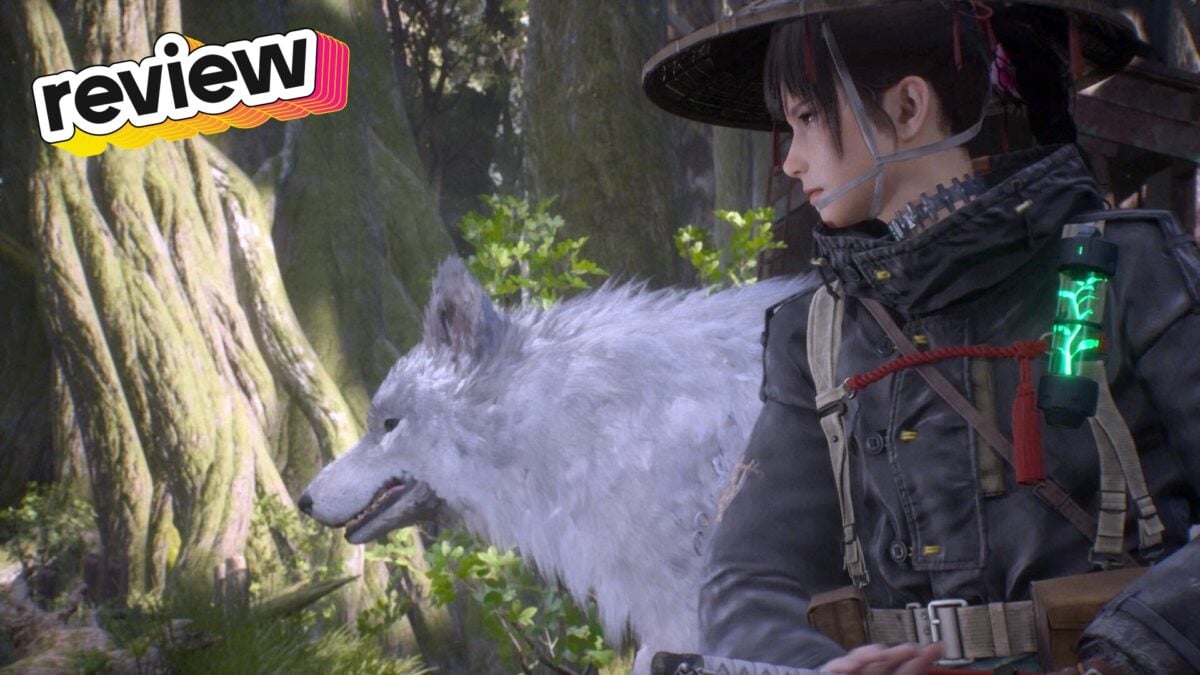
Beast of Reincarnation is a classic example of a game with strong ambitions and good ideas that nonetheless struggles to stay consistently compelling from start to finish. Game Freak, known primarily for the Pokémon RPGs, has never created a game of this scale before. But with the help of support studios, it’s made Beast of Reincarnation a pretty solid Soulslike that has both enough originality to make it a fresh spin on a genre that’s grown oversaturated over the past decade, as well as a less intimidating, more accessible approach to difficulty than many of its genre peers. It’s still an exceptionally difficult game, but Beast of Reincarnation’s punishing, post-apocalyptic world gives you tools to navigate it in a way that suits different playstyles. Still, at a certain point it feels like Game Freak’s fantastical, nature-loving vision of a Soulslike runs out of ideas when it still has a lot of runway to walk.
At its core, the Soulslike genre is defined by enemies that hit hard, demand precise reaction timing, and can quickly overwhelm you if you’re not careful. Beast of Reincarnation delivers this in spades as its nature-reclaimed world pits you against both blight-ridden wildlife and the decaying remains of human technology, sometimes at the same time. Emma, a young woman who has been essentially raised in a box by one of the remaining human colonies in 4026 Japan, is one of the only people who is able to absorb the blight that has overtaken animals and killed almost all the human beings in this world. As such, the locals have effectively wielded her as a weapon to defeat giant, plant-like creatures called malefacts, while also ostracizing her for her “blight-stained” nature.
The creatures that have survived in Beast of Reincarnation are, much like Emma, covered in overgrowth that has killed off most other life on Earth, and while there are only a handful of enemy types, Game Freak’s decades of experience in creature design shines through in how well it manages to merge plant life with the skeletal structures of animals. The giant creatures that inhabit the desolate remains of Japanese cities have become so overgrown by vegetation that they look like they could have stepped right out of the thick layers of growth that cover buildings and other human structures, as if they’d been stuck inside for centuries, waiting to finally reemerge. The animals that adapted to the blight come in many shapes and sizes, and each offer their own distinct challenges, like the birds that peck and claw at you from the sky and the giant bears that lunge at you with ferocity. Pepper in a few crazed robots from humanity’s last fleeting attempts at self-preservation, and you’ve got enough enemy variety and challenge that even high-level players will have to be careful about freely running around the world.
Getting cornered for just a split second gives even Beast of Reincarnation’s weakest enemies a big enough window to overwhelm you. At first, the best way to handle any enemy is through timed parries whose window for execution is always shorter than you feel like it’s supposed to be, as Emma’s sidestep dodge barely gets her out of the way until you upgrade far enough into the skill tree to get a dodge roll that actually moves her to safety. In a way, that forced reliance on parrying is helpful as a teaching tool, because dodge rolls aren’t going to be enough to give you the upper hand on the game’s incredible bosses. Those you can really only defeat if you’ve mastered Beast of Reincarnation’s parry system. It’s endlessly satisfying to hear the loud “clank” of Emma’s sword in rhythmic succession as a giant horse-like monster or fowl brings down its might upon you and you effortlessly deflect it. Beast of Reincarnation’s powerful foes give you a lot of reason to approach fights with caution, and that makes the moments when you enter a flow state of dancing with an enemy all the more rewarding.
Emma’s ability to absorb the blight in her opponents allows you to consistently add to your tool kit after each boss fight, as each time she fells one of the powerful malefacts, she adds their power to hers. I was always fascinated to see what attack that I’d been dodging and parrying would show up on my skill tree after I took down one of the game’s bosses, and frankly, by the time the game was over, the sheer breadth of abilities Emma had at her disposal was overwhelming enough that I had comfortably settled on a handful of combos through muscle memory rather than trying to unleash the collective might of the boss pantheon on enemies in the late game. And really, the most interesting part of Emma’s abilities is one that doesn’t come from anyone else and is her power alone.
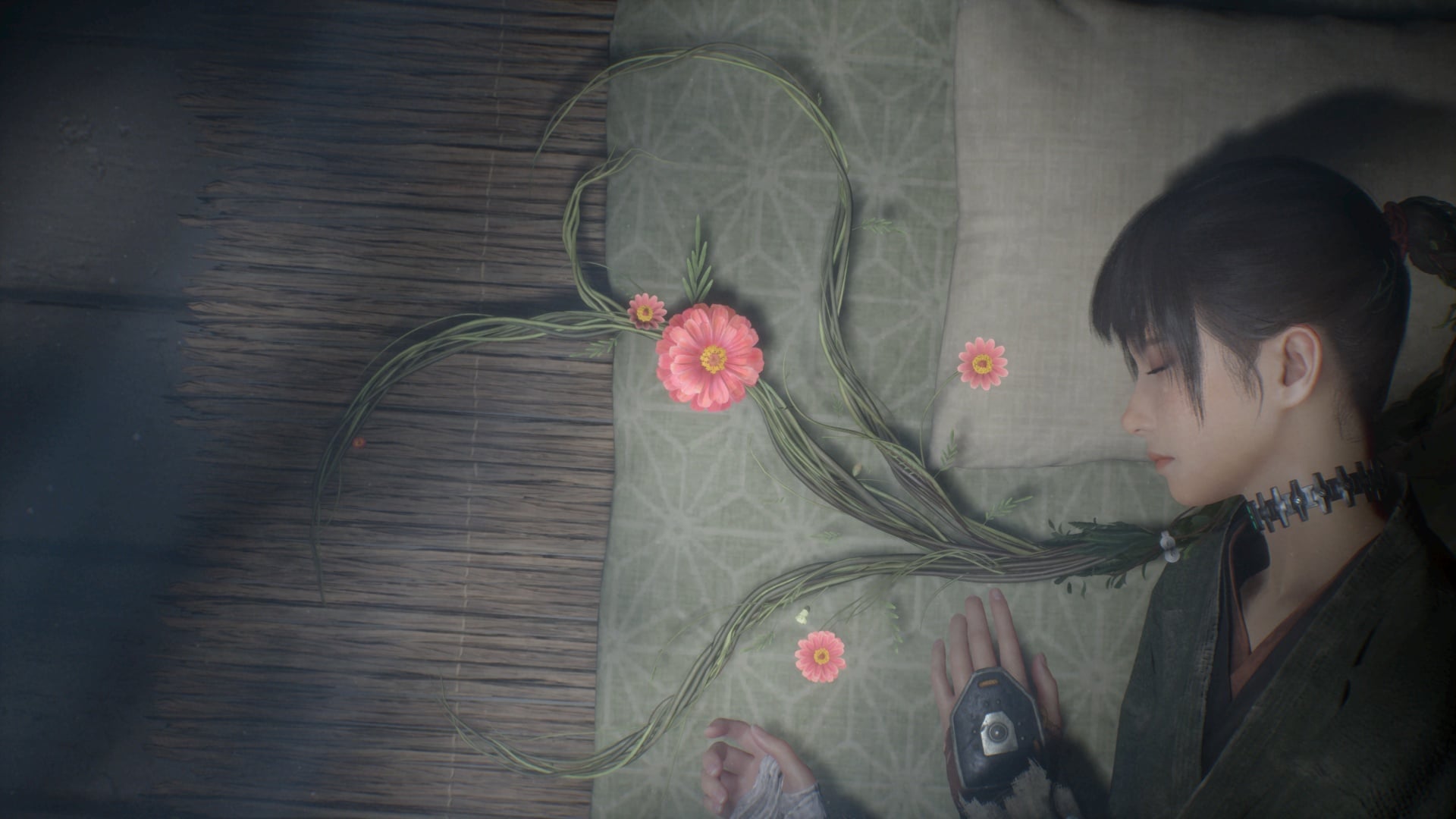
Part of what makes Beast of Reincarnation’s open zones and enemy-populated paths a joy to move through is that Emma’s blight-covered braid is able to extend to help her move throughout the world. Holding down the jump button raises her several feet above the ground by the roots extending from her hair, to the point where you can easily get to high ground if you see a squad of enemies between you and your destination. Once you’re safely above your enemies, you can create a bridge that extends far enough out to easily reach platforms on the other side of small openings, or that puts you in an opportune position to descend upon an enemy with a stealthy killing blow. Beast of Reincarnation’s traversal mechanics are one of the key ways in which the game makes an intimidating genre more approachable, elegantly letting you move through the world and helping you avoid or set up combat encounters. There’s a lot of room in Beast of Reincarnation to approach encounters on your own terms, create a plan of attack, and execute it, and it’s all thanks to your ability to move through the world from on high rather than needing to sprint past enemies as they’re swinging at you just to reach the safety of another campsite.
I did encounter a handful of instances in which the controls felt finicky. I’d spam the up button on my d-pad to try to use a healing item only for Emma to not use one, or I’d press L3 and R3 in an effort to slow down time and unleash a flurry of sword strikes on a vulnerable enemy, but to no avail. In a game like Beast of Reincarnation, even a split second of missed response time is enough to determine a fight. The strange thing is that these issues were so inconsistent, I would go hours without encountering them, only for them to happen again just when I’d started to forget.
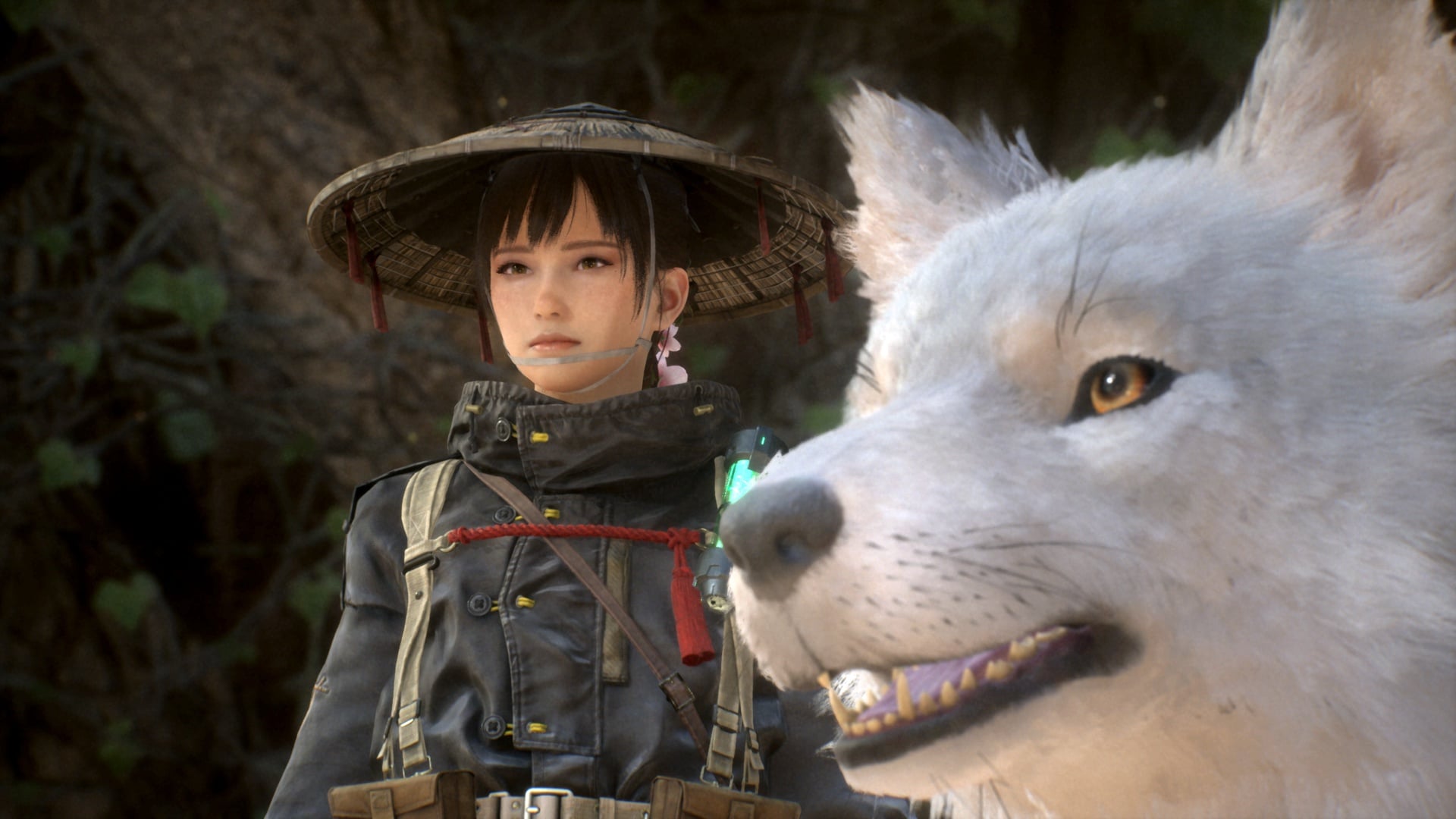
If all I had in these fights was Emma and her abilities, these kinds of hitches would be game-breaking, especially in the later chapters where enemy numbers increased. But Emma isn’t alone in these fights and travels, and her blighted wolf companion Koo is quite helpful in making Beast of Reincarnation’s challenge palatable without giving players a “get out of jail free” card during the most hectic of scraps. Koo is also affected by the blight in the way Emma is, capable of absorbing and building upon his abilities with each boss the pair defeats. Koo primarily fights autonomously and is a capable fighter on his own, but as you accrue points through successful parries, you can order him to use various abilities that play into Beast of Reincarnation’s various elemental affinities and status effects. in a way, it feels like Game Freak’s Pokémon roots rising from beneath the weather-worn soil to greet the sun. Koo’s abilities can give you the upper hand through their effects, of course, but pulling up the menu to give him orders also slows time down enough for you to catch your breath, assess a situation, and determine the best course of action. It will not save you if you’re in the process of being whaled on, but I found myself looking to Koo regularly just to give myself a moment to plan my next move.
The connection between Emma and Koo is a cornerstone of Beast of Reincarnation, but it’s not quite as compelling as the relationships Emma shares with her fellow humans. Or at least the weird semblance of relationships that people who barely know how to be people are capable of. Beast of Reincarnation’s cast of travelers fighting the malefacts are all, to some degree, recluses who barely know how to speak to one another. Emma has been isolated from most people her whole life because of her blight-stained status; Kagura, the child cook of the crew, has spent most of her life in servitude; and Brad, the grumpy grandpa controlling the walking vehicle they ride around in, has willfully avoided people for many years and is now essentially babysitting two girls and their giant wolf pet.
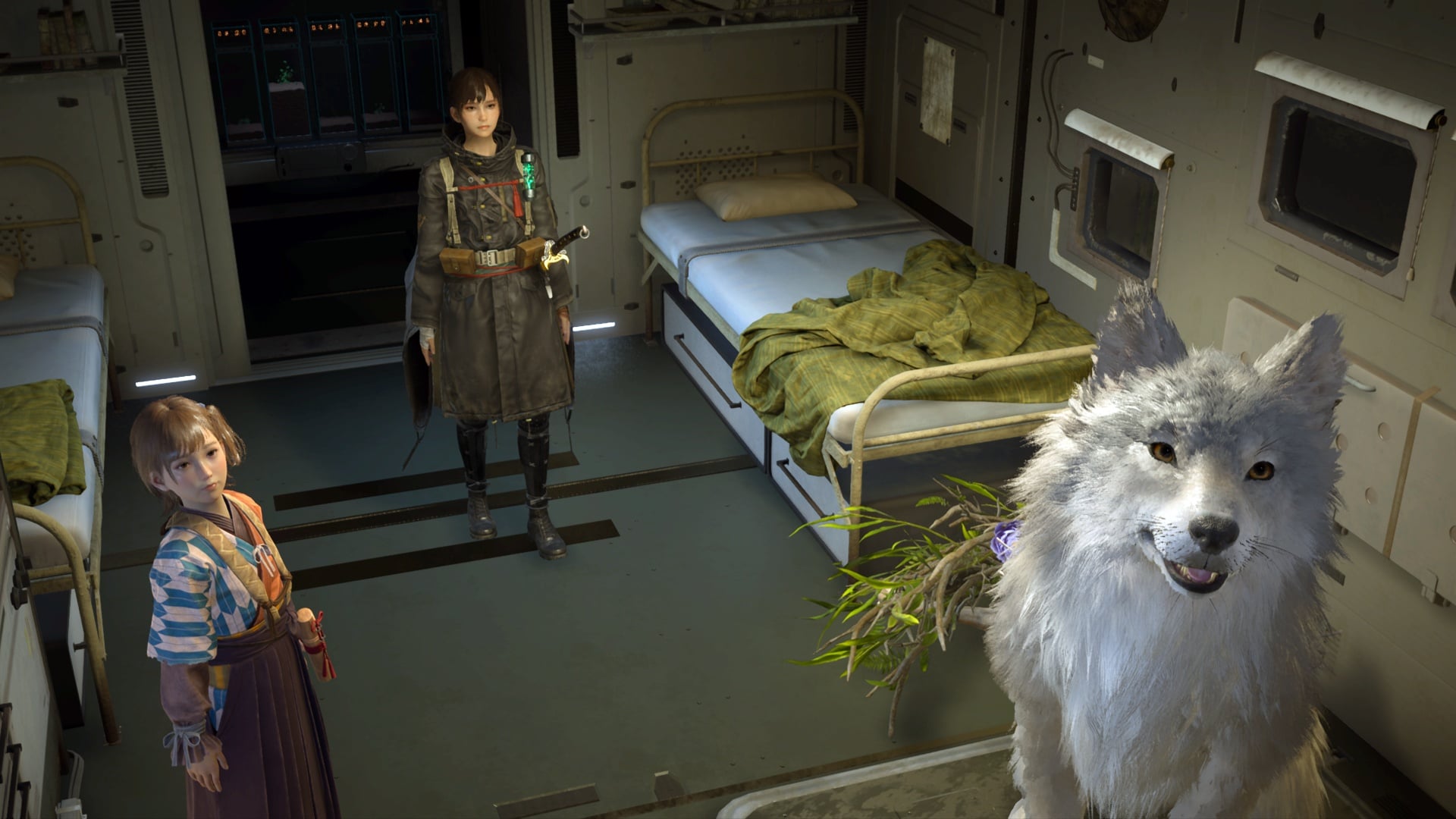
Beast of Reincarnation is a pretty stoic experience with an emotionless delivery for much of its run, with performances to match, but the specifics of some of the interactions between Emma, Kagura, and Brad are compelling in their own way. Emma doesn’t know how to be human, she doesn’t seem to experience emotions or understand them at all, so when Kagura asks her very simple questions about her observations out on the field, Emma only knows how to describe her experiences in a cold, calculating way. She has no human intuition, no ability to offer insight, and she characterizes a new ally she met on the field in the most straightforward ways, describing her hair’s length and noting that she was strong enough to defeat an enemy with ease.
Those moments of Emma and Kagura trying to talk about fairly mundane things but lacking the vocabulary or understanding to articulate them do more to illustrate the gradual deterioration of humanity in Beast of Reincarnation than vine-covered buildings or aging robots that had decayed to the point of nearly forgetting their original purpose. After 2000 years of barely surviving, human beings have lost so much of their basic decorum, hope for a future, and even their desire to envision what they want to do with their lives, that these young women have never had to contend with the basic parts of what it means to be person. Their childlike understanding of the world around them, enhanced by the sense that Brad is looking upon them with pity and withholding something much larger from them, speaks to just how much human culture has been lost to time. Emma has very little experience to draw from, which is why she asks Brad and Kagura to help her understand what drives a person to want to be more than a weapon.
-
BACK-OF-THE-BOX-QUOTE:
“Like Pokémon but with more existentialism.”
-
DEVELOPER:
Game Freak
-
TYPE OF GAME:
Post-apocalyptic soulslike game that combines skillful swordplay and animal companion commands.
-
LIKED:
Incredible boss fights, some of the best uses of mobility in the genre, the existential and sci-fi elements of its story are pretty strong.
-
DISLIKED:
Plays the hits by repeating boss encounters throughout, controls can be finicky, performances across the board are pretty stilted.
-
PLATFORM:
PC, PS5 (played on), Xbox Series X/S
-
RELEASE DATE:
August 4, 2026
-
PLAYED:
~24 hours
All of those foundations make for what could be and often is a great entry in the Soulslike canon. The problem is, Beast of Reincarnation overstays its welcome, and it becomes apparent that despite how strong its bones are, the game only has so many ideas and too much time on its hands to cover. About midway through, I was sucked into Beast of Reincarnation and ready to face more of the challenging boss fights, only to realize that I was about to face a moderately beefier version of a fight I’d already done. A chapter later, I faced another boss I’d already defeated before, which mostly used the same attacks and strategies, so my muscle memory was able to see me through. When I get back to my moving base, Emma, Koo, and Kagura talk about the same ideas, ask the same questions, and wonder if they’ll find the same answers. Beast of Reincarnation isn’t even that long. I clocked about 24 hours in my first run, and while I wasn’t exhausted by the time I reached the end, the realization that it would recycle boss fights to pad things out did kill my initial momentum. This feeling of the game relying on old tricks to artificially extend itself came not just from identical boss fights, but also chapter bookends featuringnearly identical conversations between its cast. Beast of Reincarnation could have been a bit shorter, tighter, and its most impressive moments more impactful, but instead it retreads old tricks and rehashes old questions.
It’s also worth noting that this is a Game Freak game, and while the company has said that it outsourced much of the development and primarily had a directorial role, the studio’s history with technical troubles on games like Pokémon Scarlet and Violet is likely to give some folks pause. I played Beast of Reincarnation on PS5, and while there were definitely framerate drops in the endgame as enemies became more abundant, I had a mostly fine experience in performance mode. However, I have spoken to people who played the game on PC and Xbox who noted some significant trouble on those platforms. I haven’t been able to play those versions myself, but I would be remiss to not mention that here. I was able to experience Beast of Reincarnation with minimal performance issues, and those bits of late-game lag didn’t color most of my playtime.
At their best, Beast of Reincarnation’s boss fights are incredible, but Game Freak falls into a rhythm of playing the hits, to the point where some of its later battles are no longer a real challenge because you’ve done them already. Its highs are high the first time you see them and underwhelming the next time the game presents them to you. There are more of those excellent fights on the other side of the repeats, and a stronger game would have let go of the dead weight. Beast of Reincarnation has good ideas and is an exciting challenge; it just loses the wind in its sails for a while before getting back on track at the end.