







In the summer of 2003, college student Mara Whitefish and her friends venture outside the city to a party at the home of a successful young writer, one of many seizing the advent of online blogs to make a name for himself. Among the guests are people Mara knows well, people she’s only loosely connected to, and people she doesn’t know at all. During the day, a family can be seen in the yard, including two young children running and playing with boundless energy. By evening, the family has left, but playing as Mara, I noticed a new detail had appeared in their absence: a row of miniature animals all carefully placed under a nearby clothesline, “each positioned in line with the greatest deliberation.”
Presumably at some point one or both of the kids I’d seen before had come over here and done this, using toys and imagination and their own burgeoning understanding of the world to make something and in so doing, to try to create some sense of order in all the dazzling, overstimulating, confusing cacophony of life. This moment struck me as a kind of microcosm for Perfect Tides: Station to Station writ large. In the world of this game, all the characters, even those children at the party, are growing, changing, leaving a mark on things, grasping at meaning, experimenting with what it means to be alive. This game knows that not just its protagonist but every person is a world entire, made up of questions and desires and fears and contradictions and mysteries and more besides.
Like each of us, Mara Whitefish is many things: she’s a college student, an 18-year-old, an aspiring writer, a person whose understanding of herself and of the world around her is expanding with every book she reads and each new crack that forms in her heart. What makes this game so remarkable is the way in which, far more than most games and more so even than a great many books and films, it treats each and every person as fully real, with their own interiority, their own experience of the world. Mara is still trying to figure herself out but there’s no way for her to do that without running up against the realness of others; who they are, what they want. Whether they intend to or not, sometimes they will hurt her, and whether she means to or not, sometimes she will hurt them. This is life. This is part of figuring out what it means to be a person.
Writer and cartoonist Meredith Gran, who created the webcomic Octopus Pie before making the Perfect Tides games, is deeply aware of the interiority and interconnectedness of all her characters, a quality that comes into sharper focus when you contrast Station to Station with most other games.
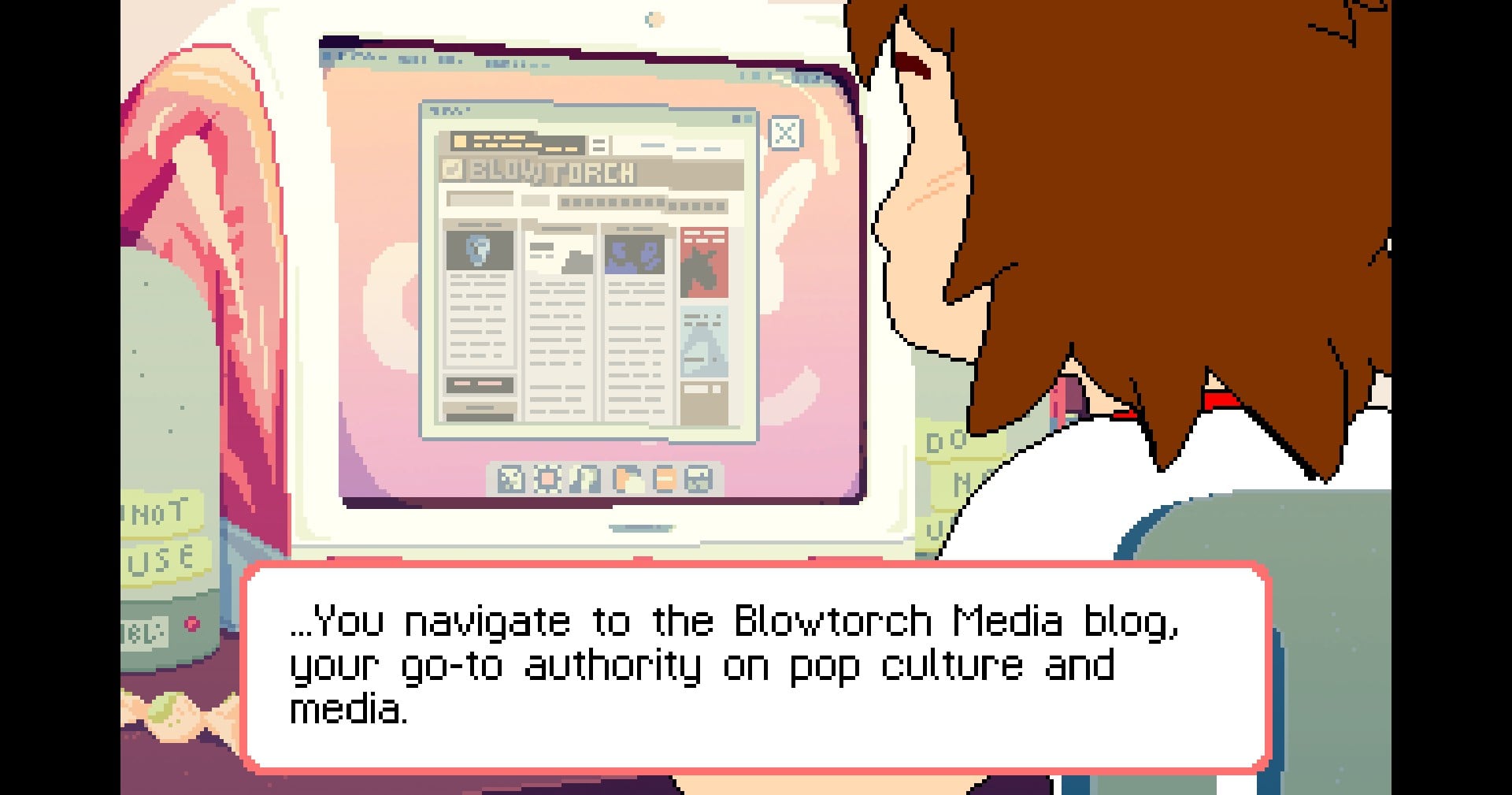
Right now I’m playing Dragon’s Dogma 2, a fun open-world RPG with wonderful texture, but in that game I’m surrounded by “pawns,” beings who lack a will of their own and exist only to serve the hero. I understand why the Dragon’s Dogma games do this—it saves the creators from having to do the work of trying to imbue each member of your party with unique and complex personalities, for one—but it’s also just being up-front about a principle that many games are designed around but that few admit to so openly: your experience as the player is the only one that really matters.
Many games that purport to have wonderful stories don’t care too much about the realness of other people. Often a game’s vast world is plainly just there for you to pillage or conquer, to cut a bloody path through, and like someone visiting the theme park in Westworld, you can utterly disregard the personhood of anyone else you encounter, because they, too, exist only for you. I’m not saying that every game needs to engage with the intrinsic humanity of all its characters—I enjoy stomping goombas and clobbering evil henchmen as much as the next person—but Station to Station is the very rare game that makes you feel the realness of others.
This is, I think, one thing that great writing can do: It can make us feel more deeply connected to the larger web of humanity, to those whose lives are wildly different from our own, to those who came long before us or those who will come long after. In a 1963 interview with LIFE magazine, the great writer James Baldwin said,
You think your pain and your heartbreak are unprecedented in the history of the world, but then you read. It was Dostoevsky and Dickens who taught me that the things that tormented me most were the very things that connected me with all the people who were alive, or who ever had been alive.
Okay, you might be wondering, but what is this game actually like? Station to Station is a point-and-click adventure game set in a fictionalized, post-9/11 New York City which the game’s writing brings to remarkably vivid, immediate life. It’s also a sequel to 2022’s Perfect Tides. That game, set in the year 2000, was also about Mara Whitefish, then a high school student, navigating friendships and romance and family struggles and online communities while living on a lightly fictionalized version of Fire Island.
Like Station to Station, it was observant and heartbreaking and very funny, a remarkable debut for Gran as a game creator. It’s worth playing, but definitely not required before you jump into the sequel. Where the original Perfect Tides was a very promising first effort, Station to Station sees all of that potential being fully delivered on in a game that’s much grander in scope while also somehow even more intimate and affecting.
Station to Station may be a point-and-click, but it’s not the sort in which you routinely have to fill your inventory with items from the environment and then use them to solve puzzles. Instead, for the most part, life just flows forward here. You’ll live through the year 2003 as Mara, going to class, writing essays, reading books, hanging out with friends, falling in love, goofing off online, and just generally trying to figure out who you are and what you want out of this thing called life. (You’ll also experience the most remarkable karaoke night ever presented in a game, though I won’t say any more than that; like so much of Station to Station, it’s best to just experience this moment for yourself.)
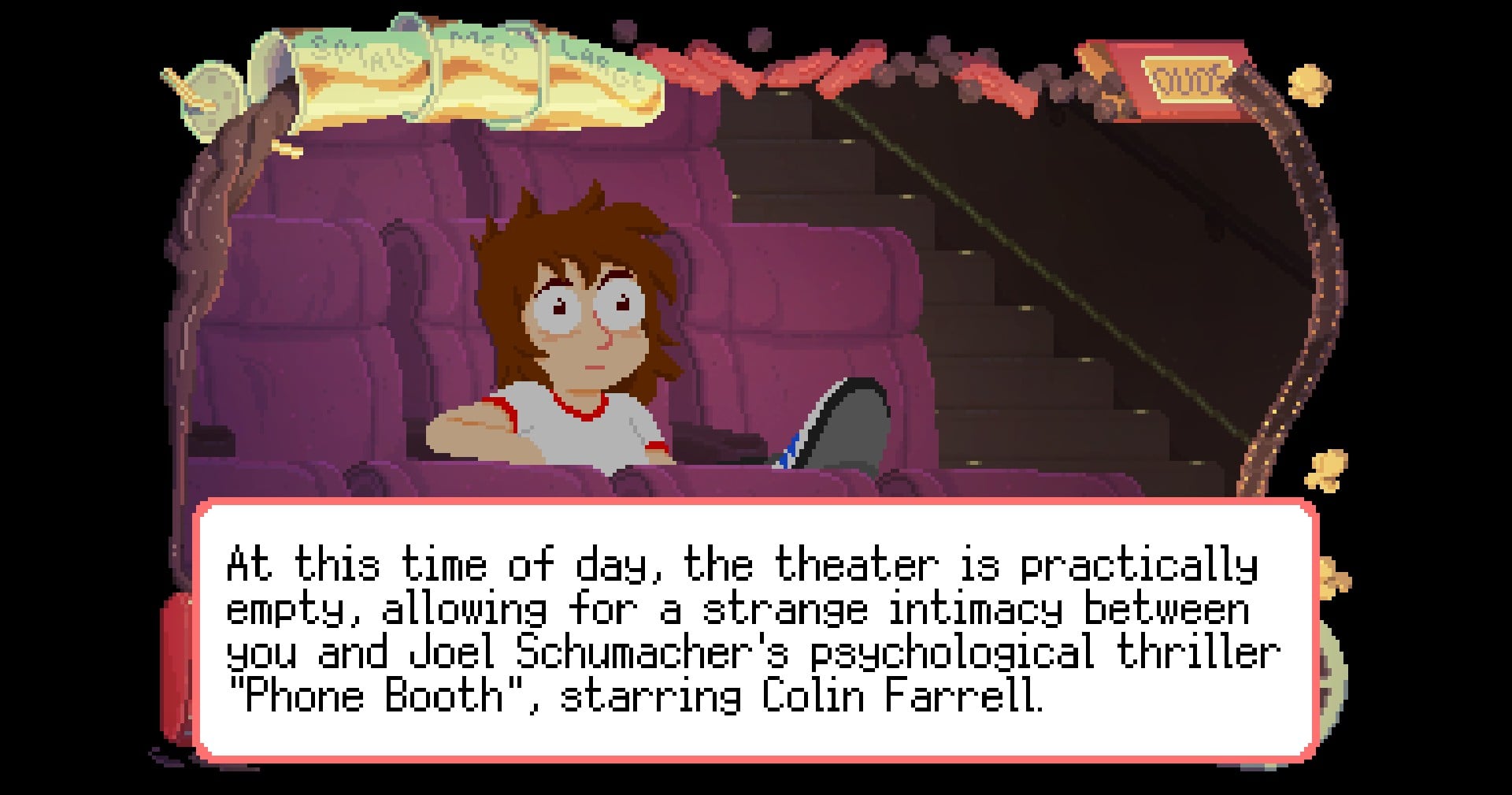
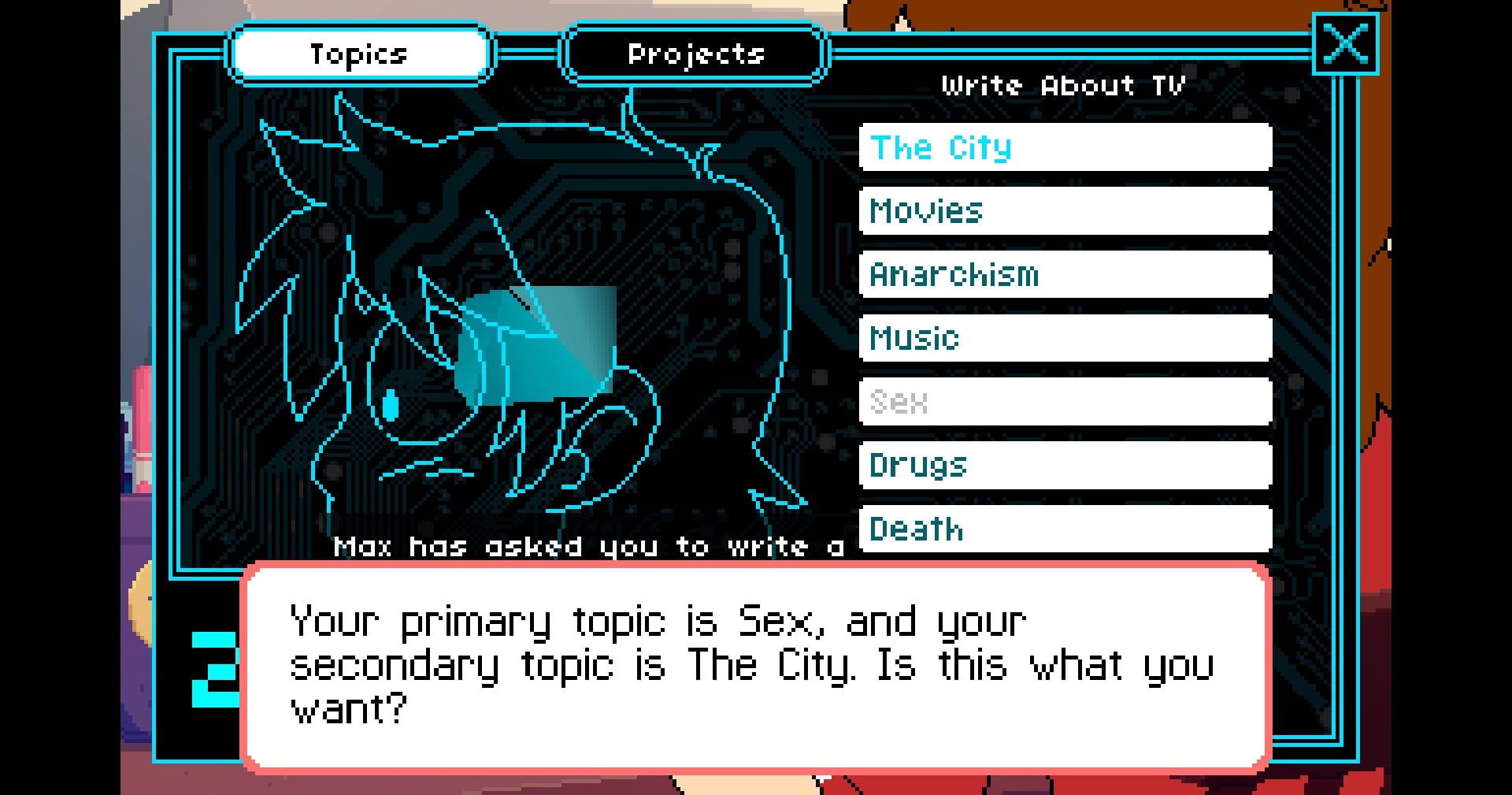
Sometimes you’ll have the opportunity to decide how to spend a particular window of time: will you read a book, write an essay, catch a movie? Once I had Mara fill an afternoon with a trip to the movie theater to watch the 2003 Colin Farrell film Phone Booth, which was maybe not the best use of my time or hers, but it wasn’t wasted, either; films, like books and other experiences, can expand Mara’s understanding of the world around her, helping her develop her own tastes, sensibilities, and convictions. One in-game menu shows Mara’s mind expanding as her knowledge and experience of various topics grows: the city, anarchism, music, movies, sex, death, all that good stuff. The more life experience she has to draw on about a given topic, the more effectively she can write about it. And Mara wants to be a writer.
That’s why she’s so excited when she comes into contact with some heavy hitters in the blogging world; lively, insightful writers forging their own path in a rapidly changing cultural landscape. One of Station to Station’s many remarkable qualities is just how perfectly it captures 2003 as a cultural moment; the shitty politics of Bush and the neocons, sure, but also how exciting it was to see the internet explode into a space where writers were challenging the traditional foundations of publishing, making names for themselves and developing loyal followings by just starting their own websites and doing their own things. For an aspiring writer at the time, what was happening online was electrifying (even if personally I was more galvanized by what I saw happening on a particular gaming website than anything in the blogging sphere). Mara discovers that some of the men she admires so much for their online writing are pretty disappointing in some ways as actual, flesh-and-blood people.
And it’s this constant discovery of herself and of others that makes Station to Station feel so alive. Meredith Gran gives every character a full measure of humanity; they all have their own desires, their own failings. They’re all capable of hurting you or letting you down. This, too, is life. Station to Station has perhaps the most memorable depiction of mindblowing sex I’ve ever seen in a game, but it also has so many moments of lifelike frustration, of quiet beauty, of newfound wisdom. Over the course of 2003, Mara will fall in love, have her heart broken, read some books that broaden her mind, do some formative writing of her own, hurt people she doesn’t mean to, react with pettiness to well-meaning guidance, and find what beauty she can in this wild, strange, joyous, painful, electric experience that is life.
Through it all, we as players are fully immersed in her experience thanks to the game’s keenly observed, period-perfect details. I lived through that year as well—I’m slightly older than Gran, as it turns out—and yet I was in awe of her ability to conjure it so vividly; it’s almost as if she has the ability to step back into 2003 from today just to be sure she has the details right. For instance, in the dingy apartment where the game begins which Mara’s friend Daniel shares with a roommate, there’s a promotional standee for the 2002 film Ballistic: Ecks vs. Sever, a now largely forgotten flick starring Antonio Banderas and Lucy Liu. It’s exactly the sort of random thing you’d expect to see inexplicably lying around a college student’s apartment at the time, and if you examine it, you’ll get the backstory on how it came to be there. And this isn’t a one-off; the game is full of these kinds of pitch-perfect details which, combined, fully immerse us in its early 2000s setting.
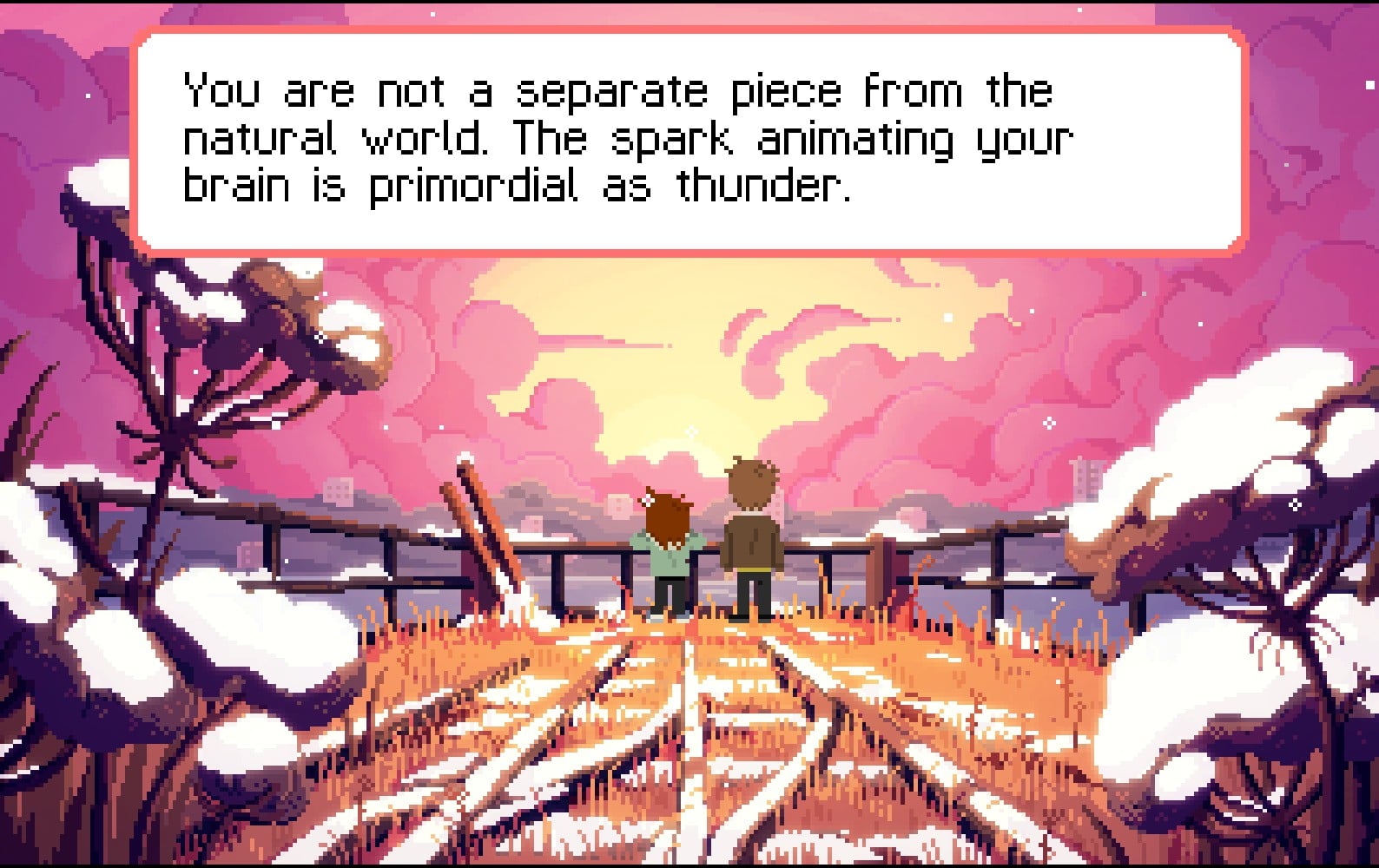
This is a game that knows what life is made of; all the perfect nights with friends, all the loneliness, all the grief, all the frustration with ourselves and others, all the searching and wondering and wanting. This is a game that knows that we take our beauty where we can find it, that sitting outside a bar under a starry sky with a true friend as you talk about the uncertainty of the future is a gift, that there’s wisdom in being grateful for the grace we’re afforded, as imperfect as it may be.
I want to be clear: this isn’t a game I love because I can “relate” to it. There are ways in which Mara and I are similar and ways in which we’re not. She grew up on the East Coast, me the West; she’s cis, I’m trans; she’s straight, I’m queer. She was raised Jewish (though is unsure, in her late teens, just what place Judaism has in her life); I was raised Catholic (though me and Jesus don’t talk much anymore). There are ways in which I envy Mara, and ways in which I feel sorry for her. She’s very much her own person.
And yet for all of its specificity about its time and place, about Mara’s particular aspirations as a writer and her curiosity about the world around her and her desire for love and sex and her uncertainty about what her Judaism means to her and everything else, it made me feel connected to not just her but all of humanity, to all the people who are alive or who have ever been alive. That’s something only a truly great game can do.
Perfect Tides: Station to Station arrives on Switch on May 14. It’s also available on Steam.