



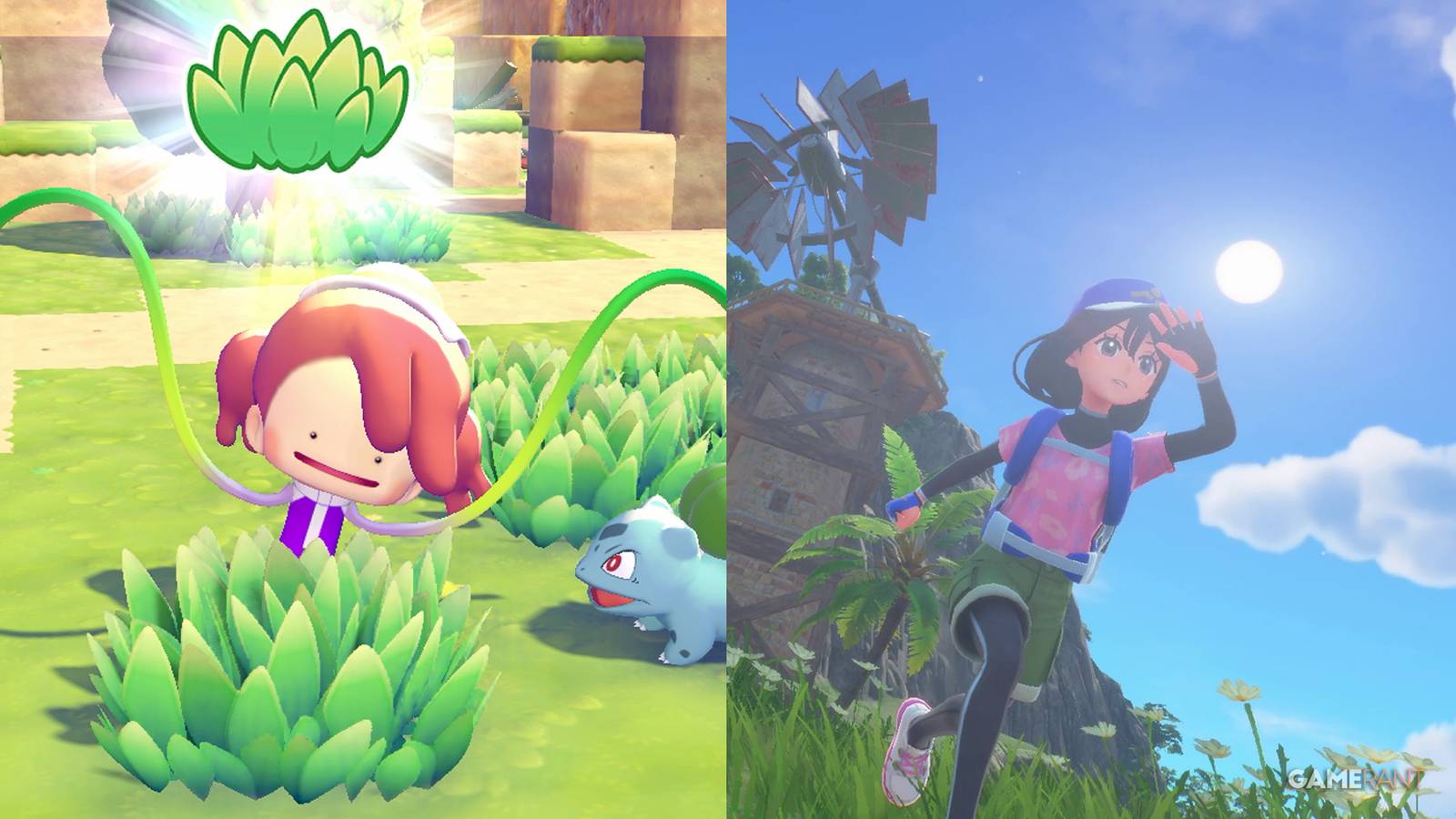
For a series all about the magical powers of 1,000+ kinds of unique creatures, playing as a human in the mainline Pokemon games is actually a pretty weird choice on paper. Pokemon is one of the quintessential power fantasies for children, so it’s natural that the games make a big deal out of creating playable characters that the player can project themselves onto. However, it’s still a missed opportunity that the mainline games haven’t taken full advantage of all the unique ways that playing as the Pokemon themselves could have on the gameplay: namely, by adding direct control of the Pokemon to help make navigating the game world more interesting, like in Pokemon Pokopia. This wouldn’t mean removing the human player character from the equation, but rather occasionally shifting the perspective to a Pokemon in order to explore out-of-reach areas or solve puzzles.
While humans in Pokemon are important for player immersion, Pokopia is a recent reminder of why actually getting to play as the series’ trademark pocket monsters can be much more interesting than being stuck as the trainers simply telling them what to do. Ditto’s toolbelt of different moves to help explore and shape the world around it makes exploring the zones of Pokopia a breeze. By playing as the Pokemon to creatively use so many different moves to explore, navigation feels much more rewarding than just telling Charmander to use Cut to get that one item. In other words, playing as a Pokemon makes running around way more fun than playing as a trainer, and the mainline games haven’t capitalized on that yet.
How to Visit the Dev Island in Pokopia (Developers’ Cloud Island Code)
Players can check out the developers’ island in Pokopia and get inspiration for their own builds – here’s how to visit it.
Pokopia-Style Navigation Could Be What Pokemon’s Open Worlds Need
While Pokemon Scarlet and Violet were fun, the first fully open-world Pokemon games failed to reach the heights they could have. Outside of some of its cities and Area Zero, Paldea’s landscape was largely same-y and served more as a means to an end to finding Pokemon and trainers to battle than solving puzzles to find secrets while exploring. There were various Ominous Stakes to find and some scattered secret items, but it’s not a super-immersive open world.

Balance the critic averages
Balance the critic averages
Easy (6)Medium (8)Hard (10)
And that’s fair – at its core, Pokemon is about battling, not dungeon crawling – but if the games wanted to try the open world, they needed more stuff to do beyond Pokemon and trainer encounters. They needed stuff to discover, different ways to discover it, and to reward the player for that exploration. Paldea’s Ten Sights were a good start, but sometimes the world felt empty, and the player couldn’t really interact with the landscape like they could in other open-world games. And that is what Pokopia did so well.

Pokopia technically isn’t an open-world game, but its individual zones are still expansive and have a lot for the player to do. Beyond building, Ditto’s moveset lets it destroy terrain, reach places other Pokemon can’t, and even turn itself into other objects just for the fun of it. It’s really not different from the Ride Pokemon of the past, or even so-called “HM slaves:” Pokopia’s Ditto has a variety of exploration abilities, and being the one to use those moves directly is more interesting than just watching Charmander use Cut because you told it to.
Accidentally discovering the museum hidden in Rocky Ridges just by playing around with Rock Smash and Rollout was such a fun surprise, and it was well hidden enough that it felt like a real reward — you could go the whole game without finding it, but it’s big enough that there’s real substance to rebuilding it once you do find it. Paldea had Koraidon and Miraidon as the main way to explore, but there weren’t really any clever puzzles or surprises on the map that hit that same way.
Swapping Between People and Pokemon in Gameplay
While carving new caves with your bare hands in Pokopia is fun, the self-inserting aspect of the human Pokemon trainer is still important enough that it can’t just be thrown away. Pokopia itself acknowledges this by having Ditto take on a customizable humanoid form so players can project on it a little better. The mainline titles would need to find a balance between letting the player have their human avatar and finding good moments to switch control to a Pokemon.
A possible answer would be to merge the Ride Pokemon system from games like Let’s Go, Generation 7, and Generation 9 with Pokopia’s hands-on move usage. The player would be free to navigate the region on foot, but to overcome certain obstacles or solve puzzles, they could call on a Pokemon to help them out. But instead of having the player ride it, the perspective would change to the Pokemon itself while the trainer steps back.
In a way, Pokemon Scarlet and Violet’s Indigo Disk DLC allows players to control their Pokemon and explore with them, collect items, and auto-battle.
This would be a little like Super Paper Mario or the Trine series, where the player can swap characters on the fly to solve puzzles and navigate levels. If the player is too big to fit into a corridor to grab an item, they could switch to a small Pokemon like Joltik to crawl in and get it. If they want to scope out what’s ahead, they could send out a Flying-type like Pidgeot to get a look at any upcoming obstacles. If the path is blocked by a rockslide, they could send out a powerful Pokemon like Machamp to punch a new way through the mountain. Gym puzzles could make especially good use of controlling Pokemon to find answers.

The problem is that this sounds like HM slaves with extra steps, especially if the player would have to currently have the exploring Pokemon on their team in order to use them. And while being able to use whatever Pokemon you want in these situations sounds fun, the best way to minimize player burden would be to make the explorer Pokemon be in a separate group from the actual battle party – again, like the Ride Pokemon mechanic.
It could be a lot of fun if the player could still assign Pokemon they’ve caught to a “battle team” and “exploration team,” but having to go and find specific Pokemon to serve those roles in the exploration team could be annoying for players who are more interested in Pokemon’s signature battling mechanics. It would be more efficient to just give the player one specific Pokemon to use for each “navigation” role. They could even just bring Ditto back as a Swiss Army Knife to fill every exploration niche. Even doing something like Koraidon and Miraidon from Scarlet and Violet again could work, as long as the point of view shifted to them and their abilities were more dynamic.

Why Pokémon Pokopia is the Anime-Inspired RPG Fans Have Been Waiting For
Is Pokemon Pokopia truly the best game for anime fans? Given its staggering popularity and the following reasons, it really might be.
Playing as the Pokemon Would Add a Fresh New Perspective
The Pokemon spin-offs in which you play as the Pokemon themselves are some of the franchise’s most beloved games. Beyond Pokopia, the Pokemon Mystery Dungeon series and even the PokePark series proved a long time ago that players are very willing to play as the pocket monsters themselves. With the mainline entries struggling to adapt to exploration trends in modern gaming, playing as Pokemon directly in order to explore would help the series set its own worlds apart from other games among the open-world craze.
As Pokemon regions get bigger and more complex, there are so many ways that the titular creatures could make the worlds more interesting. The Ride Pokemon are good for this, but they could do so much more with them. As Pokemon Winds and Waves are releasing in 2027, Game Freak will hopefully take a cue from Omega Force in both world design and mechanics.

- Released
-
March 5, 2026
- ESRB
-
Everyone / Users Interact, In-Game Purchases