







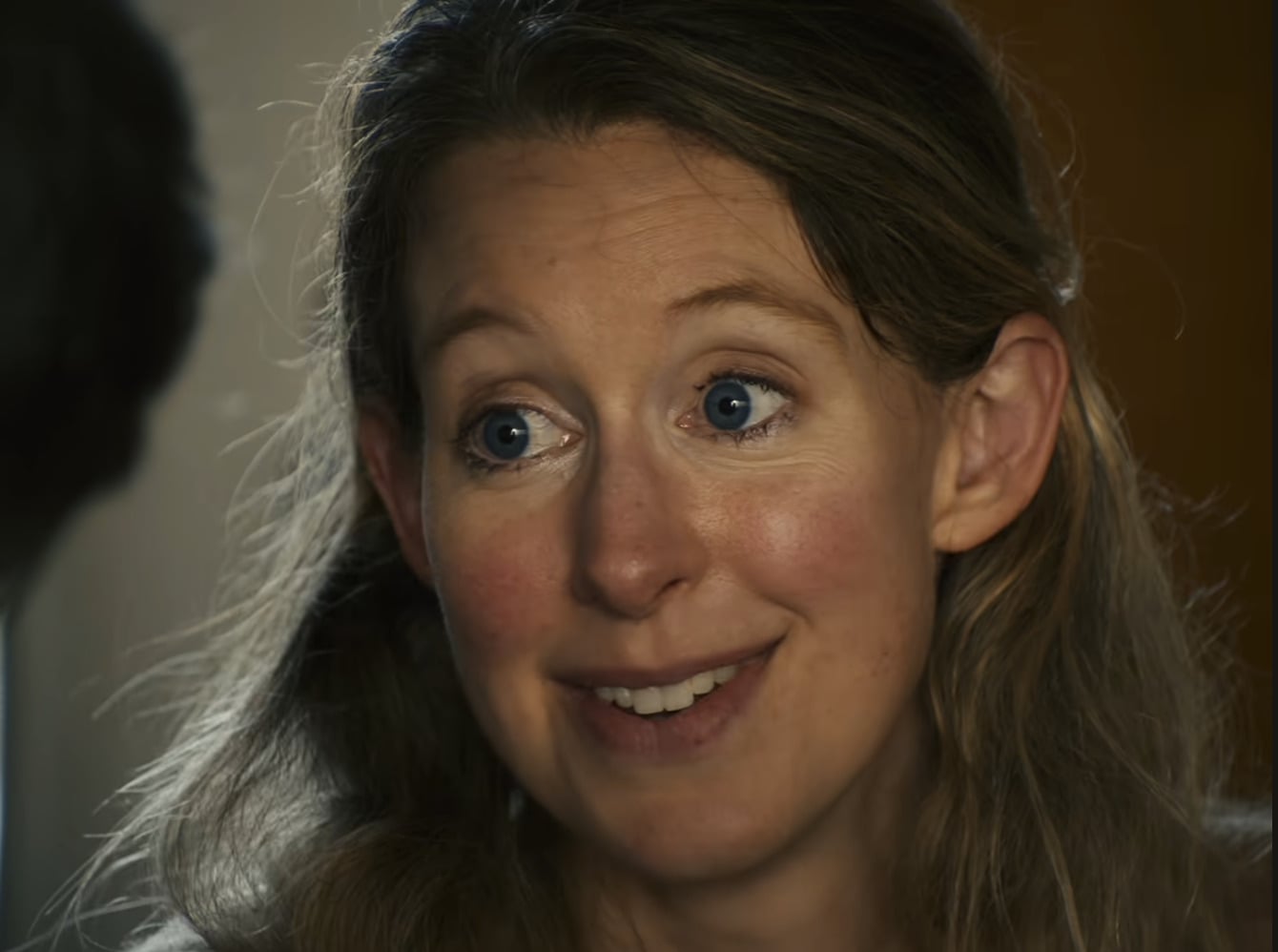
Watching You Can See Everything in a semi-crowded theater was the most kinetic, interactive experience I’ve ever had watching a simple movie…and I’ve been to a Rocky Horror Picture Show screening, crowd participation and all. I gasped, exclaimed, and clawed at my husband as we turned inside out in our seats, both riveted and repulsed by what we were seeing on screen. Is it the movie of the year? Definitely. Does it accomplish what it attempts? Maybe. Maybe not.
In You Can See Everything, Elizabeth Holmes, convicted of defrauding investors of her health tech company Theranos, has 34 days before she must report to prison to serve her 11-year sentence. Naturally, as one does when facing down a decade behind bars, Holmes invited a documentary crew led by Nathan “Nathan for You” Fielder and director Lance Oppenheimer to observe her final days with her two young children and her partner Billy Evans, heir to the Evans Hotels business. Remember that name, it’ll come up later.
Matter of fact, let’s bring him up fucking now. If you have any experience with an abusive or narcissistic person, an early scene involving whisking eggs will set your self-preservation alarm klaxons ringing at full volume. For the first half of the movie’s nearly three-hour runtime I felt myself thinking, “Elizabeth, girl, do we need to come save you?” Though the documentary has been marketed as showing, or attempting to show, Holmes’ true face as a person, we also get a really good look at the person standing next to her, who is just as much in frame, influencing every aspect of her life: what questions she answers for the documentary, what questions her father can answer, her public image, her likeness, her X account, right down to how she whisks her eggs. Elizabeth Holmes may be a convicted liar, but Bill Evans is a fucking monster.
Or at least he’s very good at playing one for the camera.
That’s the thing about this documentary. Sometimes you honestly believe you are seeing real people (their seeming authenticity aided in part by the young children cooing in the background, and there’s no faking the fact that those little ones will be without their mother for possibly more than a decade of their life!) until Fielder and his dogged quest for unambiguous clarity shatters that facade. And it’s not like he’s a lawyer doing a cross-examination; both Holmes and Evans trip over the most innocuous questions in their seeming attempt to stick to the script. There’s a revealing conversation about the definition of the word “can” that will strain the credulity of the most sympathetic of observers. Even Fielder can’t believe some of it, no longer willing to let their tortured definitions and interpretations speak for themselves, breaking kayfabe with a “Liz, come on.”
I recommend seeing You Can See Everything with as full a theater as you can tolerate, preferably with someone you know. Being able to check in with the human next to you like, “Are these people for fucking real?” and hearing their awkward laughs or exclamations at critical moments is integral to getting the full experience. You won’t come away with any deeper understanding of who Holmes is as a real person. You might even have questions about Fielder and how much the distance a documentarian is supposed to maintain from their subject had eroded over the 30-some days he spent with her. You can indeed see everything; whether or not you believe it, though, is up to you.