



While his politics and bigotry have long been part of the parsing, Lovecraftian scholars benefit a great deal by the fact that the namesake died before 1939. Tales of unfathomable beings, the reaches of sanity and proto-steampunk sensibilities are ultimately parceled with race science sentiments and colonial expeditions. A new game from Umurangi Generation creator Naphtali Faulkner seeks to wield the horror genre without excusing its many sins. And how does he accomplish this? Adorable penguins.
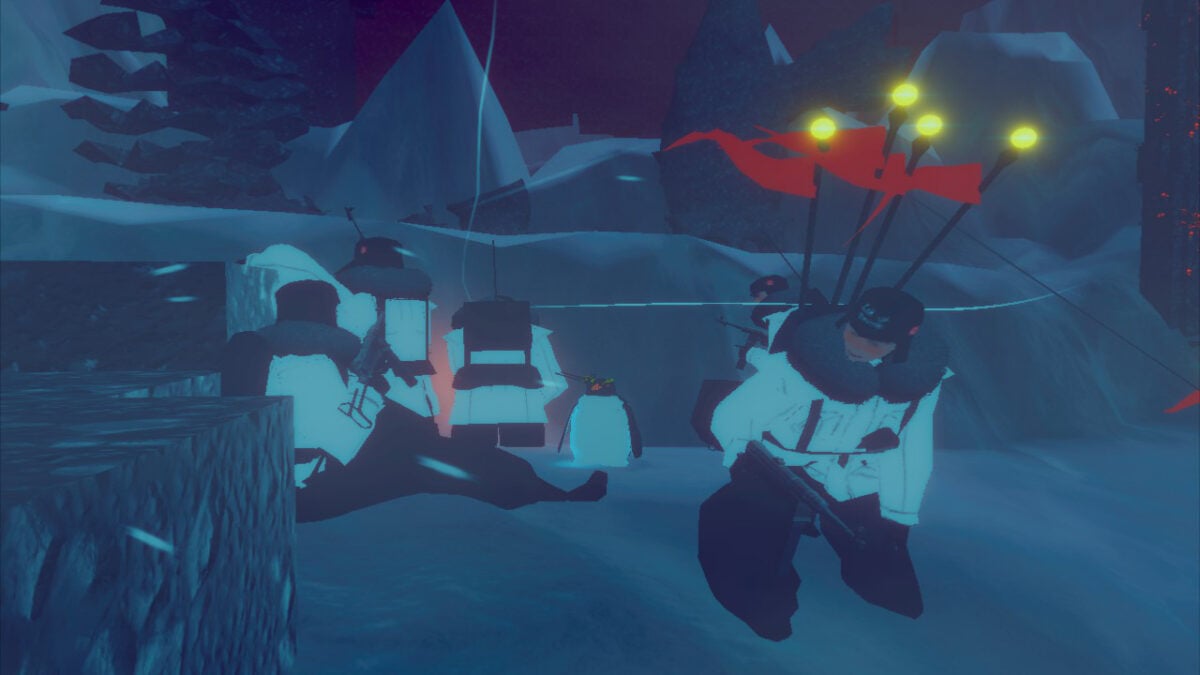
In Penguin Colony, you play as Antarctic birds. A great deal of them. Big emperor penguins. Little baby penguins. Rockhoppers. Chinstraps. By nuzzling up against another penguin, the player can transfer their essence in an instant. Each has alternating characteristics. Speed. Swimming. Jumping. A photo mode. And while it’d be dandy enough to belly slide around the tundra, their harsh but uncomplicated lives are upended.

With dabs of alternative history, the game retells Lovecraft’s At The Mountain of Madness, this time with Nazis unlocking the ice sheets instead of well funded New Englanders. Learning of an ancient god, captured in frost, their research team attempts to uncover the deity. Aiming to prove their racial purity through the ancient one’s likeness. As you might’ve guessed, the visage they discover does not resemble their own, unleashing a shapeless, mind melting terror. The penguins, far more suited for this environment in multiple aspects, are along for the ride. Waddling deeper into the tombs. Pecking shards of forbidden knowledge.
There have been plenty of Nazi bopping Lovecraft send-ups (Hellboy comes to mind). Faulkner attacks the fundamentals of the genre, wielding Lovecraft’s own oeuvre against him. In his stories, anthropologists suffer the folly of curiosity, but it is funny how often western academics in his work bring reality itself to the brink of undoing. It does not have to be on a cosmic scale how out of their depth these explorers are. Spliced between chapters are flashes of local indigenous caretakers, cleaning up the messes of self-inflated travelers for generations. Their segments feel, intentionally, like clips from other games. One half-minute chunk as if you accidentally sat on the remote’s input button, hopping in and out of an active Nightreign session.
As critical as the game’s thesis is, it knows you can’t be an overly critical penguin. Jumps make a precious little anime noise. As Nazi soldiers flay their own faces and pull intestines out like paper towels, you’ll be too busy with bellyboarding stunts. The deeper eeriness is in the scope. The game is narrated by Lenval Brown, whose voice feels like honey in your ear as it had in Disco Elysium. The landscape is vast, dark and howling. There are secrets and sights hidden throughout, often requiring you to shepherd specific penguins to best platforming challenges. These levels are built to accommodate existing jank (rockhoppers seem to have magnetic feet), but admittedly there were at least three times I found myself hopelessly wedged into a crevice in an un-eldritch way.
When I spoke to Faulkner for my zine last year, he told me he would never make you watch a penguin suffer. This is mostly true. While their nestled stance could be mistaken for ominous prayer, they are not phased by the seeping mass of elder gods as humans. You can fall into a pit or be corrupted by the shoggoth, but the game will snap you to the next available penguin. Much like playing as a photographer to an apocalyptic war in Umurangi Generation, you are here as an observer more than an interfere. You pace through impossible architecture simply to witness. It is your world. It is being upended by dolts. But defying the fabric of time and space out of hubris is not for the birds.