


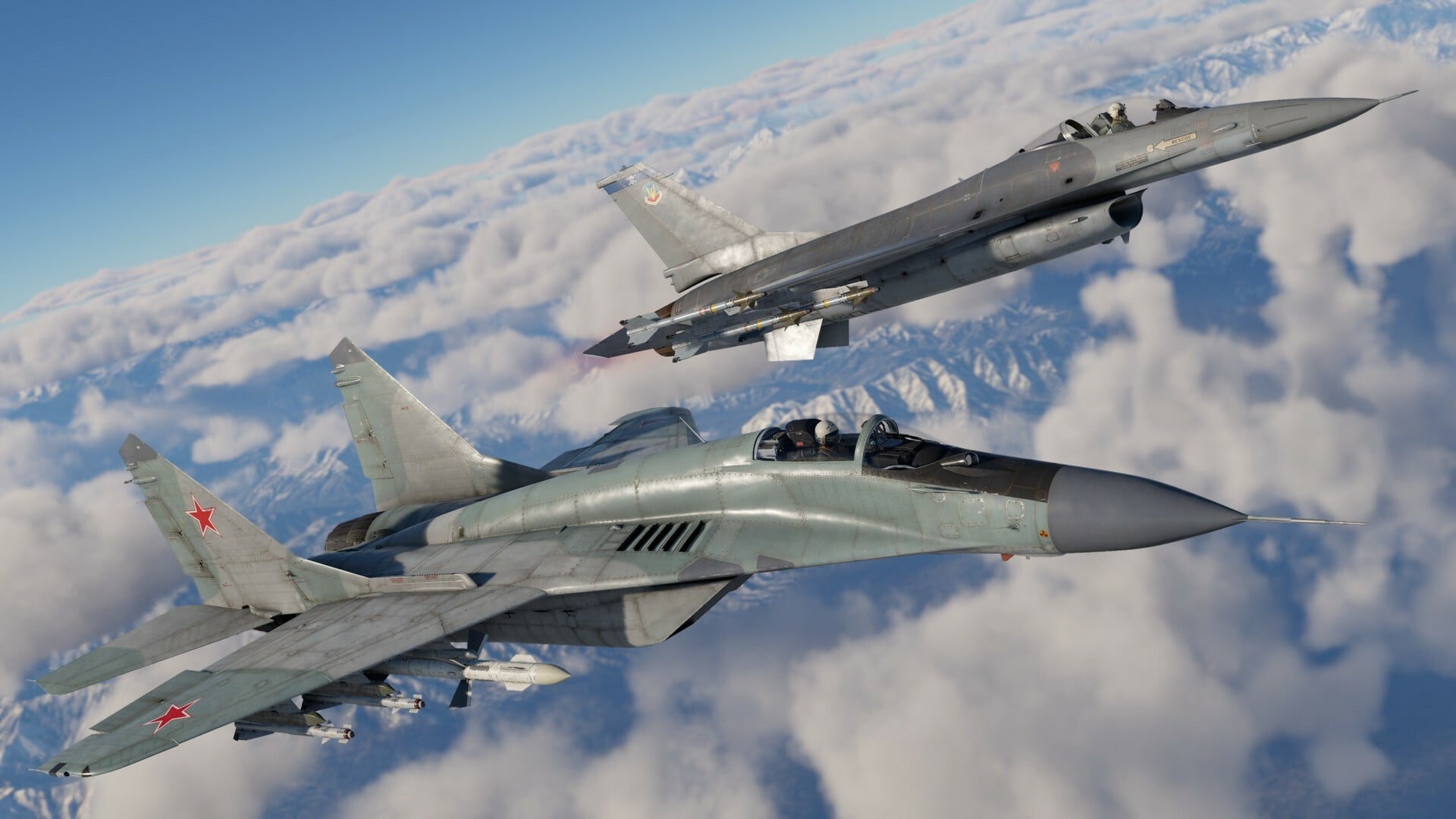
Some in the War Thunder community are currently deeply unhappy with the state of the military vehicle combat sim and the developers at Gaijin Entertainment over a number of issues, including the use of an anti-cheat program that can allegedly snoop on and even steal players’ personal files. And some players—specifically hackers—are so pissed off that they’re making some less-than-flattering accusations about the developer in response, including claims that Gaijin has been using classified government documents during development. Gaijin completely denies both allegations.
Hop in your jump seats and buckle up, folks; this is a weird one.
Even if you don’t play War Thunder, you’re probably familiar with the community’s penchant for seemingly leaking classified government documents all the time in the name of championing authenticity. While a few of these leaks definitely were of classified documents (including the one linked above), those have been mixed in with other stories popping up every few months in which the documents in question were actually publicly available and were fine (or at least fine-ish) to be shared. But regardless, the constant flow of stories like this has given the community a reputation.
So it’s fascinating that now, War Thunder hackers are claiming that developer Gaijin Entertainment is guilty of the exact same thing. In a lengthy post on Discord screenshotted and saved to Reddit, a hacker/leaker is alleging that Gaijin has been using “export restricted and classified documents…internally in game development.” The poster includes what they claim are screenshots of developers discussing and using two specific examples of export-restricted documents in internal conversations around updating certain vehicles for accuracy.
Export-restricted documents are subject to a number of rules, restrictions, and penalties around their use that vary depending on country of origin, their purpose, who is accessing them, why, where, how, and whether or not those involved are aware of their classification. While it’s difficult to say exactly how severe these two specific claims are without more information about the origins and classifications of the documents, the allegations at minimum seem to involve information about the internal workings of a country’s military equipment.
Casual use of such documents in game development, particularly as a part of efforts to replicate and distribute an accurate model of the equipment, would be at the absolute minimum frowned upon by most governments. But even assuming there would be no technical legal issue with the two examples the leakers are offering, the poster also claims they are aware of “more severe instances” of this behavior they have yet to disclose—seemingly of straight-up classified documents, which would presumably be of even greater concern. (Thank you to national security lawyer Kel McClanahan of National Security Counselors for the extremely helpful rundown of classified documents).
Wilder still, though, is that this information isn’t being leaked out of nowhere. The leaker claims they’ve been sitting on this information for a long time, and are only sharing it now in seeming retaliation for “corruption and malpractice” at Gaijin Entertainment. Specifically, they call out a recent update to the game’s Viking AC (anti-cheat) that multiple leakers claimed was collecting personal and irrelevant user data and sending it back to Gaijin, including screenshots of individuals’ screens and personal files. They allege that Gaijin quietly turned this off after the information was brought to light.
The anti-cheat allegations first dropped around a month ago, and Gaijin Entertainment issued a response at the time via community manager Stona_WT. Stona acknowledges the use of Viking as an anti-cheat, and admits that it does process player data in an effort to curb cheating. However, they continue, “any data processing associated with anti-cheat is limited to what is necessary to support fair gameplay, and that the solutions used in connection with War Thunder are designed to operate in accordance with our Terms of Service and applicable legal requirements.”
“We take user privacy seriously and strive to ensure that our data handling practices align with established data protection principles, including those reflected in GDPR and other relevant regulations,” they continue.
Not everyone was satisfied with this statement. Since these issues were first brought to light, a number of users have been pushing for a review bomb of War Thunder on Steam, though others are criticizing those calls on the basis that the War Thunder community calls for review bombs so often that people have stopped paying attention. That’s because for months now, the community has been dissatisfied with a number of other issues, including alleged poor communication on the part of the company, game-breaking bugs, aggressive monetization, and a perceived bias toward Russian vehicles over those of other countries. There’s also a Reddit thread still circulating from a former Gaijin Entertainment community manager claiming that the company had been sloppy with players’ personal data in the past, further heightening the tension.
Even so, the community is divided. Not everyone believes that the anti-cheat is doing what leakers say it does. Others are pointing out, correctly, that the two examples given by the hackers relate to fairly vague discussions of “export restricted” documents, which is a broad category that could encompass all sorts of documents of varying severity. And some people are noting that all this information is coming from…hackers. You know, people who hack the game in ways that are often detrimental to the experience of players who play by the rules. Why should they listen to hackers in the first place?
Gaijin Entertainment, meanwhile, denies everything. The company provided Kotaku with lengthy responses to all these accusations. It again denies claims that the anti-cheat it uses is harvesting unnecessary user data, saying that while it does use third-party anti-cheat tech that may require access to system-level information, that information is used solely to prevent cheating, is fully within “the boundaries of applicable law,” the company’s Terms of Service, and GDPR, and does not involve “arbitrary surveillance, unauthorized access to personal files, or indiscriminate collection of user data.”
“We are not planning to remove anti-cheat functionality, as it is essential for maintaining a fair and competitive environment,” Gaijin continues. “At the same time, we remain committed to continuously reviewing and improving our data protection practices, ensuring transparency where possible, and maintaining player trust through responsible handling of any data involved.”
With regards to the allegations of export restricted documents, Gaijin says this is a misunderstanding, and asks players to take a closer look at the claims themselves. “Even if the screenshots in that post are genuine, what do they actually show? Someone whining that it’s unfortunate we can’t use export-restricted documents.”
“To be clear, we cannot and will not use any classified or restricted materials,” Gaijin’s statement adds.
Finally, Kotaku also asked Gaijin about the general community frustrations around communication, bugs, and frustration over lack of response to feedback that’s led to multiple review bombings in recent months. Gaijin had the longest response for this one, so here it is in full:
War Thunder is a large-scale live service game that receives five major updates each year. Every update brings in enough new content to rival a standalone title, so it’s only natural that we need time to refine and balance it to ensure the best possible experience for players.
We do prioritize critical issues – game-breaking bugs such as client crashes are detected and fixed as quickly as possible, since they impact the entire player base. At the same time, many players are concerned with more specific aspects, such as the combat performance or armament of particular vehicles. These concerns often come with conflicting expectations: for the same vehicle, one group may ask for improvements, while another insists on the opposite. From each player’s perspective, this can feel like a clear issue, but in reality we have to carefully evaluate the data and work toward a balanced solution. The same kind of conflicting feedback applies to game modes and maps as well.
Over the past year, many players have noted that we’ve become more open in how we communicate, and that’s something we’ve been consciously working on. Over the last couple of years, we’ve been shifting our approach – moving toward more direct communication from developers themselves, explaining what we’re doing and why (i.e. these series of posts https://warthunder.com/en/news/9897-development-community-update-no10-starting-the-year-off-en). This more transparent and immediate dialogue has generally been received better than more frequent but indirect communication through community managers alone. We’ve also improved our bug fixing communications and started a new post series on our website telling what we fixed exactly (https://warthunder.com/en/news/?tags=Fixed).
At the same time, the scale of the game presents its own challenges. Different parts of the community care about very different things, and it’s not always possible to address every question individually. In fact, responding to highly specific and often contradictory requests typically requires far more time and effort than addressing broader topics where there is clearer consensus.
That said, we still don’t always get the communication right. At times, we act before we fully explain our decisions, and that can lead to confusion. But we remain committed to listening to our players and guiding the game’s evolution in a direction that keeps it engaging and enjoyable.
The community’s response to Gaijin’s statements remains to be seen, but taking the company’s words at face value doesn’t change the fact that the War Thunder community seems overwhelmingly unhappy. Even those who don’t necessarily believe the leakers sound exasperated, either with the developers or the rest of the community or the state of the game or all three.
Meanwhile, the review bomb effort is…kind of working? War Thunder’s recent Steam reviews are currently “Mixed” with only 66 percent of them positive, though its overall reviews remain “Mostly Positive” at 74 percent. Steam’s “exclude off-topic review activity” filter has kicked in by now, but turning it off reveals a surge of negative reviews from players with tens, hundreds, even thousands of hours of playtime. Most of these reviews call attention to one or more of the recent accusations or, at minimum, mention the growing unrest around bugs, communication, and more. One negative review from two days ago, from someone with nearly 500 hours in-game, sums it all up pretty well. It just says: “listen to the community fam.”