


Throughout the decades, the FPS genre underwent so many changes that masterpieces of yesteryear eventually became unplayable. A 2002 FPS game doesn’t need to hold up in 2026 to be considered great, but very few folks play a classic simply to experience history. They still need to be fun enough to enjoy… and, in very rare cases, they might be even better now than they were at launch.
Yeah, these FPS games defeated Father Time.
Frankly, only a handful of titles qualify for this topic, and most single-player FPS games from the ’90s and 2000s have aged like milk in the sun. The exceptions deserve all the praise in the world for their forward-thinking mechanics, innovations, and sheer quality, all risky stuff that could have backfired during their heyday.
- Only post-2000 games will be considered.
- I will mention mods or similar stuff that are vital nowadays.
- Single-player only.
- I’m focusing almost exclusively on the gameplay, not the story or themes.
F.E.A.R. Was Decades Ahead Of 2005
An FPS Masterpiece With Second-To-None AI
- GOAP AI always impresses.
- Perfect blend of horror and action.
- Runs mostly well on modern systems, but the DirectInput bug causes slow-downs. PCGamingWiki has the steps on how to fix it (just added dinput8.dll to the game’s folder).
Whenever an opportunity presents itself to write about F.E.A.R., I simply must take it. While the sequels are fairly generic for their era, the original game perfected the horror FPS hybrid formula, to the point of arguably setting a standard that has yet to be surpassed. F.E.A.R. manages to be a technical marvel, a tribute to J-horror, and an all-around fantastic military shooter with a unique atmosphere.
The “Goal-Oriented Action Planning” AI is still Monolith’s crowning achievement, and it helps ensure F.E.A.R.‘s timelessness. Rather than brain-dead AI who follow the same steps over and over again, enemies dynamically react to their surroundings to formulate a plan to achieve their goal (which is usually something simple like “kill the player). This technology injects an element of emergent gameplay into situations that most modern shooters cannot replicate, allowing repeat playthroughs to feel different since they are influenced by your actions.
GOAP is the main reason that F.E.A.R. has only gotten better with age, but it isn’t the only one. The game’s free-flowing environmental destruction physics put to shame so many newer titles that rely on set-pieces. You can turn a hallway into a warzone. Even the level design’s interconnected arenas has aged well, as it doesn’t allow players to simply adopt a cover-shooter approach.
S.T.A.L.K.E.R.: Shadow of Chernobyl Is Literally Better Nowadays
A Survival FPS Classic That Still Feels Ahead Of Its Time

- A-life.
- The survival horror atmosphere feels pretty modern.
- Community fixes are plentiful, and you can just install the Zone Reclamation Project to fix most of the vanilla game’s bugs and issues.
Jank can be part of the charm of certain games, particularly mid-2000s European projects that seem to be held together with duct tape and prayers. However, when the jank transitions into bugs, crashes, memory leaks, and stuttering, any charm quickly dissipiates, leaving behind only frustration. S.T.A.L.K.E.R.: Shadow of Chernobyl was special right out of the gate, but its technical issues guaranteed cult classic status rather than anything more.
Nowadays, community patches improve the vanilla content so much that you should be able to avoid many of the classic pitfalls, and modern CPUs and SSDs also make a massive difference. Simply put, playing Shadow of Chernobyl in 2026 is a better experience than playing it in 2007.
All of the above wouldn’t matter if the core experience didn’t also age gracefully, and Shadow of Chernoyl certainly has. Similar to F.E.A.R., the survival FPS game’s longevity can be partially credited to AI, specifically A-Life. GSC designed the Chornobyl Exclusion Zone to exist independent of player intervention, creating a breathing world that feels way, way more alive than nearly every other open-world release.
SWAT 4 Is Irrationally Brilliant
The Best Tactical FPS Game Ever?

- Randomized missions, endless replayability.
- Rules of engagement.
- SWAT 4: Gold Edition is readily available on GOG, and the site also has the must-install Elite Force mod.
I miss SWAT, and the last numbered entry was something special. In-between System Shock 2, Tribes: Vengeance, and BioShock, Irrational Games dipped its hands into the Police Quest franchise, crafting a title that stands to this day as one of the purest tactical shooters. Rather than a high-octane thrill ride with tactical gameplay, SWAT 4 forces you to actually analyze a situation to find the best approach.
Instead of going through a story, the core game revolves around independent missions, casting you as a police officer on dispatch. Every time you load a level, SWAT 4 randomizes a few key elements like enemy and hostage placement, access points, and even traps, ensuring that you cannot just mindlessly hit the same beats in every run. Players need to carefully guide their four-man squad, and the interface still looks great.
SWAT 4 features strict Rules of Engagement that punishes unauthorized or excessive force, and you need to do “basic” things like identify yourself as a cop.
The Chronicles of Riddick: Escape from Butcher Bay Is More Than Just An FPS Game
High Quality Licensed Games Are More Of A 2020s Thing Than A 2000s Thing
- Hybrid that shines in all areas.
- Great licensed games are very much a new thing.
- Play the 2009 version, if possible.
Why were the Riddick games so great? I’m talking about Escape from Butcher Bay in this article, but Assault on Dark Athena deserves its flowers as well (and it came with a remaster of Butcher Bay).
Released at a time when movie tie-in games were bargain-bin fodder, Escape from Butcher Bay defied expectations by being kind of groundbreaking. Rather than another generic shooter, Starbreeze put together a genre-blender that expertly combined stealth, melee brawling, and ranged combat, all presented in an immersive sim coating that rivals the likes of Deus Ex and Dishonored. All three elements combine surprisingly well, and they are amplified by the campaign focusing on hubs rather than corridors.
Bolstered by a minimalist HUD that feels modern, Escape from Butcher Bay loaded Riddick’s entire model, allowing players to actually see the character’s torso or legs. That might sound unspectacular nowadays, but it wasn’t uncommon for a 2000s shooter to essentially star a floating camera with a gun. This sounds cliché, but you really start to feel like Riddick by the end of a playthrough.
Far Cry 2 Is Ubisoft’s Most Un-Ubisoft FPS Game Ever
Setting The Stage For A Million Open-World FPS Indie Games

- Minimalist HUD.
- Survival elements.
- Far Cry 2 runs great on modern systems.
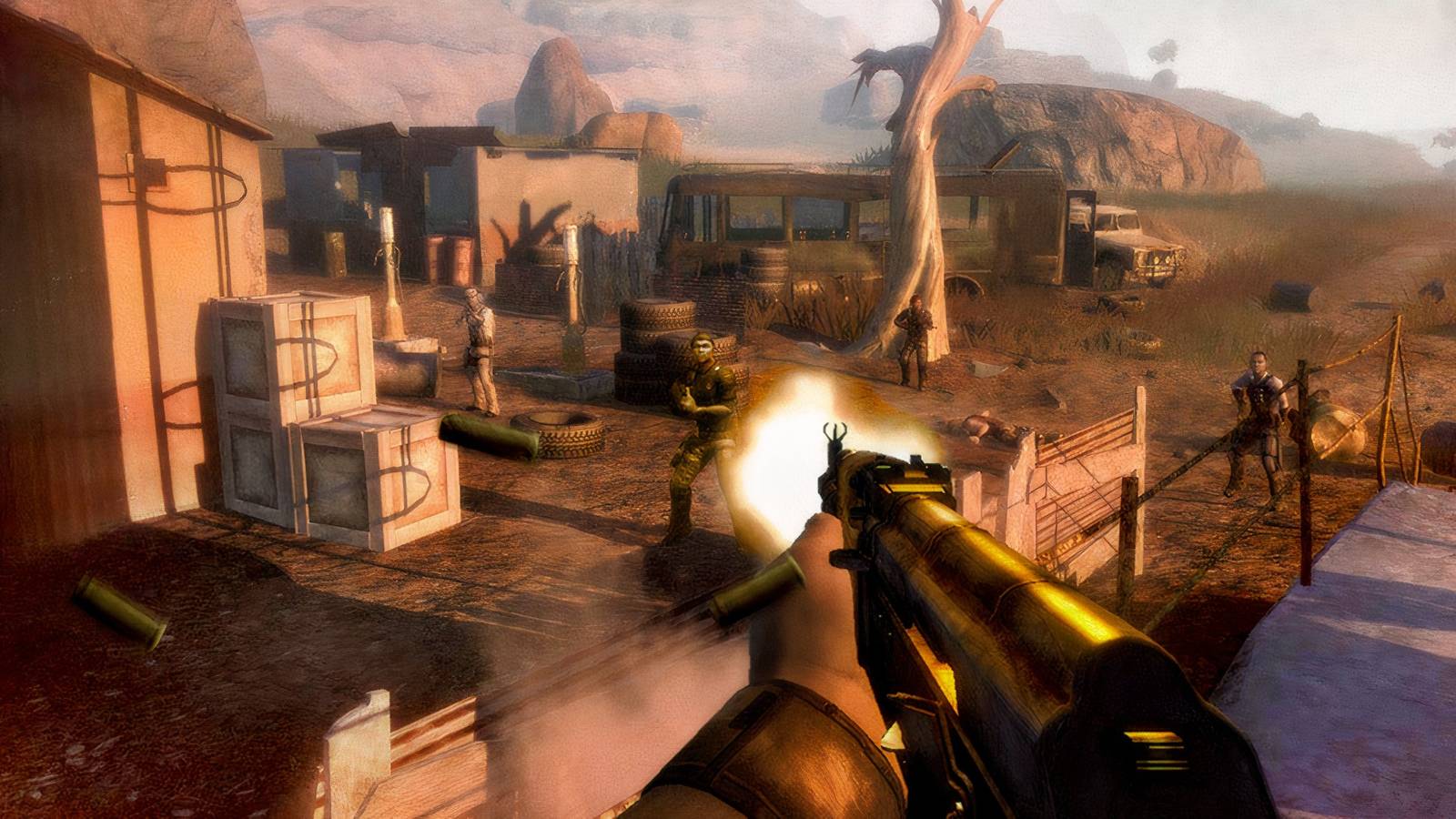
I imagine this one might be a touch controversial, as tends to be the case whenever an Ubisoft open-world game is concerned. Even today, Far Cry 2 is still polarizing, and most people ignore everything that came out before the third entry. While I personally prefer some of the subsequent releases, Far Cry 2 is the only game in the series that has improved with age.
We live in an era dominated by survival-shooter open-world indie games that sell themselves on their brutality; meanwhile, AAA titles grow increasingly more sanitized and unwilling to take risks. Far Cry 2 seems like something Ubisoft would never create nowadays, as it makes decisions designed to maximize the player’s discomfort. “Realistic” might still be a stretch, but the game goes out of its way to preserve the illusion by, for example, forcing you to pull out a paper map to see where to go next.
Far Cry 2 is a modern indie darling created by an AAA studio, one that emphasizes unscripted sandbox encounters, features permadeath for buddies, and malaria. I wouldn’t necessarily say FC2 is the most fun FPS ever, but it feels more at home in 2026.
I will say, a few story elements haven’t aged extremely well, but nothing too bad.
Deus Ex Is A Forever 10/10
Still A Wildly Impressive Immersive Sim, RPG, And FPS Game
- Branching paths.
- Augmentation system.
- Deus Ex doesn’t run flawlessly on modern PCs, and you probably will need to get Kentie’s DeusExe.
I don’t think it would be outrageous to say that Deus Ex is the greatest immersive sim of all time. Sure, nostalgia might play a factor, but it isn’t just rose-tinted glasses. Speaking strictly about its gunplay, Ion Storm’s magnum opus doesn’t leave a stellar first impression, as weapons initially feel stiff and inaccurate; however, that makes sense when the player realizes that their RPG skill points determine their performance.
That’s the thing to keep in mind. Deus Ex is an RPG sim that happens to have FPS gameplay. Approaching it as a standard member of the latter will not result in a good time, and patience is required to get into the flow of things. However, once that happens, you find a game that grants so much player freedom. This isn’t an illusion of choice; you get to decide how to act and solve objectives, along with picking augmentation that fits your playstyle.