

Fire Emblem: Fortune’s Weave just received its own dedicated Direct ahead of its September 17, 2026 launch, and Nintendo used the majority of the presentation to explain the Heroic Games, the four warriors competing in them, and the major systems and mechanics players can expect from the game. Initially, the upcoming tactical RPG’s premise seemed fairly straightforward, with four heroes entering a prestigious competition where the winner will supposedly be granted any wish they desire. Each hero has their own motivation for participating, and players will be able to experience all four of their stories while gradually preparing their armies for the next major battle. That alone is already enough to build an entire game around, but Nintendo had to go and spoil what could have potentially been Fire Emblem: Fortune’s Weave‘s biggest twist, right there in the Direct—to the point that many of us probably wish we hadn’t even watched the presentation.
For nearly 19 minutes, the Fire Emblem: Fortune’s Weave Direct focused on Kai, Dietrich, Theodora, and Lita as the stars of the show, only to suddenly jump five years ahead of the Heroic Games and reveal that Dagda is on the verge of destruction, all four heroes have vanished, and none of them is actually the story’s true protagonist. Instead, that role belongs to a mysterious soul summoned to confront the demon god Balore or travel through time and change the four heroes’ fates. It’s an incredible premise and one that completely recontextualizes everything shown before it, but that’s precisely why it feels like something players should have discovered for themselves rather than having it casually revealed before the game is even out.
The Heroic Games Is Apparently Only Fire Emblem: Fortune’s Weave’s Opening Act
Again, for most of the Direct, Fortune’s Weave is presented as the story of Kai, Dietrich, Theodora, and Lita—four heroes who have entered the Heroic Games for very different reasons. Kai wants to rescue his imprisoned father, Dietrich wants to find stronger opponents, Theodora hopes to restore honor to her people’s faith, and Lita is pursuing the person responsible for murdering her father. Their goals are simple enough to understand, but personal enough in nature to make each of the four distinct campaigns feel worth experiencing.

Guess the games from the emojis.
Guess the games from the emojis.
Easy (120s)Medium (90s)Hard (60s)
It was even confirmed during the Direct that players can switch between the four heroes at the Pale Raven’s Perch, with each hero’s progress saved separately. That means their stories can be played alongside one another rather than requiring completely separate playthroughs as Fire Emblem: Three Houses required. Each hero can recruit different allies, travel across the continent, explore dungeons, and prepare for scheduled tournament matches, all while moving closer to the final stage of the Heroic Games and the wish waiting at the end.
Fire Emblem: Fortune’s Weave Key Features Revealed During the Direct
- FOUR PARALLEL HERO CAMPAIGNS – Follow Kai, Dietrich, Theodora, and Lita through interconnected personal stories.
- FREELY SWITCH BETWEEN HEROES – Change protagonists while preserving separate progress across all four campaigns.
- CLASSIC GRID-BASED TACTICAL COMBAT – Position units, exploit terrain, and manage dangerous enemy counterattacks.
- EXPANDED WEAPON AND MAGIC OPTIONS – Wield swords, gauntlets, spears, axes, bows, spells, and rarities.
- WEAPON-DURABILITY COMBAT ARTS – Spend durability to unleash stronger attacks, extended range, or tactical effects.
- HEALTH-COSTING BLAZE ARTS – Sacrifice hero health to activate powerful, battlefield-changing special abilities.
- FULL BATTLE TIME REWIND – Reverse individual moves and return to any previous battlefield point.
- THREE-TIER CLASS PROGRESSION – Advance through beginner, specialty, and advanced classes with unique strengths.
- LIMITED-TIME CITY PREPARATION – Train, shop, upgrade weapons, volunteer, and take certification exams between matches.
- RELATIONSHIP-BASED CHARACTER RECRUITMENT – Recruit warriors through gifts, meals, conversations, and repeated personal interaction.
- CONTINENT-WIDE WORLD MAP EXPLORATION – Visit towns, encounter enemies, gather information, and discover optional destinations.
- DUNGEONS WITH SEPARATE TURN-BASED CLASHES – Explore for materials and fight using coordinated party combos.
- TIME-PASSING TRAVEL AND ACTIVITIES – Every journey and preparation choice advances the campaign’s limited calendar.
Now, had Nintendo ended the Direct there, players could have reasonably assumed that Fortune’s Weave would spend most, if not all, of its runtime following these four competitors and their stories. Perhaps their stories would eventually intersect, the tournament’s true purpose would be exposed, and the heroes would be forced to set aside their rivalries to confront a shared enemy. That would be a fairly predictable Fire Emblem plot line, but there would still be plenty of mystery surrounding how it happened and what role each hero played in the larger conflict.
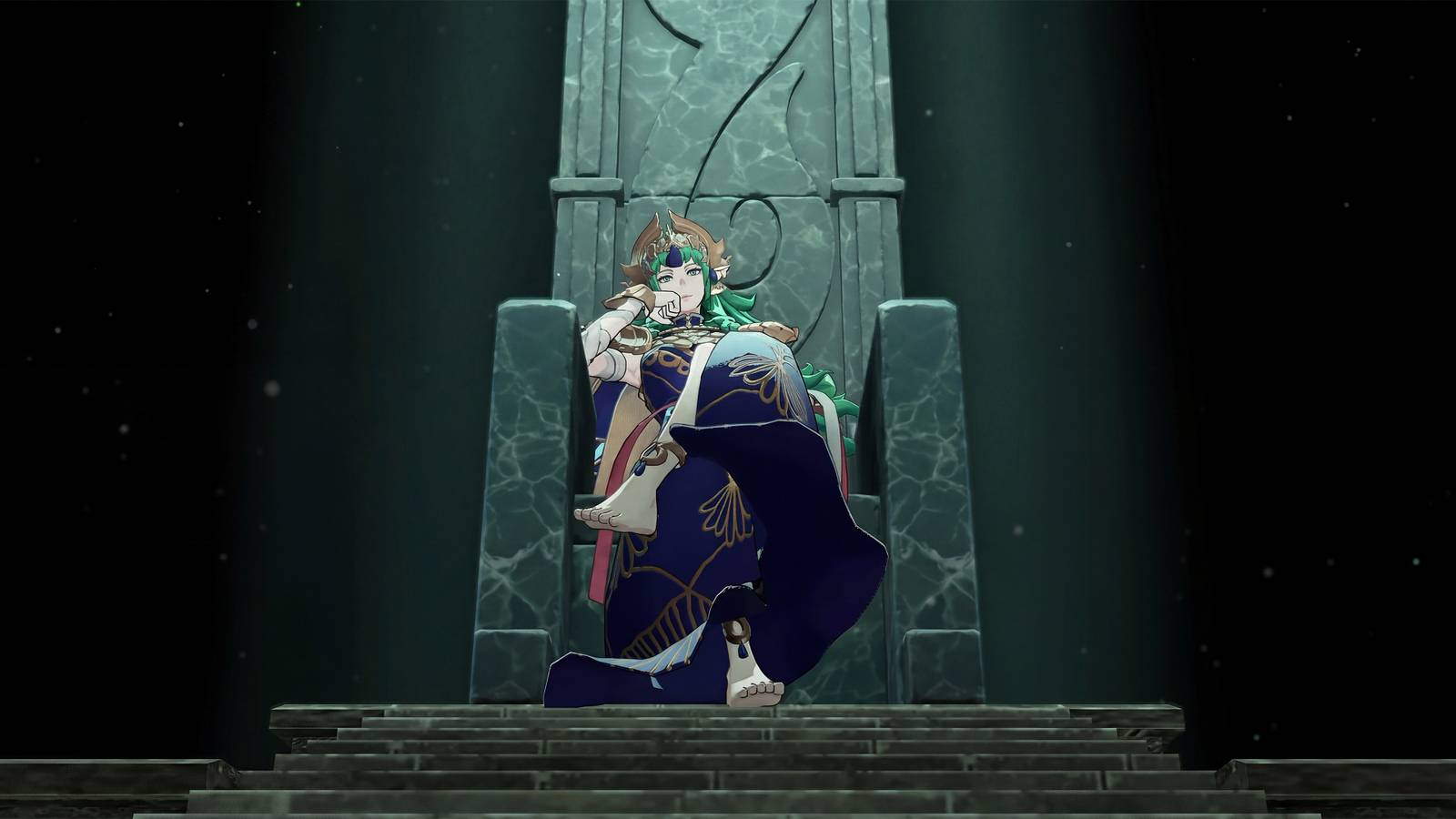
Instead, the Direct skips five years into the future and explains exactly how badly everything goes. Five years after the Heroic Games, Dagda is apparently facing destruction at the hands of the revived demon god Balore. Even more surprisingly, the four heroes who played such an important role in the tournament have all vanished. The progenitor god Sophus then summons a single soul, whom the Direct openly identifies as the story’s “true protagonist.” This character can either face Balore’s forces directly or use the time-traveling powers of Fortuna to return to the past and change the fates of the four missing heroes.
Nintendo had to go and spoil what could have potentially been Fire Emblem: Fortune’s Weave‘s biggest twist, right there in the Direct—to the point that many of us probably wish we hadn’t even watched the presentation.
In light of all this, the Heroic Games are no longer simply the central competition driving the story forward in Fire Emblem: Fortune’s Weave. Rather, they are part of a doomed timeline that the true protagonist may eventually need to rewrite. Likewise, Kai, Dietrich, Theodora, and Lita may be the faces featured throughout most of the marketing, but Nintendo has already clarified that none of them is technically the game’s true protagonist. They are important figures whose decisions somehow contribute to Dagda’s future, but the player-controlled soul appears to be the person responsible for connecting their stories and preventing the end of the world.
Fire Emblem: Fortune’s Weave’s Direct Reveal Could Have Been an Incredible Surprise
To be fair, Nintendo may have had a good reason for revealing Fortune’s Weave‘s final act ahead of its launch. Without the five-year time jump and the time-travel premise, the game might seem like little more than Fire Emblem with a gladiatorial tournament attached to it. The final reveal makes it clear that the Heroic Games are only one layer of a much bigger story and gives players a better idea of how the four separate campaigns will eventually come together. Even so, it’s difficult not to imagine how effective this reveal could have been if players had been able to discover it naturally.
Fortune’s Weave could have allowed players to become invested in the four heroes, guide them through the tournament, and possibly even watch one of them win the promised wish. Then, just as the Heroic Games appeared to be reaching their conclusion, the story could have jumped forward five years and revealed that Dagda was being destroyed, the four heroes were gone, and the person players believed to be the protagonist was only one piece of a much larger narrative.
I couldn’t help but think of Dragon’s Dogma 2 when I was watching the Fortune’s Weave Direct, simply because its own big endgame reveal was kept secret until players actually reached that point in the game themselves. Rather than advertising Dragon’s Dogma 2‘s Unmoored World as a major part of the experience beforehand, Capcom allowed players to approach what appeared to be the end of the story before suddenly pulling the rug out from under them and transforming the familiar world into something far more apocalyptic. That surprise made the true endgame feel like a genuine discovery, and Fortune’s Weave could have achieved something similar by letting players complete the Heroic Games before unexpectedly jumping five years into the future.
It’s difficult not to imagine how effective this reveal could have been if players had been able to discover it naturally.
Now, from the moment the Heroic Games begin, it will be difficult to view them as anything more than the setup for the catastrophe Nintendo has already revealed. Whenever one of the four heroes makes a major decision, players will naturally wonder whether it leads to their disappearance. Whenever the gods intervene, players will look for signs that they can’t be trusted. Even the competition’s promise of granting the winner any wish now feels suspicious because players already know that, whatever happens, Dagda is still heading toward destruction five years later.

Of course, Fortune’s Weave may still have plenty of surprises left in store, and there’s actually a good chance it does. Nintendo hasn’t explained yet why the four heroes vanish, what causes Balore’s revival, how the true protagonist interacts with each timeline, or whether changing one hero’s fate negatively affects another’s. The time-travel structure could also create multiple outcomes, with players gradually building a future army from whichever characters they manage to save.
Still, the broadest and potentially most memorable twist is already out in the open. Fortune’s Weave is now no longer just about four heroes competing for a wish. Instead, it’s about a fifth protagonist traveling through time to save those heroes after their stories have already ended in disaster. That’s an excellent premise for a Fire Emblem game, but it also feels like the sort of reveal that might have been far more powerful had Nintendo trusted players to discover it for themselves.


- Released
-
September 17, 2026
- ESRB
-
Teen / Fantasy Violence, Mild Language, Suggestive Themes, Use of Alcohol, In-Game Purchases
- Publisher(s)
-
Nintendo