


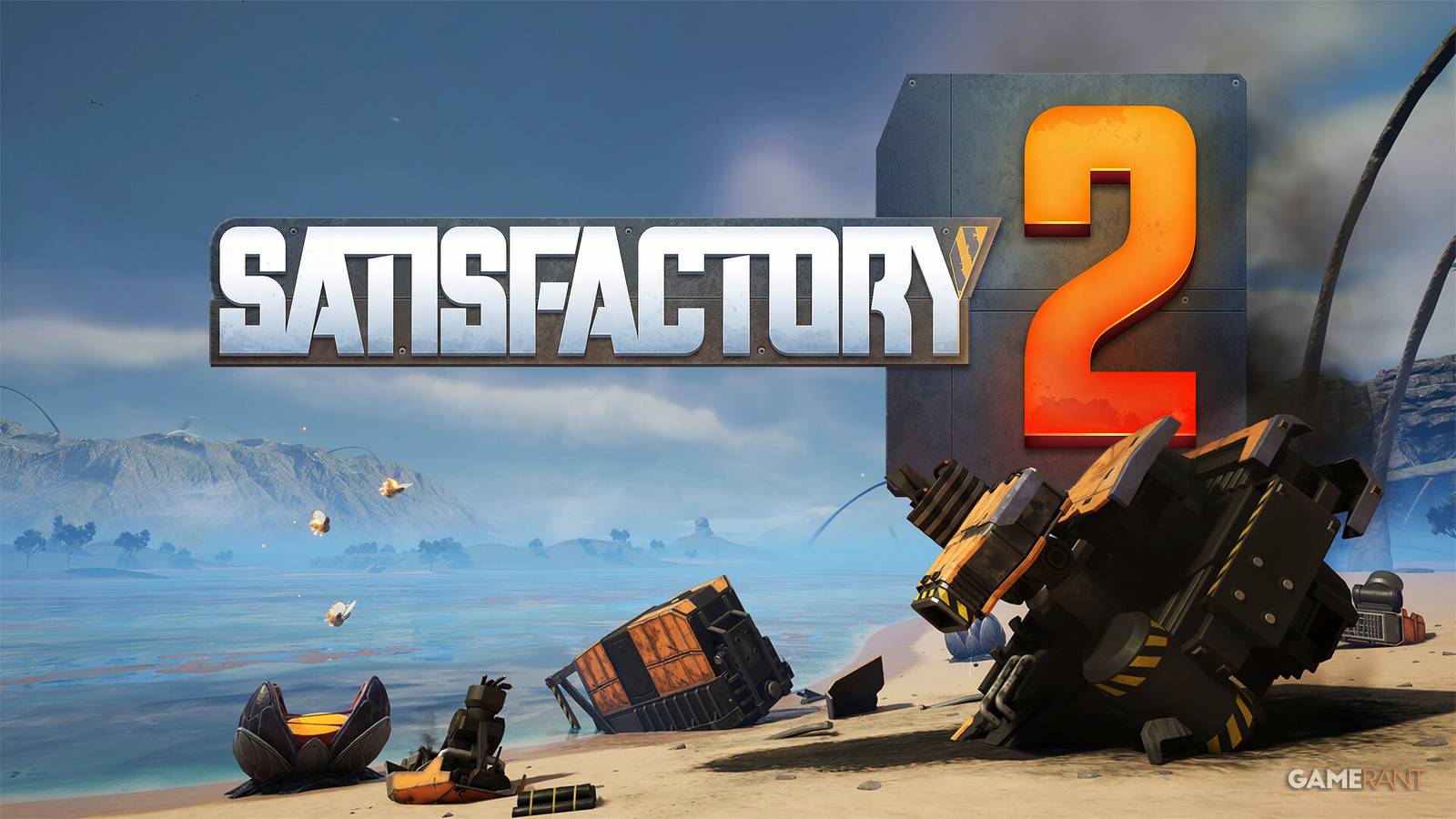
Satisfactory has long been considered the best in its genre, and that has only become even more true over the last 6 years since its early access launch on PC. Developer Coffee Stain Studios has been hard at work since then, improving what was already a solid experience, and that effort has paid off in the form of continuous positive impressions of the game and an increasingly steady player base. At the time of writing, Satisfactory still has an Overwhelmingly Positive rating on Steam with over 130,000 reviews, a 91 Top Critic Average on OpenCritic, and a 91 Metascore on Metacritic. Considering the game’s immensely high praise, and with its 1.0 launch still only less than 2 years old, one might wonder whether there’s even room for a sequel right now, or room for one at any point.
From one perspective, a sequel might seem unnecessary. Satisfactory already does a lot really well, as shown by its popularity. As such, it would naturally find itself facing some exceedingly high expectations, as it would essentially be attempting to catch lightning in a bottle a second time. However, for all its praise, it hasn’t been able to avoid criticism completely, and that’s where a Satisfactory sequel could really come in handy. It could keep all the strengths of the first game while improving in the areas where it fell short. At the same time, a sequel would also need to represent a fundamental shift in the game’s design philosophy to avoid the dreaded “1.5” label and earn the title of Satisfactory 2.
New Automation Game on Steam Feels Like Satisfactory If You Worked for Helldivers 2’s Super Earth High Command
If you love Helldivers 2’s comedic tone, automation games, or, hopefully, both, then Pax Autocratica belongs on your wish list.
What Satisfactory Already Does Well
Before digging deeper into what Satisfactory 2 could look like, the first game’s most praiseworthy qualities are worth a retrospective look. The main reason Satisfactory works so well is that it takes a simple idea and keeps stretching it just about as far as it seems it can go. It starts with gathering resources and manually crafting parts, but that quickly evolves into building full systems that handle everything automatically. Conveyors, pipes, and power grids begin to interlock, and the overall focus becomes more about designing processes that run smoothly on their own rather than making individual items. And that’s actually what hooks most players. A messy setup gradually turns into something clean and efficient, and Satisfactory keeps introducing new tools and milestones that push that sense of growth forward.
But what separates Satisfactory from most simulation games is how it treats exploration and scale as a physical problem instead of an abstract one. Expansion doesn’t happen through menus or clear grid systems, and its first-person perspective is a big part of that design. Resources are often far from where they’re needed, terrain gets in the way, and every connection has to be built and navigated at ground level. Even compared to something like Factorio, where everything is managed from a top-down view, Satisfactory makes growth harder to control because it has to be physically built, traversed, and maintained piece by piece.
The main reason Satisfactory works so well is that it takes a simple idea and keeps stretching it just about as far as it seems it can go.
At the same time, it thrives on flexibility. There isn’t a single “correct” way to build anything in Satisfactory, which means every solution reflects a different way of thinking and, ultimately, the player’s preference. Some approaches might prioritize efficiency, others may focus on organization or visual design, and many more might fall somewhere in between those extremes. That freedom is a big part of what makes Satisfactory so satisfying, though, as it offers an experience built around iteration and the urge to push systems further than where they started.
What Satisfactory 2 Would Need to Justify Its Existence
That’s where things start to get a bit complicated. Satisfactory already feels like a finished version of the idea it set out to execute. The gameplay loop is rewarding and addictive, it all scales with progress, and the game continues to evolve even after its 1.0 launch in 2024. In other words, a sequel wouldn’t be building on something unfinished and would instead have the seemingly insurmountable goal of trying to improve something that already works extremely well.
A Satisfactory 2 couldn’t get by on adding more machines or simply expanding the map, though. Those are things the current game is already capable of doing. Instead, a sequel would need to focus on the areas where the original starts to show cracks, and one of the most obvious is its narrative.
Satisfactory 2 Could Have a Story That’s More Involved Than the First
Zoomed out, the premise for Satisfactory is actually pretty compelling. The player is a Pioneer working for FICSIT, sent to an alien planet to harvest resources and contribute to Project Assembly, which is part of a larger effort to save Earth from environmental collapse. Along the way, a secondary thread emerges through the discovery of alien artifacts like Mercer Spheres and Somersloops, which trigger strange communications from an unknown intelligence attempting to reach out. ADA, the AI built into the player’s suit, eventually deciphers that signal, uses the player as a conduit, and even leverages that connection to develop new technology. By the end, the player has unknowingly helped construct and launch a massive starship, with ADA leaving alongside it while the player remains behind to continue working.
A sequel wouldn’t be building on something unfinished and would instead have the seemingly insurmountable goal of trying to improve something that already works extremely well.
However, the problem is that none of it really affects how the game is played. The story exists mostly in the background, delivered through occasional dialogue and disconnected threads that rarely build toward much. Even the alien communication, which feels like it should be a central part of the whole experience, ends up fading out rather than escalating. Many players have described Satisfactory‘s story as scattered pieces of lore that never fully come together. It gives the game context, but not much direction, in other words.
That’s where a sequel could really make an impact. Instead of treating the narrative almost like it has to be there for contextual reasons, Satisfactory 2 could make it a core part of the whole gameplay loop. Assuming a sequel would have a similar premise, Project Assembly could have visible stakes, with clear consequences for success or failure. The alien intelligence could evolve from a background mystery into an active system that influences how factories are built or how resources are used. Even FICSIT itself could become more than a distant voice, turning into a presence that reacts to the player’s choices rather than simply issuing orders. The foundation is already there. A sequel would just need to follow through on it in a way the original never quite does.
Satisfactory 2 Could Fix Where the Original Starts to Break Down
Satisfactory also has an issue with pacing and complexity that a sequel could rework entirely. In its early hours, the game can feel rather slow, and then overwhelming much later on, as everything stacks on top of each other without always providing the tools to manage them effectively. That becomes especially noticeable at scale, where large factories can be difficult to read and maintain, especially within the limits of a first-person perspective. A sequel could address that by introducing better in-game planning tools, clearer ways to visualize production lines, or systems that help manage complexity more efficiently.
Finally, there’s an opportunity to rethink how Satisfactory‘s systems behave once they’re built. Right now, factories are largely static. Once optimized, they run indefinitely without much need for adjustment. A sequel could push beyond that by introducing more reactive systems, whether that’s changing resource conditions or production demands, or environmental factors that force players to adapt. That would give players a reason to keep going hands-on with their factories long after they’re finished.
Of course, all of this ultimately depends on whether Coffee Stain Studios even launches a sequel. Right now, it feels like the team doesn’t really need to, as Satisfactory is already in a…satisfactory place. However, the developer has implied in the past that, while it never intended to abandon the first game after its 1.0 launch, that doesn’t mean at least a portion of its team wouldn’t be dedicated to another project. At the very least, a sequel is worth dreaming about for an excellent game such as Satisfactory, even if it never happens.

- Released
-
September 10, 2024
- ESRB
-
Everyone 10+ / Fantasy Violence
- Publisher(s)
-
Coffee Stain Publishing