



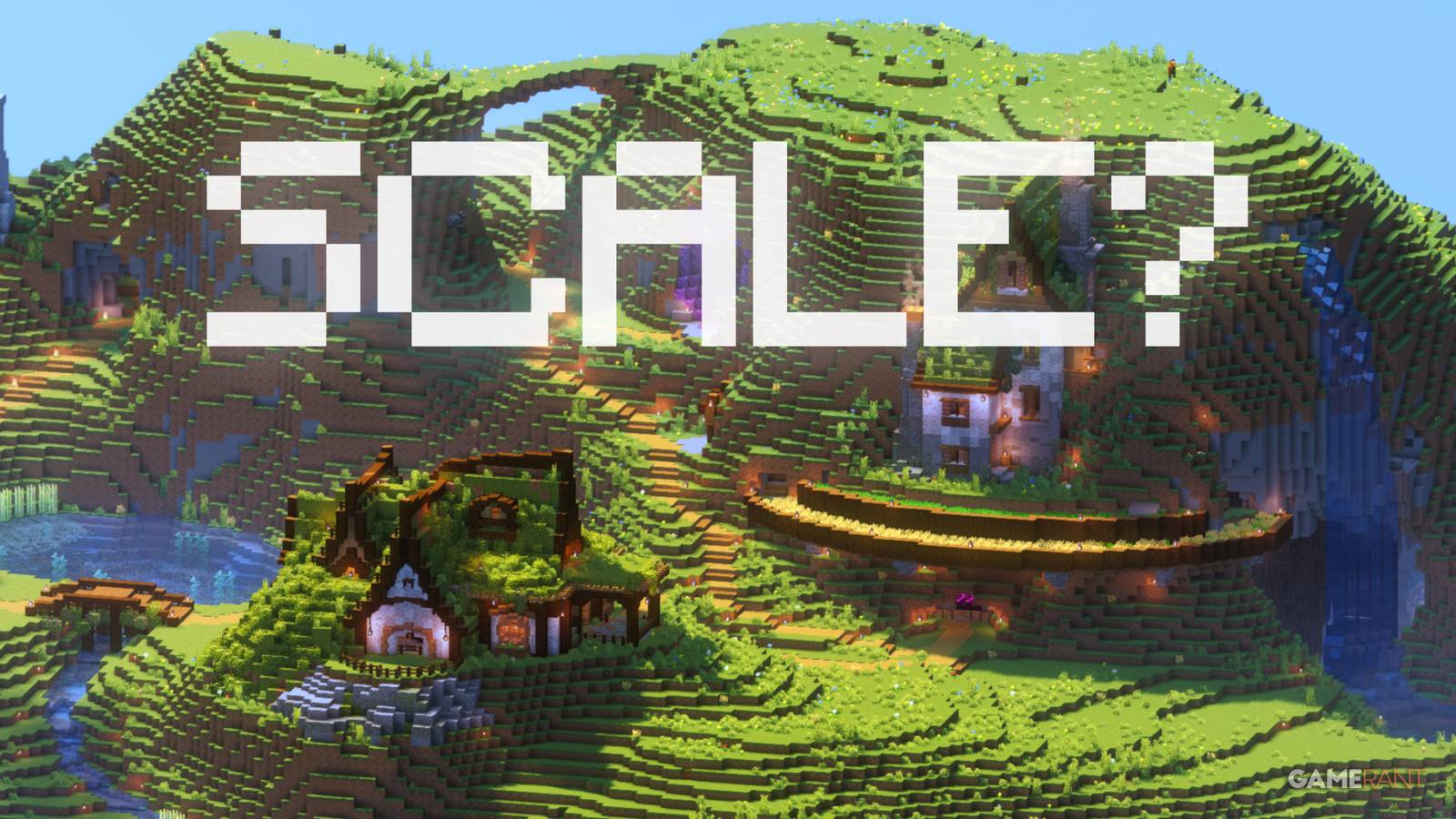
Look, given that the sense of scale and infinite possibility in Minecraft has made it the best-selling video game in human history, this headline might feel a little silly right off the bat. But it does open up an interesting line of inquiry, as in the over fifteen years since its first public release, the block-building behemoth just keeps getting bigger — more biomes, more mobs, more blocks, more everything. That question has less to do with how big Minecraft‘s world is and more to do with what that world actually does with itself.
Whether Minecraft always justifies its open world, whether the things it adds to that world make it feel deeper, or simply wider, is likely a bit more up for debate. For fans like myself, who have grown up with the game and have seen Minecraft‘s update design evolve, it’s probably what comes to mind most. As such, I’d posit that what Minecraft is really missing, more than any new biome or new mob type, is a sense of ecological depth to match its extraordinary breadth.
Minecraft: 14 Rarest Mob Variants
Players should grab a screenshot when they see one of these rare mob variants in Minecraft.
Why Minecraft Grows the Way It Does
For starters, it helps to understand the update philosophy driving Minecraft‘s expansion, because this really is a specific type of depth, despite its sweeping scale of consequence. For years, Mojang approached the game’s world evolution in a pattern that might generously be called “horizontal”: a new biome gets announced, a handful of new blocks are introduced, or a new mob is voted on, and the world grows outward. Though the game has incredible depth in other ways, and content delivery has changed in the years since, much of the same additive logic still applies in this arena: something new appears, and the old world expands to absorb it.
This is not inherently a bad thing, as Minecraft thrives on possibility, and keeping its updates broadly accessible ensures that players across every playstyle and age bracket can find something to love in each new drop. The nitpick here is that its growth is often disconnected, so, for all of Minecraft‘s enormous surface area, the experience of exploring it often feels less like navigating a living ecosystem and more like moving through a series of attractive but largely inert dioramas. The world is wide; what it sometimes lacks is depth.
What Ecological Depth Actually Means

Implementing ecological depth is one of the more plainly apparent ways to expand Minecraft, despite the fact that, on paper, it’s already a staggeringly diverse game. The thing is that not all of that diversity interacts in meaningful ways; mobs like cows, chickens, bats, and foxes roam their respective environments and even sometimes drop or interact with items. But they don’t affect those environments in any notable way, and if that were different — if mobs left genuine marks on the land they occupied, shaping it in ways players could observe and respond to — the game would gain what might be called vertical depth to complement its horizontal scale.
How Greater Ecological Depth Could Look In Minecraft
A compelling illustration of what this might look like in practice comes from YouTuber Klei_Wright, whose video Why Mojang Struggles to Design Ecologies makes a pointed, conservation-minded case study out of the bat. In real life, bats are keystone species: they pollinate plants, disperse seeds, and control insect populations at scale, but in Minecraft, the bat is essentially decorative. Giving that mob a gameplay function that interacts with the world—like expediting overall crop growth at the cost of a few pieces of that harvest—would be a double-edged success as an educational addition that’s also simply more interesting as a piece of game design.
Examples like that illustrate the gap between what Minecraft‘s mobs currently do and what they could plausibly do without fundamentally changing what the game is. Bees are the closest existing example of Mojang threading this needle: they pollinate flowers, produce honey, and will aggressively defend their hive. That sort of self-contained ecological loop makes the meadow biome feel meaningfully different from regular grasslands, so it’s tough to argue against more systems like that on a larger scale.
The sulfur cube, the headline mob of the upcoming Chaos Cubed drop, hints at something similar from a different angle: a mob that actively interacts with the surrounding blocks, absorbing materials and changing its own properties in response.
A Conversation About Minecraft’s Untapped Potential

It is worth noting that this line of thinking is part of a broader creative conversation that’s been happening across the Minecraft community for years, about the extraordinary untapped potential of what is already in-game. Biome-cetric Minecraft mod projects like Ecologics add greater environmental interdependence and demonstrate in playable form that this kind of depth is not only possible but pretty darn fun, too.
Why Minecraft Will Probably Stay This Way
Despite all this, it’s unlikely anything too deep will come to a new vanilla update to Minecraft anytime soon — and the reasons for that are twofold. First, truly dynamic ecological systems are hard to build and maintain at Minecraft‘s scale. The computational and design overhead of modeling population-level feedback loops across a near-infinite procedural world is not trivial.

Find all 10 pairs
Find all 10 pairs
Regular Cover ArtClean Cover Art
But more fundamentally, it is not what Mojang actually wants, and Jens “Jeb” Bergensten, Minecraft‘s chief creative officer, produced an internal design document, titled Minecraft Game Design Principles, that made that clear. The booklet is candid about why Minecraft resists the kinds of time-dependent, self-perpetuating systems that ecological depth would require:
“If there is a before or after, it would be something else than ‘vanilla’ Minecraft.”
Continuous ecological change presupposes a world with memory beyond the player — one where actions compound over time, and that continuity is precisely what Mojang has chosen to avoid in its core game. The player, not the world, is meant to be the driver of change. Jeb makes that principle explicit in the document as well:
“When we added the villages in the Minecraft beta, we made a conscious decision that they wouldn’t develop automatically. The villagers would not build houses, and there would not be any mechanics for adding more template-based buildings. If the village needs a protective wall, the players will need to construct it for them. Minecraft offers a setting for players to interact with, but the players decide what, when, and where that happens.”
A Wide World, With Room to Go Deeper

These are legitimate reasons, and it would be glib to dismiss them, as even the existing examples of mobs meaningfully altering the environment — sheep eating grass, Endermen displacing natural blocks — have proven annoying enough in practice that the community regularly debates whether to nerf them. But sheep and Enderman operate in the world without giving the player much to work with in return. Other potential ecological systems could allow players to engage, redirect, or exploit interactions to their benefit.
And to that end, even Jeb specifically reserved the right to break his own rules from time to time in that document. Since then, the game has added ecological texture in subtler ways, like the bee’s pollination loop, the warden’s response to sound, and the sculk’s ability to propagate. The Chaos Cubed drop and its sulfur caves, with noxious gas pools and a mob that physically reshapes itself based on what blocks it consumes, look likely to add even more of that layered texture.
Ultimately, as Minecraft continues to age and grow, ensuring that growth applies to the world’s depth — not just its breadth — seems less like something that should happen, but something that likely has to happen. That said, it’d be tough not to see that as a good thing anyway. After all, the sense of infinite vertical possibility is what made it a phenomenon in the first place.

- Released
-
November 18, 2011
- ESRB
-
E10+ For Everyone 10+ Due To Fantasy Violence