




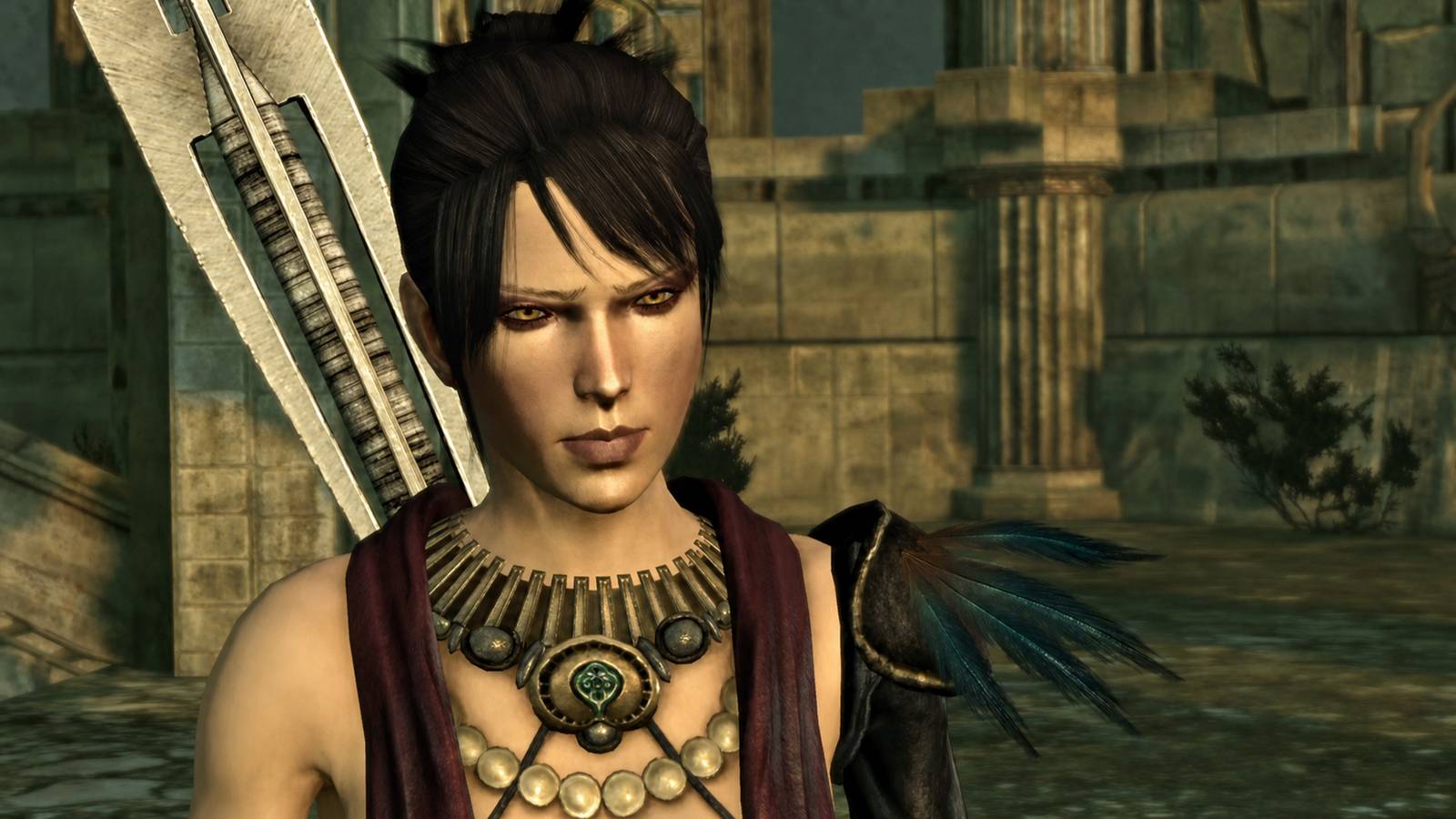
Like a lot of mid-2000s RPGs, Dragon Age: Origins doesn’t exactly measure up to modern standards, in a lot of ways. There’s the generally dated gameplay which, while rather forward-thinking at the time, is nearly painful to play today, but also the game’s shoddy state on current PCs. Playing this classic title on contemporary hardware can be an exercise in frustration, as inconsistent performance, crashes, bugs, and other miscellaneous quirks characterize the experience.
This isn’t something that rights-holder EA seems very interested in remedying, either. Unlike Dragon Age‘s sci-fi counterpart Mass Effect, there has been no current-gen return to Dragon Age: Origins, nor its successors. In 2021, BioWare launched the excellent Mass Effect Legendary Edition, which compiled the first three games and their expansions into a polished, tweaked, modernized, but ultimately faithful, package. For many die-hard fans, myself included, the Legendary Edition is basically the definitive version of Mass Effect and would be a perfect all-around product had it actually included Mass Effect 3‘s multiplayer mode, but I digress. One would imagine that Dragon Age would get its very own “Legendary Edition,” in the wake of the aforementioned’s success, but it’s looking like that won’t be the case. At least, not officially.
A Fan Remaster Might Be the Closest Dragon Age: Origins Gets to Its Own ‘Legendary Edition’
Despite remakes and remasters being all the rage these days, hopes aren’t high for a return to Dragon Age a la Mass Effect Legendary Edition. Take recent comments from longtime Dragon Age producer Mark Darrah. Speaking with gaming outlet FRVR in July 2026, Darrah said that there were once plans for Dragon Age: Champion Edition, which would have bundled remastered versions of Dragon Age: Origins, Dragon Age 2, and Dragon Age: Inquisition, but this never came to pass.
Darrah went on to discuss the difficulties posed by BioWare’s proprietary Aurora Engine, derivatives of which were used to develop the first two Dragon Age games. According to Darrah, there’s “basically no one at BioWare anymore that understands the Aurora Engine,” since so many staffers have departed over the years. This is a tragic testament to the power of institutional knowledge, so much of which has been lost over the years thanks to mass layoffs across the gaming industry. But in this particular case, there could be another solution.
A Fan-Organized Decompilation of Dragon Age: Origins Could Make Remaster Dreams a Reality
For the past three years, a team of six independent programmers has been decompiling Dragon Age: Origins, an endeavor that should yield something as close to the original’s source code as possible. From there, a number of improvements would be possible on PC. One member of the decompilation team, under the handle Shot_Let_1344 on Reddit, listed a few examples of potential improvements to Dragon Age: Origins post-decompilation, including:
- Full controller support on PC
- 64-bit support
- Cooperative multiplayer
- Fixing persistent engine bugs
Shot_Let_1344 also noted that the project is approximately 60% complete. It’s currently closed/unreleased, though the team expects to make it public in about a year, when it is projected to be around 90% complete. To be clear, this unofficial remaster team does not intend to profit off its work whatsoever. Aside from being a noble act, this lack of profit motive might help keep the project relatively safe from EA’s lawyers.
What Might the Future Hold for a Decompiled Dragon Age: Origins?
If the unofficial Dragon Age: Origins remaster endeavors described above come to fruition, Dragon Age fans could be in for a small-scale cultural revival of the first entry. We shouldn’t get ahead of ourselves, but it’s telling that Shot_Let_1344, who has apparently been working on decompiling Dragon Age: Origins for years now, is openly discussing integrating features like cooperative multiplayer and split-screen. Better controller support, bug fixes, and graphical enhancements are to be expected in these sorts of projects—game-changing multiplayer integration, not so much.
Granted, these features may have only been thrown out to illustrate a broader point, that being that the sky is basically the limit once the decompilation process is completed. It will be interesting, though, to see how the remaster project develops along this line. Mass Effect Legendary Edition is so beloved, in major part, because it left the core of the original trilogy untouched. It feels like a premium package, something that you would feel comfortable placing on your shelf as the de-facto way to experience Mass Effect. The aims of this community remaster, theoretical as they may be, appear to go beyond this.
Official, industry-backed game development is hectic and unpredictable enough, so there’s no telling how this unofficial Dragon Age: Origins project shakes out. It’s a bit unfortunate that the work for modernizing such a popular game has to fall on the shoulders of passionate, unpaid fans, and not a billion-dollar company like EA, but I suppose that’s where we’re at right now.


- Released
-
November 3, 2009
- ESRB
-
M for Mature: Blood, Intense Violence, Language, Partial Nudity, Sexual Content
- Publisher(s)
-
Electronic Arts
- Engine
-
Eclipse