







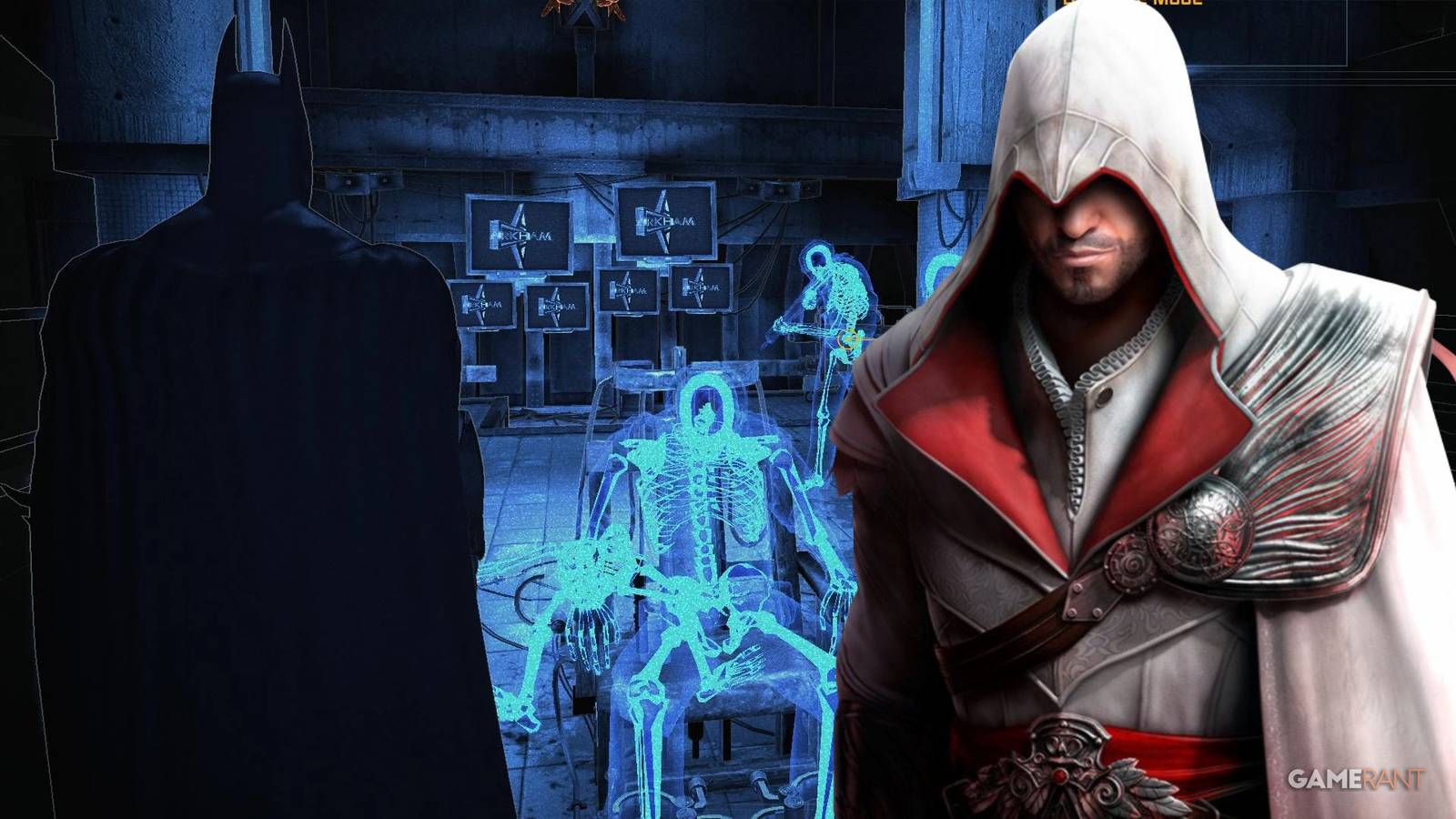
With 007 First Light just around the corner, I’ve taken a sort of retrospective attitude toward the most prominent stealth games of my lifetime. Growing up, many of my favorite games were from the stealth genre or had strong stealth-focused features: Metal Gear Solid 3, Assassin’s Creed 2, Batman: Arkham City, and Splinter Cell: Conviction all sank their teeth into me quite early on. But revisiting these titles today, I’m struck by an all-too common trope that grates on me the more I see it, and I hope 007 First Light avoids it as much as possible.
This feature goes by many different names, but it’s usually referred to by the umbrella term Detective Mode, which is what it’s called in the Batman: Arkham games. Rocksteady’s version of this system is the most iconic for a reason: it’s arguably the most in-depth. In these games, using Detective Mode is a surefire way to take your experience from meaningfully difficult to trivially easy, as every interactable, point of interest, and enemy combatant is highlighted in vivid detail, removing just about any ambiguity. This kind of makes sense for The World’s Greatest Detective, I admit, but it’s seeped into the broader stealth space in a way that tends to undermine rather than enrich.
Best Spy Espionage Games
Espionage has become one of the most popular and notable video game genres over the past few decades. Here are some of the best ones available.
Why ‘Detective Mode’ Is a Wart On the AAA Stealth Space
If we define Detective Mode as any sort of in-universe investigative overlay whose primary purpose is to reduce friction, then we can easily identify it in dozens of popular games. Here are just a few prominent titles that feature a version of Batman: Arkham‘s Detective Mode:
- All Assassin’s Creed games
- Horizon Forbidden West
- Horizon Zero Dawn
- Marvel’s Spider-Man
- Marvel’s Spider-Man 2
- Marvel’s Spider-Man: Miles Morales
- Shadow of Mordor
- Shadow of War
- The Last of Us
- The Last of Us Part 2
- The Sinking City
- The Witcher 3
Detective Mode appears quite differently across these games, but in all cases, it feels like an inelegant solution. It’s not always used for stealth purposes—The Witcher 3’s version of this mechanic is used solely for investigation, for instance—but even so, it makes for a shallower experience. It might make narrative sense for Geralt to use his Witcher senses to search for clues, but in practice, it reduces the detective-styled gameplay to an on-rails endeavor, one wherein players simply have to follow the correct on-screen colors without much need for critical thought.
Scratch & Peek

Identify the cover art while scratching off as little foil as
possible.
Identify the cover art while scratching off as little foil as possible.
EasyMediumHardPermadeath
If you’ve been plugged into contemporary online gaming discourse, firstly, God help you, but secondly, you may have seen some discussion about the much-maligned “yellow paint” trope in games. Essentially, there’s been significant pushback over the use of inexplicable yellow paint to mark interactables in games like Uncharted and Resident Evil 4, which has been deemed as immersion-breaking and unnecessary. While I think that such yellow paint controversies are often a bit overblown, I can understand where these critics are coming from: marking something with yellow paint eliminates a chance for players to engage with the game world in a more thoughtful, observant way. Detective Mode does this exact thing, but even worse. Instead of analyzing enemy patterns or carefully picking apart a crime scene, players who use Detective Mode are encouraged to engage with the game’s core mechanics on a superficial level.
Detective Mode Is a Spectrum, Not a Binary
Having said all that, I don’t necessarily think that Detective Mode needs to be totally scrubbed from the industry. Not all Detective Modes are created equal, and some certainly have more of a trivializing effect than others. Take Marvel’s Spider-Man’s rendition of the feature, which includes an indicator that tells you when it’s safe to take out an enemy. I have a lot of problems with the stealth in Marvel’s Spider-Man, but this is probably the biggest one, as it strips away the need for any degree of skill, risk-taking, or experimentation.
Fit the 9 games into the grid.
On the other hand, you could make the case that something like the Night Vision Goggles in Metal Gear Solid 3 are akin to Detective Mode, as they highlight all enemies in infrared, making them easier to track. But setting aside the fact that this doesn’t do anything other than make enemies easier to see, it’s also mitigated by its need for a battery, and it’s not available on harder difficulties. Such mitigating factors help make investigative overlays like Detective Mode more enjoyable, as they aren’t simply “press X to win” mechanics–they have drawbacks and limitations.

- Released
-
May 27, 2026
- ESRB
-
Teen / Blood, Language, Suggestive Themes, Violence, In-Game Purchases


