




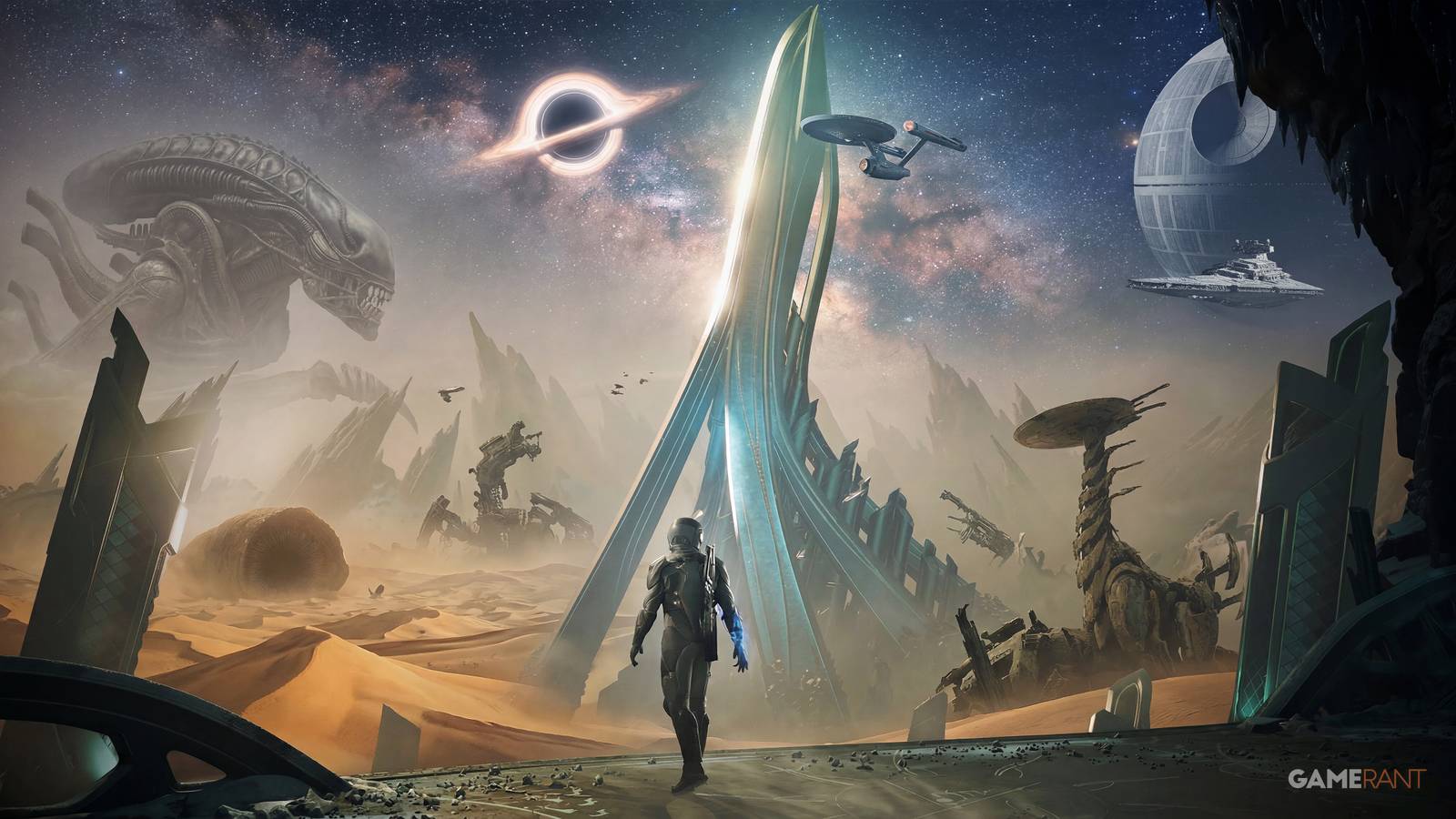
Exodus has never looked like a game that’s ashamed of where it came from. Archetype Entertainment’s upcoming sci-fi RPG is being made by a team with deep roots in some of the genre’s biggest games, and from the moment it was revealed, it has been fairly easy to draw comparisons between it and other major sci-fi stories. Mass Effect, in particular, is one franchise Exodus has never shied away from imitating, especially considering some of the team’s devs also worked on BioWare’s acclaimed sci-fi RPG trilogy in its heyday. However, its influences extend beyond just one IP and medium, reaching into various film and written media as well.
During a recent Future Games Show showcase briefing attended by GameRant, Archetype Entertainment and Wizards of the Coast spoke more openly about some of the inspirations behind Exodus, and the list is about as long as one would expect from a game this ambitious. Some of those influences can be seen in its combat, others in its approach to time dilation, and others in the feeling of setting out into a universe much larger and stranger than humanity fully understands. However, the most interesting thing about Exodus may be the way Archetype seems to be pulling from so many familiar places while still trying to make those influences serve its own world.
Exodus Is Pulling From Some of Sci-Fi’s Biggest Names
Some of Exodus‘ inspirations are already fairly easy to spot from the outside looking in. Mass Effect is the most obvious comparison, given Archetype’s BioWare history and Exodus‘ own focus on companions, choices, and deep-space exploration, but it isn’t the only major sci-fi shadow the game is standing in. With a game like this, players are naturally going to look at its gameplay, world, and lore and start connecting those pieces to some of the most recognizable sci-fi franchises in history. According to game director Chris King, that is at least partly because Exodus is being made by a team of people who all brought their own favorite pieces of science fiction with them:
I think one of the great things about this is, as people come onto the project, come onto the team, we all sort of bring our own things that have inspired us, the things we love, the things we grew up with. You’ll see there are a lot of very obvious things that we’ve taken little bits and pieces of. A lot of people here are big fans of Dune. Of course, Star Wars has an influence on all of us. The Alien movies, you know. Interstellar is probably the most visible example of time dilation in popular media, but we put our own spin on it. And that’s kind of what we like to do is kind of put our spin on these kinds of things, take the things that we loved, take the spirit of what made them exciting for us growing up and as adults too, and bring it all together and create something fresh and new that evokes the same kind of emotions that we like in the entertainment we love.
That makes sense for a game like Exodus, because its world is dealing with ideas that sci-fi has already spent decades exploring. There are familiar building blocks there, but familiar building blocks aren’t the problem. What matters is how Archetype uses them, and based on what King said, the goal isn’t to hide where the team’s inspirations came from but to take the pieces that made those stories so memorable and give them a reason to exist inside Exodus‘ own world.
And that’s actually a fair way to look at science fiction in general, as the genre has never really been known for having completely original ideas. Plenty of its biggest franchises share the same ingredients, but the difference usually comes down to what a story chooses to do with those ingredients. King seems to view Exodus the same way, as a game that may look familiar at first glance, but one that Archetype is building around its own ideas:
Chad’s favorite sci-fi franchise is Star Wars, my favorite franchise is Star Trek. And the reason I bring that up is, if you look at them, they both have spaceships, they both have aliens, but there are a lot of things different. And that’s sort of how I think about Exodus too. You could probably take an initial glance and be like, “Oh, I see similarities with companions and choices, all of these things.” But I think the kind of story we’re trying to tell and some of the things we’re experimenting with are quite a bit different than things we’ve done in the past.
Science fiction has always worked this way to some degree, which makes the long-running rivalry between some of its biggest franchises a little funny in hindsight. Star Wars and Star Trek have spent decades being compared to one another for obvious reasons, and yet both are part of a much larger sci-fi lineage. Star Wars pulled from ideas that Star Trek had already helped popularize, but Star Trek wasn’t entirely original either. Franchise creator Gene Roddenberry actually cited Forbidden Planet as one of the inspirations behind Star Trek, and that 1956 film has long been recognized as one of the genre’s most important foundational pieces.
In part, that’s what makes Archetype’s willingness to acknowledge Exodus‘ inspirations so refreshing. There’s nothing wrong with a sci-fi story having roots, especially in a genre where so many of the biggest worlds are built on ideas that came from somewhere else first. The issue is whether those roots turn into imitation or whether they become the foundation for something with its own identity. Based on how King talks about Exodus, Archetype seems far more interested in the latter, using familiar sci-fi ideas as a starting point rather than pretending the game was developed without any influences at all.
Exodus Also Has an Unexpected Connection to Horizon Zero Dawn
Inspiration doesn’t always come from the same genre a game belongs to, though. Sometimes, it comes from a single mechanic or system that developers admire enough to reinterpret in a new context. For Exodus, one of those more surprising influences is Horizon Zero Dawn, which apparently helped shape one of its combat systems, according to Archetype general manager Chad Robertson:
I think there are tons of inspirations we’ve had in the game, both from general media and film to, obviously, video games. I’ll just name one, and it’s not necessarily a singular inspiration, but there are elements in combat—one of the things that I like the most about the game—you’ll see where Chris and the team leaned in on some stuff and took some inspiration from a game like Horizon Zero Dawn. There’s this mode in the game called Precognition, where you can use it as a tool to kind of scan the battlefield to basically make decisions both strategically and tactically about how you want to approach a fight. And I won’t tease too much more of it, but there are some elements of that game that I think inspired the team.
Robertson didn’t say exactly what part of Horizon Zero Dawn helped inspire Precognition, but the connection is fairly easy to make. Horizon‘s combat often begins with players scanning machines, studying weak points, tagging enemies, and ultimately deciding how they want to approach a fight before it even starts. If Precognition works in a similar manner, it could give Exodus a way to make combat feel more tactical without slowing it down completely. Jun would still be in the middle of an action RPG, but players would have a better chance to read the battlefield before committing.

And really, that might be the best way to understand Exodus‘ inspirations as a whole. Archetype is clearly pulling from some of the biggest franchises in sci-fi and gaming, but those influences only matter if they help Exodus become more itself. Dune, Alien, Interstellar, Star Wars, Star Trek, Mass Effect, and Horizon Zero Dawn all point to different pieces of what Archetype is building, from the scale of its universe to the way its combat might function. The real question now is whether Exodus can bring all of those roots together in a way that feels worthy of the games and stories that helped inspire it.

- Released
-
2027
- Developer(s)
-
Archetype Entertainment
- Publisher(s)
-
Wizards of the Coast
- Number of Players
-
Single-player
- Steam Deck Compatibility
-
Unknown


