


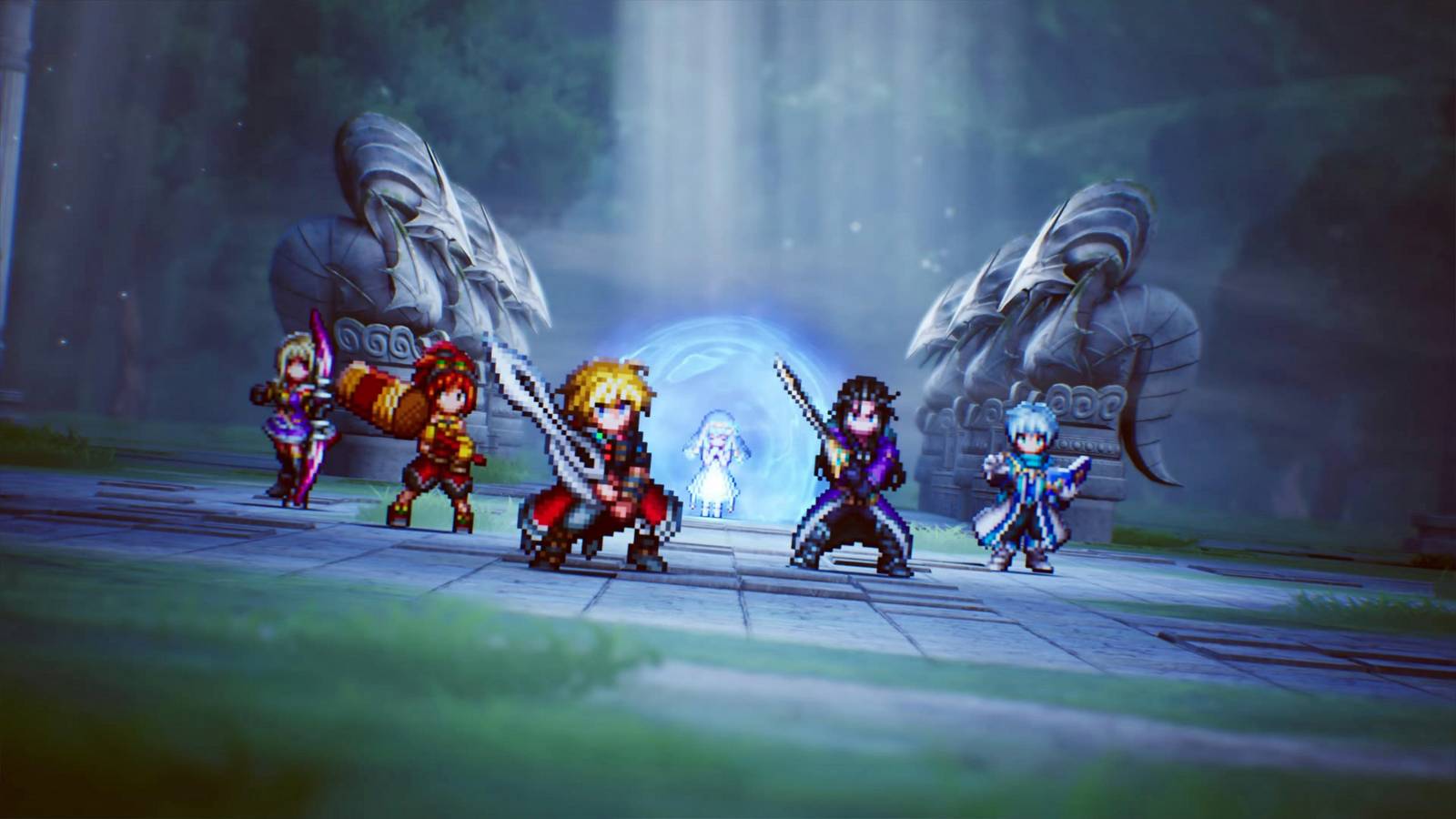
Final Fantasy is one of those franchises that I will always pre-order without question, and it has been that way since I first fell in love with the series over 25 years ago. So, going into Final Fantasy Resonance, I was ready to be impressed, and after spending nearly 50 hours with it, I can confidently say that it did, in fact, impress me. Final Fantasy Resonance is essentially a full-fledged console remake of the first story arc of the mobile RPG Final Fantasy Brave Exvius, following two knights named Rain and Lasswell as they attempt to stop a mysterious enemy known as Veritas of the Dark from destroying the world’s crystals. However, rather than simply bringing the mobile game to modern platforms, Square Enix has rebuilt it into a more traditional Final Fantasy experience, complete with gorgeous HD-2D visuals, strategic turn-based combat, and a progression system that puts a new spin on the series’ classic job system.
Final Fantasy Resonance is a celebration of the history of Final Fantasy that brings so much of what has made the franchise special over the years into one game. It’s not trying to reinvent the series or compete with the sheer scale of its modern mainline entries. Instead, it’s taking players on a trip through Final Fantasy‘s past, and after spending dozens of hours with it, it’s safe to say Square Enix knew exactly what it was doing.
Everything About Final Fantasy Resonance’s Combat Just Works
Final Fantasy Resonance has a lot going for it, from its gorgeous graphics to its narrative and its surprisingly rewarding world, but its best feature, by far, is its combat. Final Fantasy Resonance‘s combat never gets old because it constantly challenges you. Its elemental weakness and stagger system bear a striking resemblance to the Break and Boost system of Square Enix’s Octopath Traveler series, so fans should feel right at home with it, but it will also keep you on your toes. If you really want to be effective in combat here, you have to constantly change your strategy to suit your current foe’s weakness.

I’ll admit that I did do quite a bit of grinding before advancing major story beats, as I found several spots in Final Fantasy Resonance‘s overworld that, when defeated, gave me a considerable amount of XP and MRP (Mastery Rank Points) and I wanted to milk those areas for all they were worth. But even going into the game’s biggest encounters with what I initially thought was an overleveled party, I still couldn’t rest on my laurels. Final Fantasy Resonance‘s most challenging bosses always forced me to carefully examine my opponent first and then choose the best action—not just my favorite action—from there.
Final Fantasy Resonance has a lot going for it, from its gorgeous graphics to its narrative and its surprisingly rewarding world, but its best feature, by far, is its combat.
Each offensive attack in the game deals both direct damage to the enemy and its Stagger Gauge, and once its Stagger Gauge has been depleted, the enemy is stunned and will receive more damage for a brief period. In other words, the goal of any battle is to stagger an enemy or group of enemies as quickly and as often as possible. But in order to do that effectively, you have to know the enemies you’re fighting, as exploiting their weaknesses depletes those Stagger Gauges more efficiently.

If you manage to stagger every enemy in a single turn, you’ll trigger a Sweeping Stagger, which is even more satisfying because, if you play your cards right, you can get in a staggering (pun intended) number of actions before your enemies even have a chance to respond. Triggering a Sweeping Stagger actually grants your team a bonus action phase where each member is given an additional action. Then, at the end of that phase, you can unleash a Resonance attack at your foes, in which one of your equipped Visions dishes out a massive amount of damage.
In many cases, and depending on how strong your party is, by the end of all of this, you will have triggered Final Fantasy‘s iconic “overkill” effect, which means you will have exceeded the amount of damage necessary to defeat an enemy, and you’ll get bonus gil relative to the overkill amount. I actually made a game out of that alone—seeing how much unnecessary damage I could inflict on an enemy to trigger a massive overkill—and it quickly became the one thing I aimed to do in every single encounter.
Visions are where Final Fantasy Resonance really starts to prove itself, because they are the heart of its combat and the source of much of its nostalgic appeal. Visions are essentially echoes of past Final Fantasy heroes—like Terra Branford, Cloud Strife, and Noctis Lucis Caelum—who each have their own skills they can contribute to combat. When a party member has a Vision equipped, they can then take advantage of that Vision’s unique skills while still utilizing their own. However, there’s far more to the system than that, and it extends into buildcrafting that really pays off down the line.

Each party member can earn Mastery Rank Points toward their equipped Visions, gradually increasing their Mastery Rank with that specific Vision and unlocking new abilities along the way. Some ranks even grant permanent stat increases or additional Ability Points (AP), which determine how many abilities a character can have equipped at once. What makes this system so interesting is that once a character learns an ability from a Vision, they can continue using it even after switching to a different one, provided they have enough AP to equip it. Visions can also be awakened using Magicite, unlocking even more of their unique abilities. So, rather than being limited to whatever skills their currently equipped Vision provides, characters can eventually combine abilities from several different Visions to create some pretty ridiculous builds.
Boy, is it satisfying to pull off a stagger, and if you’re playing Final Fantasy Resonance correctly, you will stagger your opponents often.
It sounds similar to Clair Obscur: Expedition 33’s Pictos and Lumina system, but the biggest difference is that Visions allow characters to permanently learn both active and passive abilities, whereas Clair Obscur focuses on passive effects. However, it’s also worth pointing out that this kind of progression isn’t exactly new to Final Fantasy, either, as Final Fantasy 9 did something similar with abilities learned through equipment. In Final Fantasy Resonance, it takes quite a bit of grinding to really see the full effect of it come into play, since you have to spend time ranking up individual Visions with each party member before you can utilize their abilities, but the system overall makes all that grinding more than worth it in the end.

The one knock against Visions is that they could be harder to obtain. To acquire them, you merely walk into a Vision Sanctum in the overworld, answer a few inconsequential questions about the character, and then they’re yours. That’s it. If the game had required me to battle them first before letting me use them, for example, then the Visions themselves could have been the reward, rather than being a familiar face gatekeeping a gimmick. Even so, I still enjoyed walking into a Vision Sanctum not knowing what Vision awaited me, only to hear an iconic theme song from their Final Fantasy entry and be instantly taken back in time.
Exploring Final Fantasy Resonance’s Gorgeous World Is as Captivating as It Sounds

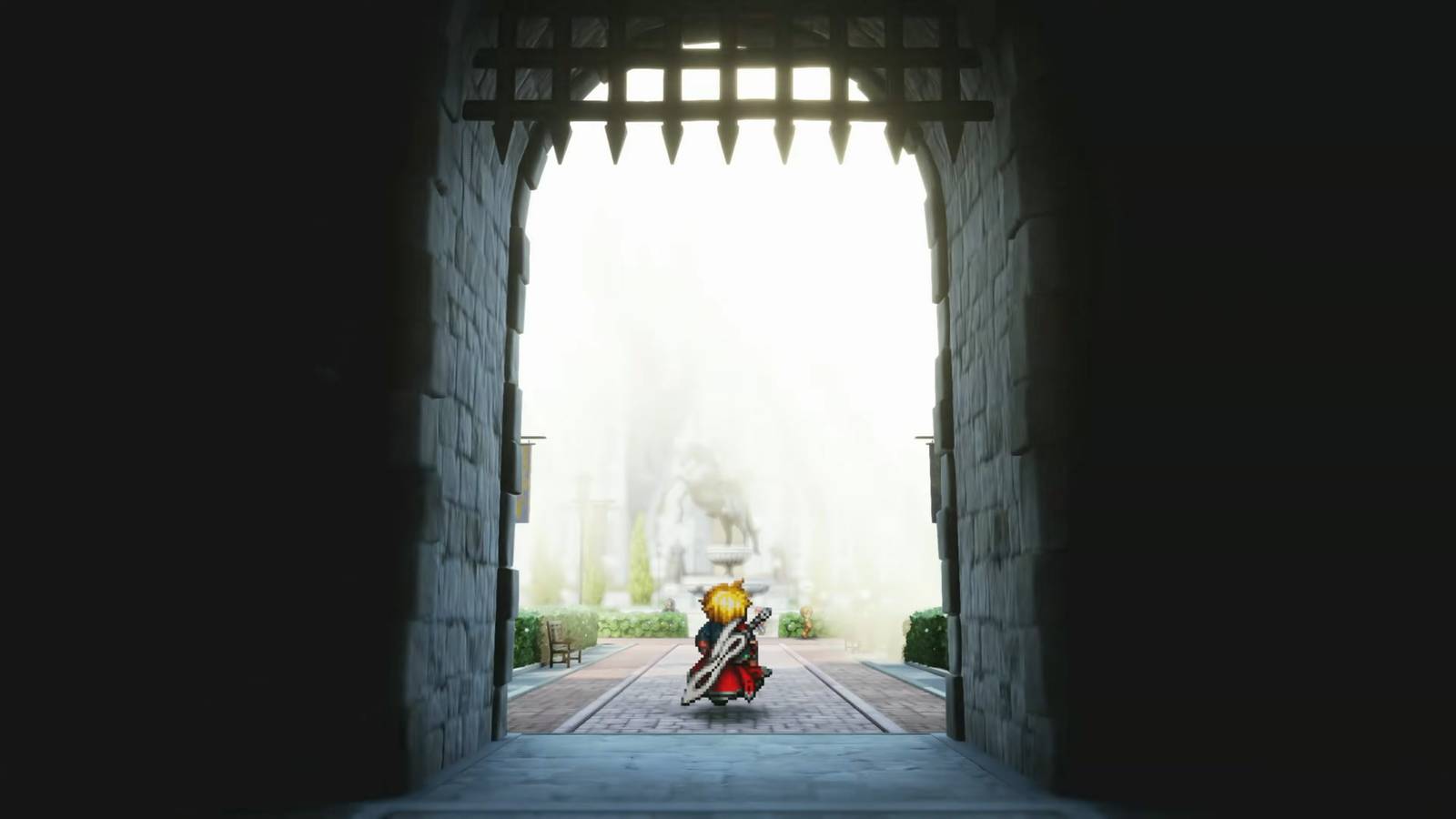
This is, by far, Square Enix’s most beautiful HD-2D game yet. The environments are vibrant and incredibly detailed, the various biomes are distinct enough that it actually feels like another world, and there are plenty of shifts in perspective throughout Final Fantasy Resonance‘s story that you get to see that world from multiple angles—and every angle looks fantastic.
But presentation aside, exploration overall in Final Fantasy Resonance is always rewarding, albeit exceedingly straightforward and simple. While there are occasionally items that I legitimately wouldn’t have found if I weren’t scouring every nook and cranny as I always have in previous Final Fantasy games, most of them are quite obvious. Even so, it’s always worth taking that optional route that you see in Final Fantasy Resonance, unless, of course, it leads you into a cave with a monster you should definitely run from until you’ve had the chance to strengthen your party a bit.

However, that’s all part of the fun. There aren’t just items to be found off the beaten path, but plenty of optional encounters as well. The caves I just mentioned host challenging boss fights that reward you with Magicite upon defeating them, which you can then use to make your Visions more powerful. But there are also Espers (one of Final Fantasy‘s many names for its summons) sprinkled throughout Final Fantasy Resonance‘s world, most of which you have to fight in order to obtain. Once you’ve acquired one, it can be summoned in combat by Fina, and they can be a tremendous help, too, and can get you out of a bind with their big exit attack once they’ve exhausted their turns.
This is, by far, Square Enix’s most beautiful HD-2D game yet, and I’ve played them all.
And if you’re looking for even more opportunities to put your party to the test, Final Fantasy Resonance also has the Colosseum and the Chamber of Arms, both of which offer some of the toughest battles in the game. The Colosseum is essentially a series of increasingly difficult encounters, with each victory unlocking a higher rank and rewarding you with powerful items. Some of its later battles even pit you against enemies that require a party well beyond the level you’d normally need to finish the main story.

The Chamber of Arms, meanwhile, takes things a step further by tasking you with finding 12 legendary weapons and pieces of armor scattered throughout the world, each sealed behind a powerful boss you’ll have to defeat to claim it. I particularly appreciate that Final Fantasy Resonance has content like this, because with a progression system as deep as its Vision system, there needs to be something worth building your party up for beyond the main story.
Finally, once you unlock the airship, things do open up quite a bit—although I almost wish they had opened up even more. The world that once felt huge feels rather small once you’re zooming around the map in an airship, but it still makes exploration fun. At that point, you can reach areas you wouldn’t have been able to reach before, and you can take your party almost anywhere on the map, even if it means putting yourself against enemies you are definitely not ready to face. But the airship is what allows you to face some of Final Fantasy Resonance‘s best boss fights.
Final Fantasy Resonance’s Narrative Is Worth the Journey, Even With Some Mediocre English Voice Acting

Final Fantasy‘s narratives have always only been as strong as their characters, and thankfully, Final Fantasy Resonance has a decently strong cast. At the center of it all are Rain and Lasswell, two knights of Grandshelt who grew up together but couldn’t be more different in personality. Rain is the more impulsive of the two, often letting his emotions guide his decisions, while Lasswell is much more reserved and disciplined. They’re eventually joined by Fina, a mysterious young woman who has lost her memories, as well as several other characters, including Lid, an aspiring engineer who dreams of becoming the next Cid, Nichol, a levelheaded strategist, Jake, a rather flirtatious rebel leader, and Sakura, a powerful mage who looks like a little girl but speaks as though she’s lived for centuries. It’s a fairly traditional Final Fantasy cast, but their different personalities give the story plenty of opportunities for both humor and some surprisingly emotional moments.
As for the story itself, Final Fantasy Resonance begins with Rain and Lasswell investigating the Earth Shrine after the magical barrier protecting it begins to weaken. However, what should have been a routine mission quickly turns into a disaster when the two encounter Veritas of the Dark, a mysterious armored figure who not only defeats them but also destroys the Earth Crystal they were sent to investigate. To make matters worse, their airship is destroyed in the process, and by the time they return home, Veritas has already launched an attack on Grandshelt. This ultimately sets Rain and Lasswell on a journey across the world to protect the remaining crystals before Veritas can destroy them as well.

Of course, being a Final Fantasy game, things aren’t nearly as simple as they initially seem, especially once Fina’s mysterious past begins coming into play. Without spoilers, it’s a familiar Final Fantasy adventure in many ways, which isn’t necessarily a bad thing. After all, Final Fantasy Resonance is clearly pulling out all the stops to be as nostalgic as it possibly can be.
Final Fantasy‘s narratives have always only been as strong as their characters, and thankfully, Final Fantasy Resonance has a decently strong cast.
The game’s side quests are all equally compelling, as they allow plenty of opportunities for the game’s cast to grow as characters, and it helps flesh out the world around them as well. Most of them are, expectedly, fetch and kill quests, but it’s the story you’re there for anyway, so the objectives never bothered me. In fact, I always saw the objectives as an opportunity for my party to grow stronger, and it helped that many of the more powerful foes these quests had me facing were unique one-offs that I wouldn’t have encountered otherwise. Plus, the rewards were never half bad either.

Where I was really let down, though, was Final Fantasy Resonance‘s English voice acting. Final Fantasy isn’t necessarily known for having stellar performances, but they also aren’t always terrible either. In Square Enix’s HD-2D games, however, they just can’t seem to nail the English performances.
Fortunately, it’s not every character, and it’s not constant, either. For one thing, Jake, voiced by Jonah Scott, is probably the most convincing of the whole bunch. In fact, Scott’s performance helped Jake become my favorite character. Well, that and the fact that he’s basically Han Solo, which just made me love him all the more. Apart from Jake, the rest of the cast is at least bearable after a while, even if their English voices are hard to digest at first. But it also helps that the characters themselves are all well-written, and they’re easy to fall in love with for that reason.
Final Fantasy Resonance Is a Celebration of Everything That Makes the Series Special

Final Fantasy Resonance’s combat is easily one of the most satisfying turn-based systems I’ve experienced in a long time, and the Vision system gives it enough depth that even after nearly 50 hours, I still found myself wanting to experiment with different builds. It certainly helps that the game gives you plenty of opportunities to put those builds to the test, with some genuinely challenging optional bosses and an overworld that consistently rewards exploration. And while it would have been nice if acquiring Visions required more effort and the airship opened up the world a bit more, those complaints never take away from the fun. Plus, Square Enix has outdone itself with the visuals here, making this the best-looking HD-2D game the studio has made yet.
Of course, Final Fantasy Resonance isn’t perfect. Its English voice acting is disappointing, and there are certainly moments when its familiar story feels a little too predictable. But the characters themselves are likable enough that I was invested in their journey regardless, and the game’s willingness to embrace so much of what made the older Final Fantasy titles special is ultimately what won me over. Final Fantasy Resonance won’t change anyone’s mind about turn-based RPGs, but it will remind fans why they fell in love with Final Fantasy over 25 years ago.