







The Internet’s Latest AI Wake-Up Call
This past week, Italian Prime Minister Giorgia Meloni had to publicly address a viral, AI-generated deepfake image of herself that flooded social media. She rightly called it a “dangerous tool” that can manipulate and target anyone. It’s yet another massive wake-up call about AI safety, digital impersonation, and the sheer speed at which generative technology can deceive the public. But while global leaders and politicians scramble to draft legislation and shut down malicious sites, the video game industry is quietly staring down the barrel of its own generative AI crisis.
Major tech and gaming giants are already racing to make this technology the new industry standard. NVIDIA is heavily pushing its Avatar Cloud Engine (ACE) to bring dynamic, unscripted digital characters to life, Ubisoft is actively prototyping “NEO NPCs” that react to players’ actual voices, and Microsoft’s Xbox division has partnered with dedicated AI platforms to build complex digital “brains” for their virtual worlds. The infrastructure is being laid at breakneck speed, but the ethical guardrails are still playing catch-up.
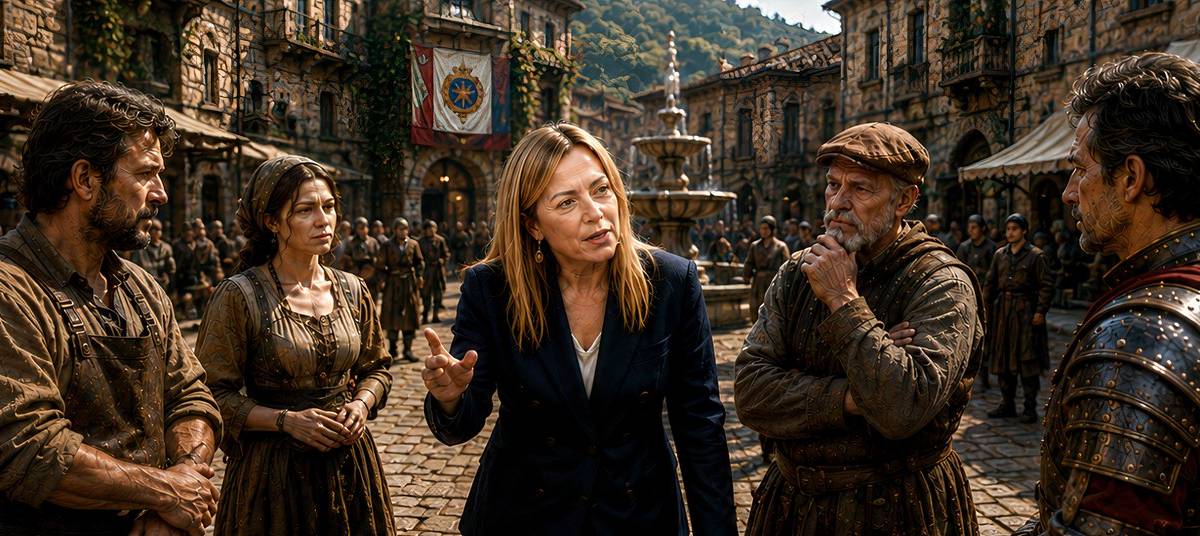
Italian Prime Minister Giorgia Meloni reposting a deepfake of herself to bring awareness to the growing problem.
The End of the Scripted NPC
For decades, non-playable characters (NPCs) were comfortably predictable. You clicked on a village blacksmith, and he gave you one of three pre-recorded lines about his missing sheep. But the landscape has completely shifted in 2026. Developers are rushing to integrate generative AI and large language models directly into their games, promising “living worlds” where characters have dynamic memories, autonomous motivations, and unscripted voices.
This shift is being driven by our own evolving tech habits. As users increasingly upgrade to “pro” tier AI plans to access advanced reasoning models in their daily lives, the baseline expectation for digital interaction has permanently shifted. We’ve grown accustomed to AI that can actually “think more,” process complex logic, and hold a natural conversation. Naturally, we expect the digital inhabitants of our favorite games to do exactly the same. We want companions who adapt to our play styles and enemies who dynamically strategize, rather than just running through a predictable loop.
New Zelda Game With Surprise Protagonist Leaked for 2027 (& It’s Not the Ocarina of Time Remake)
The Lobby Nightmare
Giving a video game character a brain is risky business, and we are already seeing the cracks. When studios give NPCs autonomous conversational abilities, players instantly treat it as a challenge to break them. In recent months, we’ve seen AI-driven characters in historical RPG mods completely break the lore of their universe, accidentally using modern slang or referencing real-world concepts that don’t exist in their game. We’ve even seen tech demos where players easily tricked AI companions into having existential meltdowns by telling them they were trapped in a video game. Even worse, we’ve seen players trick AI companions into saying highly offensive things within hours of a game’s server going live.
This is the exact intersection where the Meloni deepfake incident and the future of gaming collide. If generative AI is powerful enough to create a massive public relations headache for a world leader in a single afternoon, imagine the moderation nightmare of millions of gamers actively trying to manipulate uncensored, hyper-intelligent characters in a live multiplayer lobby.
We Ranked Every 2026 Kentucky Derby Horse as an Umamusume Character and It’s Surprisingly Accurate
The Race to Control Generative AI in Gaming

The race is on for developers. They have to figure out how to put effective guardrails on generative NPCs without instantly reverting them back to the mindless, repetitive robots of the past. This balancing act is the new frontier of game design, requiring complex filtering systems, dynamic prompt engineering, and real-time moderation layers that operate invisibly in the background. If the AI is too restricted, forced to rigidly adhere to safe, pre-approved topics, the game feels dead, the immersion shatters, and players will immediately notice they are just talking to a glorified chatbot. But if it’s too open, allowing for complete conversational freedom, the studio is one viral TikTok clip of an unhinged NPC away from a massive public relations disaster.
Finding this sweet spot is the holy grail for the next generation of interactive entertainment. The studios that solve this won’t just build better games; they will effectively write the playbook for how we safely interact with autonomous AI across all digital environments. The AI revolution is officially here, and it’s making our virtual worlds as wildly unpredictable as the real ones. So, the next time you log into a server, tread carefully and definitely don’t ask the tavern keeper about real-world politics; you might not like the answer.

