




There’s a certain comfort that comes with a Yoshi game, and for me, that goes all the way back to titles like Yoshi’s Island, Yoshi’s Story, and even Yoshi’s Cookie on the original Game Boy. Yoshi has always been my favorite character in the Mario universe, and a big part of that comes down to how often he ends up doing more for the experience than the characters the games are actually named after. He’s adorable, mechanically distinct, and consistently the character who makes everything around him better. So, walking into some hands-on time with Yoshi and the Mysterious Book, I felt like I already knew what to expect—yet it surprised me almost immediately.
I recently traveled to New York on behalf of GameRant to go hands-on with Yoshi and the Mysterious Book, diving into its opening hour, some mid-game content, and ultimately, the new direction it’s taking the franchise. The foundation of a Yoshi game is still there, complete with flutter jumps and egg throws. However, in all the Yoshi games I’ve played, never before has discovery felt more rewarding than it does in Yoshi and the Mysterious Book. Based on what I played, it feels like the Super Mario Bros. Wonder of Yoshi, with an immense amount of creativity baked into each level and plenty of surprises waiting around every corner.
Yoshi and the Mysterious Book Is All About Discovery
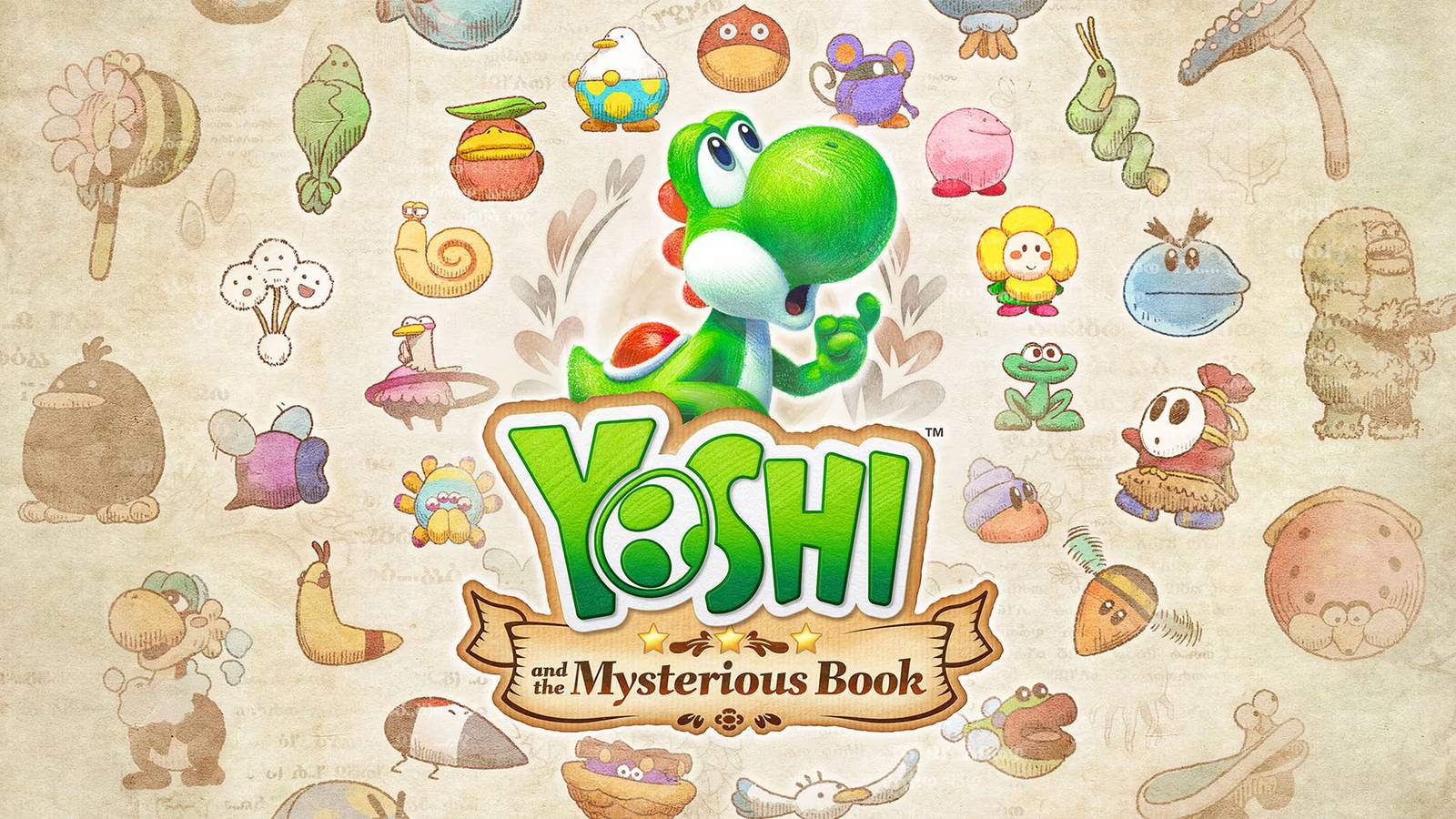
The first portion of my preview of Yoshi and the Mysterious Book saw me playing through the game’s first chapter and familiarizing myself with its satisfying, discover-driven gameplay loop. While there’s certainly what seems to be an intriguing story here, the star of the show is still very much the gameplay. Essentially, the game revolves around entering the pages of Mister Encyclopedia—otherwise known as “Mr. E”—to help uncover and document the strange creatures living inside of him. It’s not as bare bones as it sounds, though.
Each new level in Yoshi and the Mysterious Book revolves around discovering a new creature, and each creature grants Yoshi a new challenge or method for interacting with the environment. For example, the first creature I encountered was a bright yellow flower that, once I used my Tail Flick ability to get it on Yoshi’s back, began causing little buds to bloom when I passed by them. If the flower’s color ever changed, then the blooms would also change accordingly.
The next stage introduced not-so-friendly hives of bees who attacked me without prejudice, but they were fairly easy to dispose of with a well-aimed egg throw. Often, they were carrying Smiley Flowers in tow—one of the many collectible items players can find in the game—so defeating them was necessary. Another creature I encountered in the following stage would sing when stepped on, while simultaneously allowing me to reach greater heights. And yet another creature resembling fluffy cotton would float up into the air when Yoshi ran by it and, upon landing on the ground, sprout even more fluff plants.
Creatures I Discovered in Yoshi and the Mysterious Book
- CRAZEE DAYZEE that makes buds bloom.
- BEES that dart when near.
- BIRDS that sing when jumped on.
- DANDELIONS that can break down rocks.
- GLUBBITS that produce bubbles for reaching greater heights.
- SHY GUYS that direct me to other Shy Guys and objects.
- WASPS that possess watermelons useful for shooting seeds.
- LITTLE MOUSER that can be thrown into narrow passages to retrieve objects.
- PLUMEBRELLA that allows for floating when held.
But while this all sounds cute and fun, discovery in Yoshi and the Mysterious Book isn’t solely centered around the creatures themselves. Rather, it’s about learning what each creature is capable of and then using their unique quirks to complete “discoveries” of varying degrees in each level. Small discoveries range from “bopping” a creature by jumping on it to simply trying to eat a creature that is too large for Yoshi to gobble up. Medium discoveries are a bit more complex, like making all the flowers in an area bloom before a timer runs out. These are all optional, but they ultimately encourage players to try just about anything they can think of, as it might lead to them uncovering a secret that isn’t immediately apparent.
Each new level in Yoshi and the Mysterious Book revolves around discovering a new creature, and each creature grants Yoshi a new challenge or method for interacting with the environment.
Big discoveries, on the other hand, must be found before players can end their exploration of that level. Whether it’s making three big flowers bloom or reuniting a group of Shy Guys, big discoveries are considered the culmination of the player’s experiences within that stage and are generally centered around the new creature they found. What’s great, though, is that you’re not forced to end the level once you make a big discovery. Instead, you can keep exploring if you wish, and manually exit the stage at any point after that.

And speaking of Shy Guys, that level was probably my most memorable time with Yoshi and the Mysterious Book. While the stage tasked me with reuniting all the lost Shy Guys in the area, each of them also had a special request for me once I found them. This generally involved bringing the requested item to them, but where things started to get humorous is when those items caused unexpected interactions. At one point, I accidentally launched a rocket at an entire row of Shy Guys, blasting them across the screen and forcing me to retrieve them again. Despite the hard work I had put into finding them, losing them that way wasn’t frustrating in the slightest, if that’s any indication of Yoshi and the Mysterious Book‘s casual, fun nature.
Experimentation Is the Name of the Game
But one of the game’s best qualities is that, while it is very laid back, it doesn’t hold your hand very much at all. In fact, once some initial comments from Mr. E are out of the way, it’s entirely up to you and your observational skills to complete a stage—making tasks feel like actual discoveries rather than chores. Many times, there isn’t a clear indication that you’re standing near a potential discovery, so you’re even more encouraged to start experimenting and interacting with the environment using every tool and ability at your disposal.

Yet, despite the game rarely holding my hand, I never felt lost, never lost momentum, and always felt encouraged to find everything. Every new interaction naturally pointed me toward the next, whether it was a creature behaving in an unexpected way or an environmental detail that felt just out of place enough to investigate. Instead of waiting to be told what to do, I was constantly testing ideas, and more often than not, those ideas actually led somewhere. And while my playtime was brief, even the Nintendo rep sitting next to me pointed out discoveries I made that they hadn’t seen before, which just goes to show how much there is to do and find in Yoshi and the Mysterious Book.
The purpose of completing discoveries is to earn stars at the end of each level, with small discoveries awarding one star, medium discoveries awarding two, and big discoveries awarding three. Upon exiting a stage, Mr. E summarizes the player’s accomplishments, showing each discovery made and allotting the appropriate number of stars. Then, if any discoveries were missed, he offers a hint in the form of a silhouette about it. Once players have acquired enough stars from one stage, a new creature will typically appear, and they can move on to the next level.

Before moving on, though, Mr. E offers players a chance to name the creature they’ve discovered, which is just one of the many ways Yoshi and the Mysterious Book allows for experimentation. Whatever name is chosen for that creature, it will remain that way for the rest of the game and will be referred to as such from then on. I personally preferred Mr. E’s “canon” suggestion each time—except for Shy Guy, whom I named “Gregory”—but it emphasizes Yoshi and the Mysterious Book‘s playful personality. I could never come up with a name like “Crazee Dayzee” on my own, but I couldn’t get enough of the game consistently referring to a Shy Guy as “Gregory.”
Despite the game rarely holding my hand, I never felt lost, never lost momentum, and always felt encouraged to find everything.
If it wasn’t already rewarding enough to receive stars for completing discoveries in each stage, the pages in each of Mr. E’s chapters gradually come to life as new creatures are logged as well. Where a single Crazee Dayzee might have been wandering around before, several of them occupy the space after, and even interact with one another. When more creatures are added, they might also engage with other creatures in the book or different parts of the environment they previously ignored, so you can actually see your progress animated in real time as opposed to a simple list.
As players progress through the game, they might get a hint from Mr. E that an area they previously visited has changed in some way, granting them an opportunity to make even more discoveries they might have missed or simply couldn’t acquire before. It could be that the environment itself has changed or the creatures within it, but either way, it adds to the game’s replay value. For example, I revisited the area with the singing birds, only to find that some of them had lost their voice. It was then up to me and my observational skills to discover how to get their voice back, and I was rewarded in turn.
On top of everything else, Yoshi and the Mysterious Book absolutely nails its presentation. The art style is charming in a way that feels immediately inviting, with vibrant colors and expressive animations that bring each creature and environment to life. It’s beautiful without ever feeling busy, striking a careful balance where there’s always something interesting to look at but never so much that it becomes overwhelming. That same philosophy carries over into the sound design as well, with playful, reactive effects that complement the game’s sense of discovery without distracting from it. Even from a technical standpoint, the experience feels smooth and consistent on the Nintendo Switch 2, reinforcing that sense of ease that defines so much of what makes the game work.
Yoshi and the Mysterious Book Leaves a Strong First Impression

Based on my time with Yoshi and the Mysterious Book, what stands out most is how confidently it leans into discovery as its core identity, building on the familiar foundation of past Yoshi games while giving it a fresh sense of purpose. It reminded me a lot of Super Mario Bros. Wonder in that way, where creativity is a constant, and nearly every level feels like it has something new to show you. That said, one lingering question I walked away with is how that design philosophy will scale across the full game, especially when it comes to length and pricing. Super Mario Bros. Wonder took around 20 to 25 hours to fully complete, and that felt more than worth the investment, so if Yoshi and the Mysterious Book can match or even exceed that level of content while maintaining its sense of discovery, it’s going to be an easy sell.
Even with that uncertainty, I came away from my preview feeling confident that this will likely be a day-one purchase for me. There’s something about the way it encourages curiosity without ever making progress feel like a chore that stuck with me long after I put the controller down. By the time my session ended, I was genuinely reluctant to stop playing, and I left with a smile on my face and a warm heart. It felt less like I had simply tried a new game and more like I had stepped into something inviting, something I wanted to return to, almost like a warm hug that I wasn’t quite ready to say goodbye to.


- Released
-
May 21, 2026
- ESRB
-
Everyone / Mild Fantasy Violence
- Developer(s)
-
Nintendo
- Publisher(s)
-
Nintendo
Yoshi and the Mysterious Book releases May 21, 2026 for the Nintendo Switch 2. Game Rant was provided travel support for this preview.