






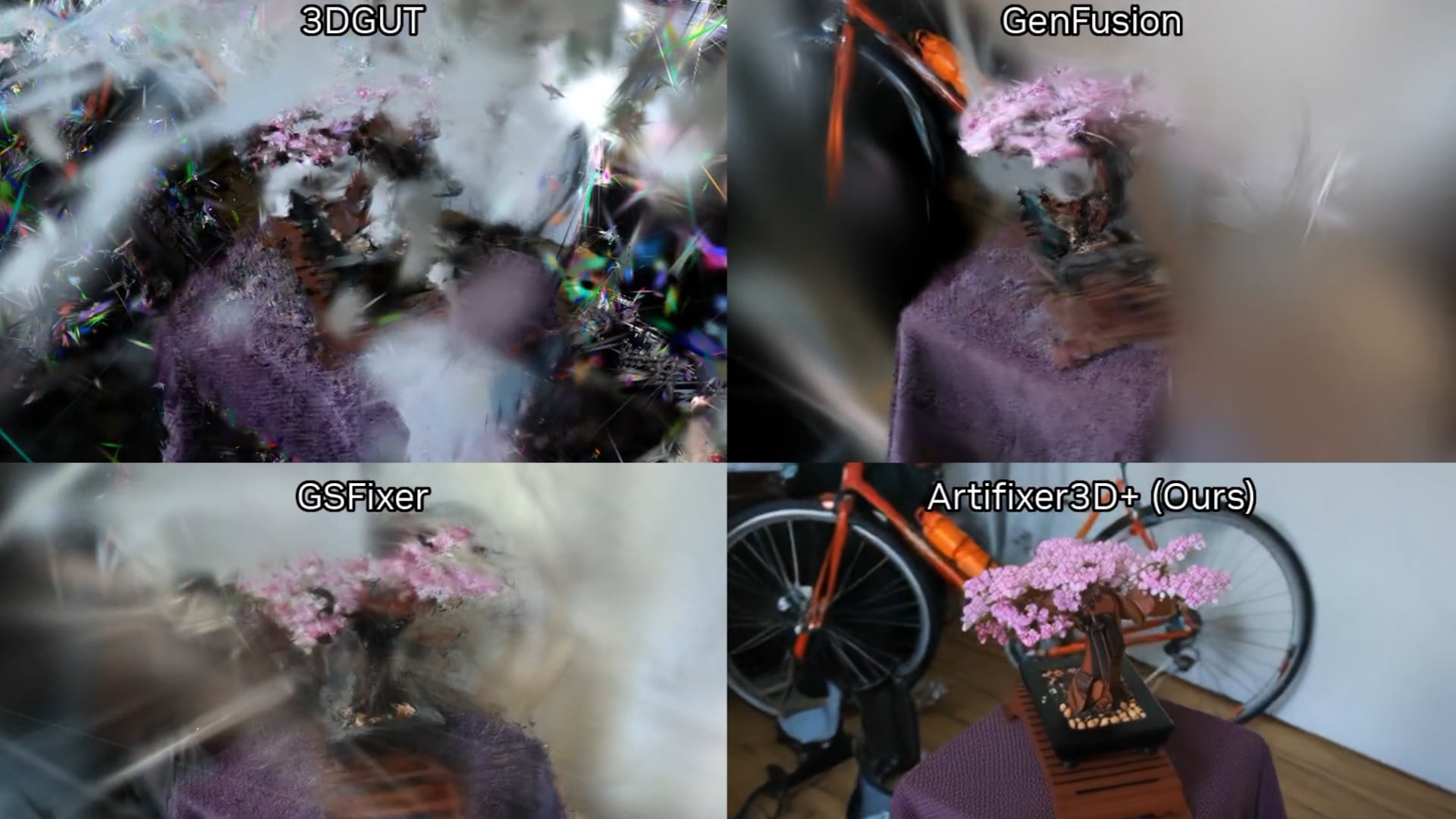
Since 2020, a rapidly evolving neural network technology called NeRF (Neural Radiance Fields) has been used to create 3D scenes from 2D photographs and videos. The most famous example is probably Luma AI, available to use in a browser, which can turn your mobile videos into geometric spaces. In the last couple of years, a big leap forward arrived with (and this is real) Gaussian Splatting, which dramatically speeds up the process through the magic of tiny balls. Now Nvidia is showing off a new prototype tech called ArtFixer which allows its AI to fill in the information gaps with what it calls an “open auto-regressive model,” generating what it imagines should appear in areas missing from the initial footage. Which all sounds neat, until you realize this is why we can’t have nice things.
3D Gaussian Splatting is a technique for creating an explorable 3D render from photographs or video with the ultimate result of making RAM more expensive. It has also been used for special effects shots in movies during the last year, and is arguably a way to more quickly render geometric structures for gaming, although right now it absolutely cannot do that. But the key takeaway points here are:
- It’s demonstrative of how AI hallucination is very much the point
- It’s yet another reason all our consumer tech now costs at least a third more than it did two years ago
- The language they use to describe it is very silly
You’ve likely seen it in the wild: it was used in the recent Superman movie for rendering the holograms of Supe’s Kryptonian parents, and indeed in Sinners to allow Michael B. Jordan to interact with himself. It’s also less effectively used in music videos such as A$AP Rocky’s “Helicopter”:
And yeah, it looks utterly awful. But Nvidia reckons it has a solution.
3D scene reconstruction works great until the camera never sees part of the scene.
ArtiFixer from NVIDIA Research is an open autoregressive model that fills in the missing geometry that other methods leave blank.#SIGGRAPH2026 paper, code + demo: https://t.co/D9PX2OzbZf pic.twitter.com/AGQicvVKkW
— NVIDIA AI (@NVIDIAAI) June 22, 2026
Nvidia’s paper on its ArtFixer tool begins with a line that is absolutely incomprehensible if you’re not already AI-pilled:
Per-scene optimization methods such as 3D Gaussian Splatting provide state-of-the-art novel view synthesis quality but extrapolate poorly to under-observed areas.
By the second paragraph we get:
First, we train a powerful bidirectional generative model with a novel opacity mixing strategy that encourages consistency with existing observations while retaining the model’s ability to extrapolate novel content in unseen areas.
Rockwell retro encabulator, anyone?
Sadly for me, I have now sort of fathomed what this all means, and it seems to break down to saying that current technologies are rubbish at hallucinating the missing spaces when trying to create a 3D space from flat images. For an imperfect example, think of the weird gaps you get in Google Earth and Street View, which is compiled from overlapping photographs taken by a 360 degree camera. While that’s starting with far more information than ArtFixer is designed to use, you still get weird anomalies where stitching goes wrong and the photographs don’t overlap properly. This would be an AI that could fill in those gaps with what it claims are photorealistic renders, although entirely based on what the software makes up based on its hallucinatory nature.
So it sounds useful, right? While its applications in gaming are currently very limited—not least because Gaussian splatting doesn’t work with most other tools regularly used for 3D rendering, so as of now you cannot light them, apply physics, or add shadows—you can imagine how it could improve CAD software and the like. And it’s unquestionably a big step forward from NeRF, which required countless calculations to extrapolate the data, whereas this splatty tech turns everything into teeny “paintballs” that can more rapidly be viewed from any angle. When it does integrate with other tools necessary for 3D gaming, it might potentially offer a way to have near photo-realistic art in games, maybe, possibly? Except, oh my goodness, it uses all of the RAM.
I think what’s most clear from my limited research is that Nvidia is perhaps exaggerating the poverty of rival techs, and very much underplaying the amount of VRAM necessary to do any of this. Regular Gaussian splatting tech alone requires at least 24 GB of VRAM, and that’s before factoring in the AI requirements of ArtFixer’s imaginations, which will be boiling lakes for every tweak.
RAMming it home
Which brings us to the shitty dilemma. On one level, technology like this is an innovative and fascinating means of creating special effects shots that were previously impossible or required far more complexity and time, via the inherently hallucinatory nature of AI. Those extraordinary bullet time shots in The Matrix required huge rigs of dozens of enormously expensive cameras, and painstaking splicing of the resulting still images, but now you can achieve exactly the same effect with Gaussian splatting with far fewer resources. It then makes sense to fill in the gaps with AI that can hallucinate the rest, and in doing so barely brush up against the plagiarism issues or indeed cause vast job losses. But at the same time, technologies like this becoming more commonplace only drive up the cost of RAM and require even more AI data centers, to devastating environmental effect. It’s a really impressive tech solution that’s hurting us in multiple ways.
We learned yesterday that Valve’s new Steam Machine is going to cost over $1000, but that it would have been closer to $750 were it not for the effects of AI on consumer tech pricing. We’ve seen repeated price increases on all current-gen consoles, reversing the norm of every previous console generation, and driving out millions from being able to afford modern gaming. And if you’ve built a new PC recently, as I just did, you’ll know you’re adding at least $500 to what it would have cost you a couple of years back just to have enough RAM inside to keep your Chrome tabs open. The more we see the big tech firms pushing out these AI-based solutions for problems that have already been solved, the worse this situation is going to get.
ChatLSD
And finally, those hallucinations. What ArtFixer really usefully demonstrates is that the idea that AI hallucination is a bug is a complete misconception. AI, as we now use the term, is hallucination-based. AI is a mathematical guessing machine, such that the hallucination is not a side effect but the means by which it operates. It’s why it, for want of any other term, “works.” Every LLM you use, whether it’s Claude, ChatGPT, or (god forbid) Grok, is a balancing act between how useful it is and how much it’s allowed to make shit up. The more you turn down its ability to hallucinate, the less useful it becomes. Generative AI is the result of feeding in a vast quantity of data, and then asking it to combine pattern recognition with hallucination.
That’s why AI is so good at taking a bunch of photographs and, using its training of millions of hours of real-world footage, imagining what would most likely fill in the gaps. They’re making-shit-up machines.
Even if all that doesn’t bother you, the environmental impact of all this hallucinating really should. Or that a PS5 Pro now costs $900. Or, you know, how the unregulated AI industry and the uncontrolled trillions of dollars invested into it will inevitably bring about the next global financial crash. Maybe that’s something to worry about too.