






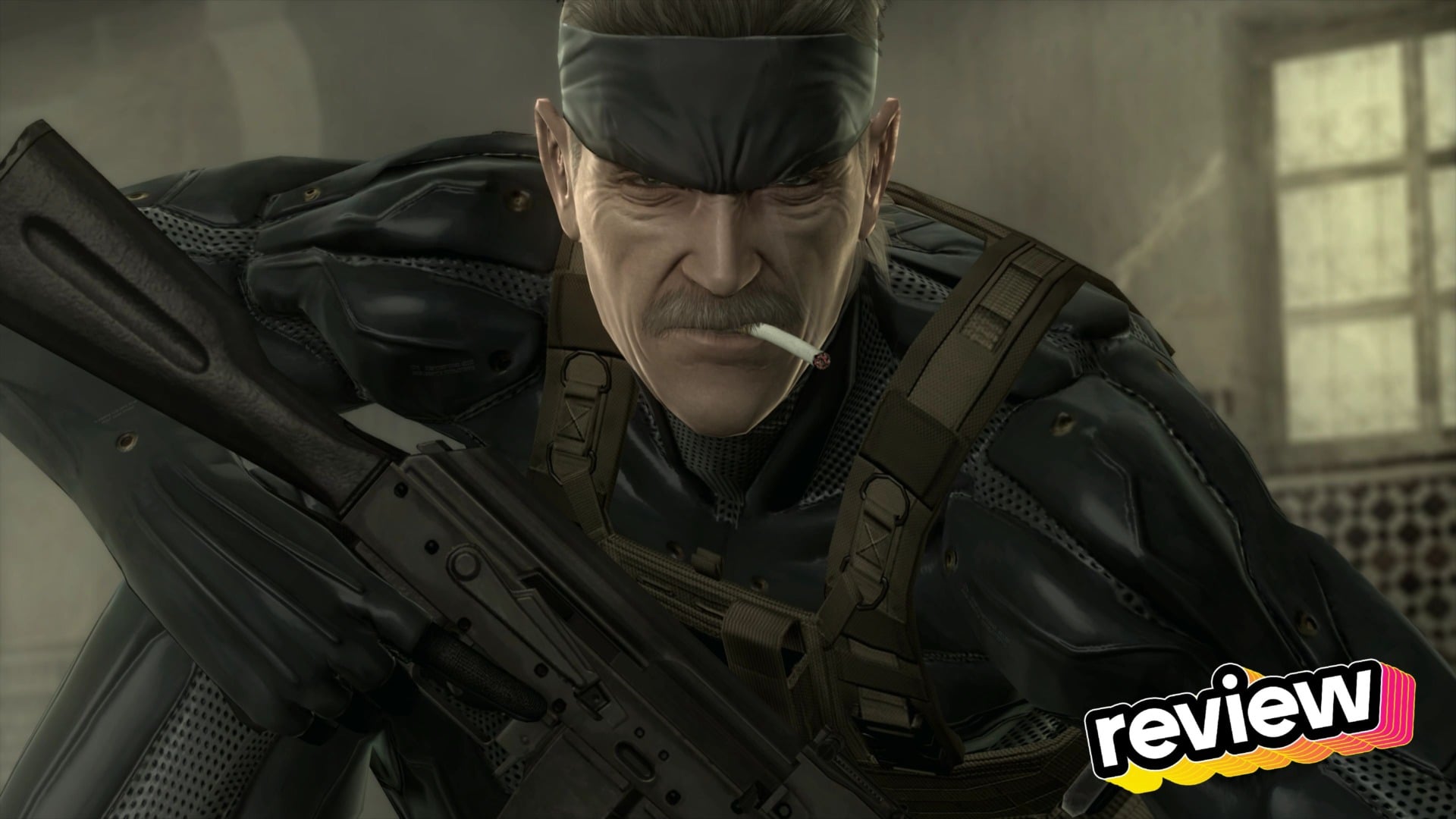
I’m admittedly a Johnny-come-lately to the work of Hideo Kojima. It took me until 2020 to play Metal Gear Solid and Metal Gear Solid 2 (finishing the latter less than 24 hours after Election Day—a confluence of events so thuddingly ironic that it could easily be a plot point from the game itself), and until 2024 to play Metal Gear Solid 3, via Master Collection Vol. 1. These are, indeed, some of the best games ever made: inquisitive, personal, needle-sharp things that probe the possibilities of interactive fiction in ways both generous and bombastic.
Until last week, I had not played Metal Gear Solid 4—not for lack of interest, but for lack of requisite hardware. Since its initial release in 2008, the game has been rotting behind bars in PS3 jail, a place that was assumed for years to be nigh-impregnable. Talk has long circulated about the obstacles preventing a modern rerelease, chief among them being the game’s heavy reliance on the PS3’s bespoke, convoluted processing architecture. Others have speculated that maybe its plethora of brand tie-ins—Apple, Playboy, Triumph Motorcycles, etc.—meant too much legal red tape. Many fell back on the more straightforward assumption that a port was doable, but Konami just couldn’t be arsed.
Whatever the reason, we need pine no more. Eighteen years and some internal shake-ups later, Metal Gear Solid 4 has finally been liberated, and the results speak for themselves. For those who have played the game before and are only looking for an impression of its technical performance and faithfulness to the original: Metal Gear Solid 4 on PS5 runs in 4K resolution at a buttery and consistent 60 frames per second. Most if not all of the copyrighted material is preserved. And yes, Otacon’s gag about not needing to swap discs on the PS3 has been cheekily adjusted. A great deal of care was clearly put into this project, and at the risk of hyperbole, finally having every mainline entry in the Metal Gear Solid series accessible on one generation of hardware strikes me as a pretty historic moment for video game preservation.
For those new to the game, welcome to the club. There is nothing like Metal Gear Solid 4. Thinking about it for more than five minutes at a time makes me feel like I’ve been staring at the sun too long. I’m immensely grateful to have experienced it, and I will probably never play it again.
Video Games…Have Changed
The first rule of Hideo Kojima is that he’s better than people give him credit for and the second rule is that he’s worse.
More specifically: Kojima is a great game designer and an…inconsistent writer whose reach sometimes exceeds his grasp. I don’t really mind this, broadly speaking—it’s heartening to see an artist so earnestly invested in interrogating and reinterpreting the boundaries of his chosen medium, even when he stumbles. Video games are still young, and they need people who care.
Metal Gear Solid stands out as a series that is reflective of both the anatomy and evolution of games as a whole. From the jump, it has wrestled openly with questions of agency, casting protagonist Solid Snake in the dual roles of player subordinate and player avatar—simultaneously a soldier following your orders and you, following the game’s orders. Attention is often called to Snake’s unmatched martial and tactical prowess, even as the games are designed to make players feel defenseless and withdrawn. This seems to be Kojima’s archetypal conception of the Video Game Character, and, by extension, the Video Game Player: someone with a pliable will, prone to suggestion, paradoxically both invincible and brittle depending on the buttons being pressed.
Meanwhile, to state the obvious, the series’ storytelling methods have been enormously influential. Metal Gear Solid was far from the first game to have cutscenes (Kojima himself was already pushing this particular envelope a full decade earlier with Snatcher), but its outsized direction and editing set a new bar for what the medium could accomplish in three dimensions. I want to avoid overusing the term “cinematic”—it’s a murky analytical framework that everyone seems to define differently—but for the sake of simplicity, Metal Gear Solid was cinematic: it moved like a film, and suddenly every other game wanted to move like a film, too.
Metal Gear Solid 4 sits directly at the crossroads of all of this. It is a game about losing control of your body and spirit, and watching others fight your battles for you; many of its formal and structural snafus are directly downstream from industry-wide trends its own predecessors helped create. It’s all the best and worst traits of the series, tightly entwined and folded into a Möbius strip.
Contrary to what you may have heard, Metal Gear Solid 4 does, indeed, have gameplay. This came as a huge relief: the game’s reputation as an indulgent cutscene compilation precedes it, and though I’d osmosed a handful of stray details over the years—an oft-memed quote here, an utterly mystifying out-of-context story beat there—I realized, as I sat down for my first playthrough, that I knew little about its actual design.
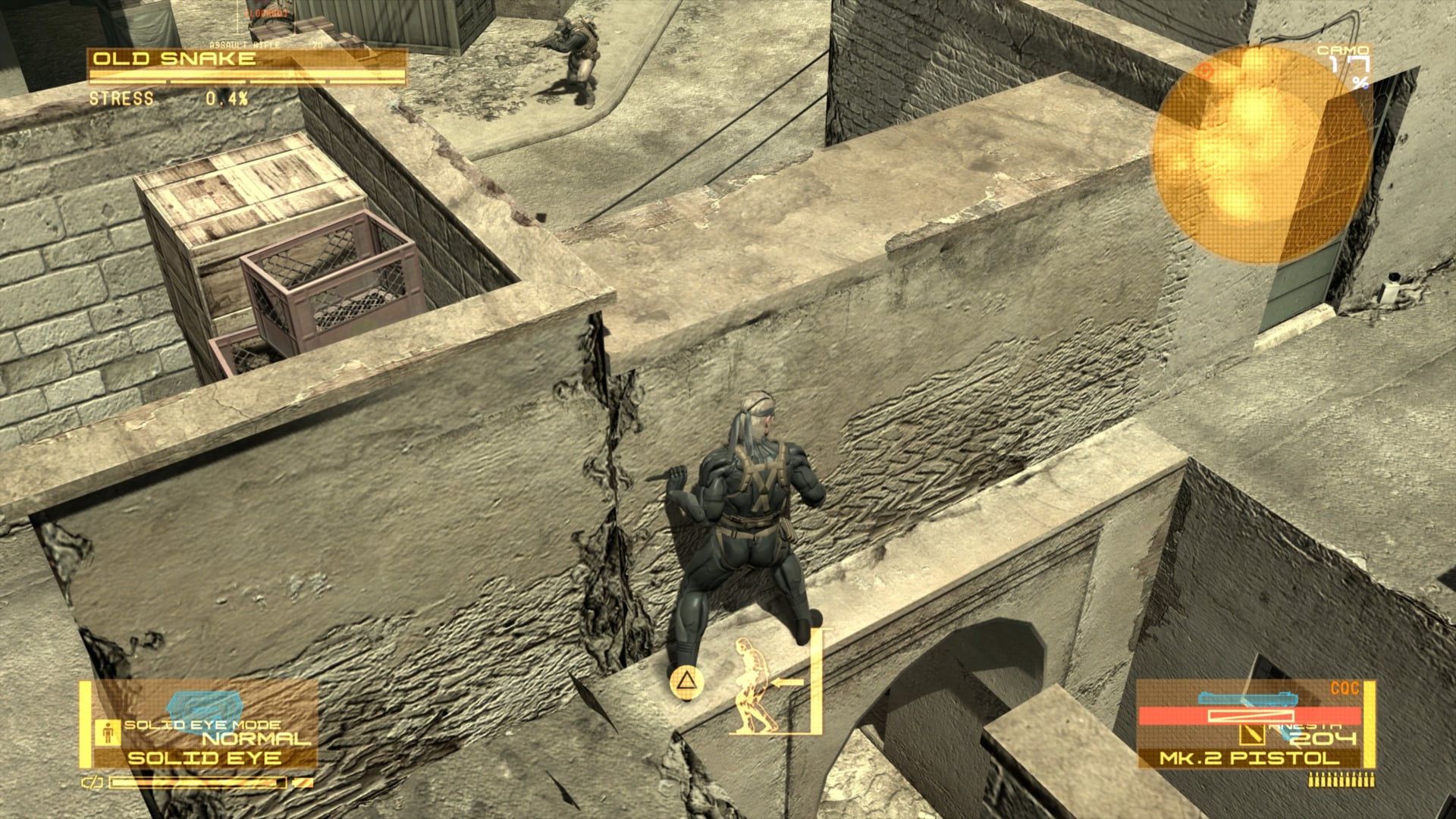
There is a game in here, and it’s good, sometimes brilliant. Most of Metal Gear Solid 4’s mechanical skeleton is lifted directly from Metal Gear Solid 3, specifically Subsistence—players are given unrestricted camera control, and have access to an abundance of combat options at both close and long range. The camouflage system returns in the form of the “OctoCamo,” a specialized suit that automatically takes on the appearance of any given patch of terrain after Snake lies motionless across it for a couple seconds. (Even today, this remains an impressive little technical magic trick, and is a far more dynamic implementation of the camo concept than MGS3’s menuing—that brief moment before the suit changes color is more than enough time for someone to spot you.)
The radar, much like Metal Gear Solid 3’s motion detector, offers minimal detail, representing enemies as amorphous blobs and eliminating map data entirely. I appreciate that, as the Metal Gear Solid series progressed and its level designs became more graphically and geometrically intricate, it only imparted less top-down information to players about their surroundings, encouraging them instead to build their own mental map. These games are at their most captivating when they blur distinctions between observation and participation, turning the simple act of passively monitoring a three-dimensional space into a tense, engaging exercise.

Metal Gear Solid 4: Guns of the Patriots
-
Back-of-the-Box Quote:
“Talk about Beauty and the Beast. She’s both.”
-
Type of game:
Tactical Espionage Action
-
Liked:
Frictive stealth gameplay, deeply personal story, every cutscene featuring Liquid Ocelot
-
Disliked:
Messy structure, muddled ethos, every cutscene featuring the guy who keeps shitting his pants
-
Developer:
Konami
-
Platforms:
PS5 (played), Xbox Series X/S, Switch 2, Switch, PC
-
Release Date:
August 27, 2026
-
Played
Roughly 15 hours
Metal Gear Solid 4’s active combat zones put this dichotomy front and center. Two of the game’s five chapters place Snake in the middle of an ongoing battle between two opposing factions—a private military company and a local rebel group—with players being given the option to either sneak past both undetected or curry favor with the rebels by offering supplies and combat aid.
This is, conceptually, a fantastic system. Watching from a safe distance as two armies brutally gun each other down until their numbers are depleted enough to allow safe passage, cutesy video game item noises plinking every time someone dies and drops their weaponry, is as potent a commentary on war-as-entertainment as anything else in the series. Aligning with the rebels is both a signature Kojimian straining of the player-game relationship—you are explicitly instructed at the beginning of the first chapter not to side with either group—and yet another vector of puppetry and control. Are you helping them to further their goals, or your own? Mechanically, the answer is obviously the latter. On more than one occasion, I caught myself hoping for the former.
In practice, the system isn’t perfect. Fighting alongside the rebels ultimately only results in one less obstacle on the playing field—the journey from point A to point B never really feels meaningfully changed, and there’s little in the way of alternative outcomes. (This is about the point where I start asking myself if something I dislike in a Hideo Kojima game was actually made that way on purpose, then repeat that same thought process until I go insane.) And to accommodate the larger firefights, maps are more open than they were in Metal Gear Solid 3, with less infiltration and a stronger emphasis on gunplay. Guns are absolutely everywhere in this game, and sourcing ammo is easier than ever thanks to an in-game munitions shop that can be accessed from the menu at any time. Again, yes, I could put on my thinking cap and spin up some argument about how this is The Point, but the end result is the same: the game feels a bit less like Metal Gear Solid and a bit more like everything else.
Snake himself is, quietly, the most interesting and meaningful piece of Metal Gear Solid 4’s mechanical schema. A failsafe baked into his genetic code during the cloning process has led to rapid, premature aging (God, I love this mumbo-jumbo horseshit), and his battlefield chops ain’t quite what they used to be. He now has a “stress level” that must be constantly managed, and his coordination will worsen if it passes a certain threshold. Hiding from nearby enemies, being shot at, standing in the sun for too long, even crouching too much and triggering a lumbago flare-up (been there, brother) will make it spike.
For all of this game’s pontificating and melodrama, details like this are its sturdiest emotional anchors. Snake feels genuinely frail, and constantly pulling him back from psychosis or death only to drop him into yet another battle he hardly understands is an acutely uncomfortable experience. I can’t help but admire the confidence in taking the most developed and complex iteration of the franchise’s stealth system (at the time) and slapping weird, prohibitive old-man mechanics on top—it’s another in a long series of reminders that Snake is not an aspirational character, and that he’s being put through things that nobody, physically or emotionally, is equipped to handle.
Anyway, most of this goes pear-shaped pretty quickly. Following chapter 2, Metal Gear Solid 4 largely does away with its (just barely) established structure and morphs very suddenly into an inchoate bramble of hypnotically clunky dialogue and drawn-out setpieces. The ten-hours-of-cutscenes-sized elephant in the room stirs at last, lifting its head up and regarding you with beady solemnity as you load into a chapter consisting of an an hour-long tailing sequence, a ten minute-long on-rails motorcycle chase, and a boss fight, all strung together with, conservatively, 90 total minutes of characters explaining themes to you.
Metal Gear Solid 4’s lopsidedness is as fascinating as it is aggravating. I’m all for games with uneven, idiosyncratic structures, even and especially when that unevenness is a result of the game in question being unfinished (which I strongly suspect is the case here). The remaining chapters still have plenty to offer: chapter 3 is entertaining inasmuch as it’s cool that Snake dresses like Alain Delon in Le Samouraï and skulks around Prague, and I’m far from immune to the cavalcade of fanservice/fan excoriation in chapters 4 and 5, which is where much of the game’s reckoning with its own legacy crystallizes (more on this later). There’s also a compelling thematic throughline of regression through space and time, with Snake traveling in reverse order through environments evocative of 21st- and 20th-century American military campaigns while his adversaries become less human in tandem. (This is not my own original interpretation—I first came across it a couple years ago via this piece, which is so good that it makes me wonder if I actually like Metal Gear Solid 4 way more than I think I do.)
Unfortunately, most of the game’s best ideas are undercut the moment it stops communicating them via design, which only ever happens with increasing frequency. Kojima’s relationship with cutscenes, especially here, both does and doesn’t indicate to me an insecurity around the validity of video games as a vehicle for narrative storytelling, one that I’ve seen reflected elsewhere, both before and since the release of Metal Gear Solid 4.
On one hand, he’s a game designer at heart, and has always taken pains to make his stories as interactive as possible. The codec calls, which appeared as far back as the original MSX2 Metal Gear, are one example. Later games would occasionally prompt players to press a button in the middle of a cutscene, at which point alternate viewing angles of the current action would be shown—real-time, player-dictated film editing. Metal Gear Solid 4 takes things a step further by occasionally displaying multiple concurrent cutscenes side-by-side and encouraging players to switch between them depending on which they find most interesting; one particularly memorable sequence divides the screen vertically in two, placing a frenetic, meticulously choreographed cutscene on the right and a real-time boss fight on the left. (This is probably the best joke in the game, and I’m not convinced it’s meant to be funny.) These are, in essence, parlor tricks, but they nevertheless reflect a determination on Kojima’s part to never let the player feel completely inactive.
On the other hand, there’s an abiding, tacit sentiment among game audiences, critics, and developers—not all of them, mind you, but certainly more than I’d prefer—that video games are better the closer they get to other mediums. Almost 30 years after people heaped praise on Metal Gear Solid for “looking like a movie,” they’re saying the same about Grand Theft Auto VI; a few years ago, it was Ghost of Tsushima and its embarrassing “Kurosawa mode”; Heavy Rain, by most metrics one of the worst games ever made, won three BAFTAs in 2011.
Kojima was not the sole cause of this mindset, nor is he straightforwardly a victim of it. Yet I detect in Metal Gear Solid 4 a hint of misunderstanding, a suggestion that the series is worth caring about at least in part because it can cram ten hours of cinematics into a fifteen-hour video game, because it has partially transcended the puerile trappings of its medium and more flagrantly aligned itself with the seventh art. The other Metal Gear Solid games were heavy on cutscenes, sure, but it rarely felt like the stories were inelegantly jostling for your attention.
To say nothing of the stories themselves.
Acts of Service and Vandalism
The third rule of Hideo Kojima is that he wants to have his cake and the fourth rule is that he wants to eat it too.
Metal Gear Solid 4 is a game about itself. It’s about plenty of other things, too—war as a business, U.S. interventionism by proxy, fatherhood, motherhood, transhumanism, incontinence-as-praxis—but, above all, it’s about Metal Gear Solid, its history, its impact, its decay.
It’s been well-documented that Kojima didn’t want to make Metal Gear Solid 4. Hell, he didn’t even want to make Metal Gear Solid 3. I don’t blame him—Metal Gear Solid 2 (which, for the record, has pretty much become my favorite game) is as satisfying a textual and metatextual conclusion to the series as any I could imagine, its finality so totally convincing that it was years before I came around to the idea of playing 3, let alone 4. No answer to the series’ biggest unresolved mystery—the identities of the Patriots, members of a shadow organization controlling the United States at the highest level—could ever be as disturbing or provocative as the description already offered in 2: “Not what you’d call ‘human’ […] A kind of consciousness formed layer-by-layer in the crucible of the White House […] The very discipline and morality that Americans invoke so often.”
But, as is too often the case, it wasn’t up to me. After much ado (and, notably, some death threats), Kojima put himself back in the driver’s seat for Metal Gear Solid 4, with the stated goal of tidily wrapping up all the dangling threads fans had been hectoring him about for years.
Of course, it was never going to be that simple. To say Metal Gear Solid 4 is self-aware would be the understatement of the century. It’s packed wall-to-wall with dialogue about how Snake is past his prime, about how all anyone can do is keep fighting the same battles ad nauseam, about how only a hard reset can truly sever the cycle of suffering. The game’s latter half sees Snake and co. returning to an unsettlingly faithful HD recreation of Metal Gear Solid’s Shadow Moses Island, now almost entirely abandoned and overrun with (robotic) vermin. The message is clear: this game is a shambling corpse, far past its expiration date and looking desperately for a way out. To play it is to see a frustrated artist’s messy contention with his own work and audience unfold in real time. It is, among everything else, deeply, jarringly human.
If you don’t mind heavier spoilers, Harper Jay MacIntire’s piece from a couple of months ago is an excellent and thorough breakdown of this particular reading. I agree with the overall thrust of her analysis—that Metal Gear Solid 4 is, in large part, an extended commentary on the incompatibility between art and capital, and that its Frankensteinian hodgepodge of familiar characters, locations, and motifs is intentionally confrontational.
Still, some things stick in my craw. I don’t completely buy that the entirety of the game’s expansive cast (seriously, there are so many characters in this, it’s absurd) is there solely to drive a point home about the futility of chasing the nostalgia dragon. Partially because I don’t think Kojima is actually that cynical—he genuinely loves his creations, and wants other people to love them, too—and partially because Metal Gear Solid 4 expends so much effort gathering fan-favorite characters together for big, explosive Avengers: Endgame moments that it’s impossible for me not to read its pandering as at least somewhat earnest.
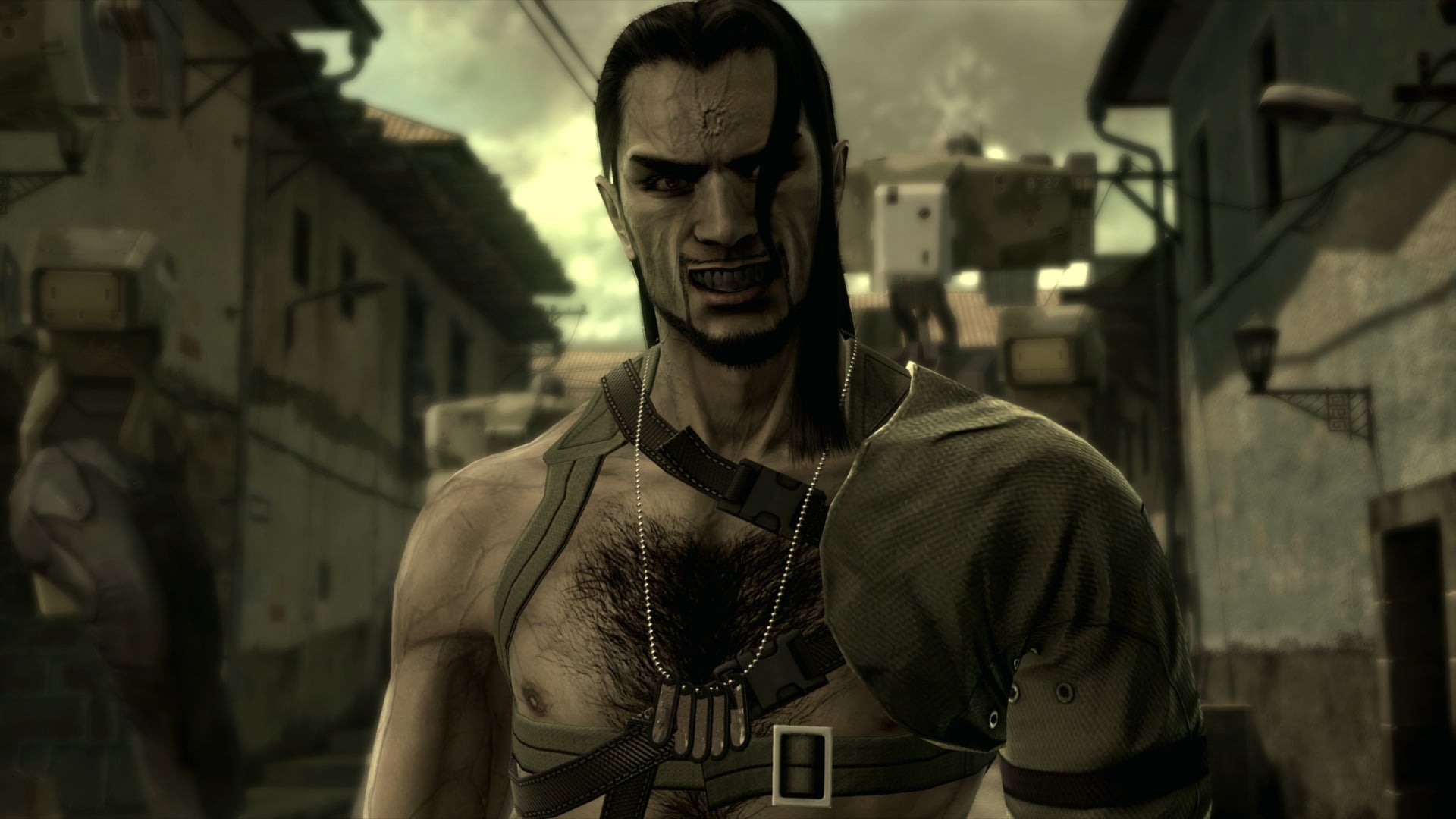
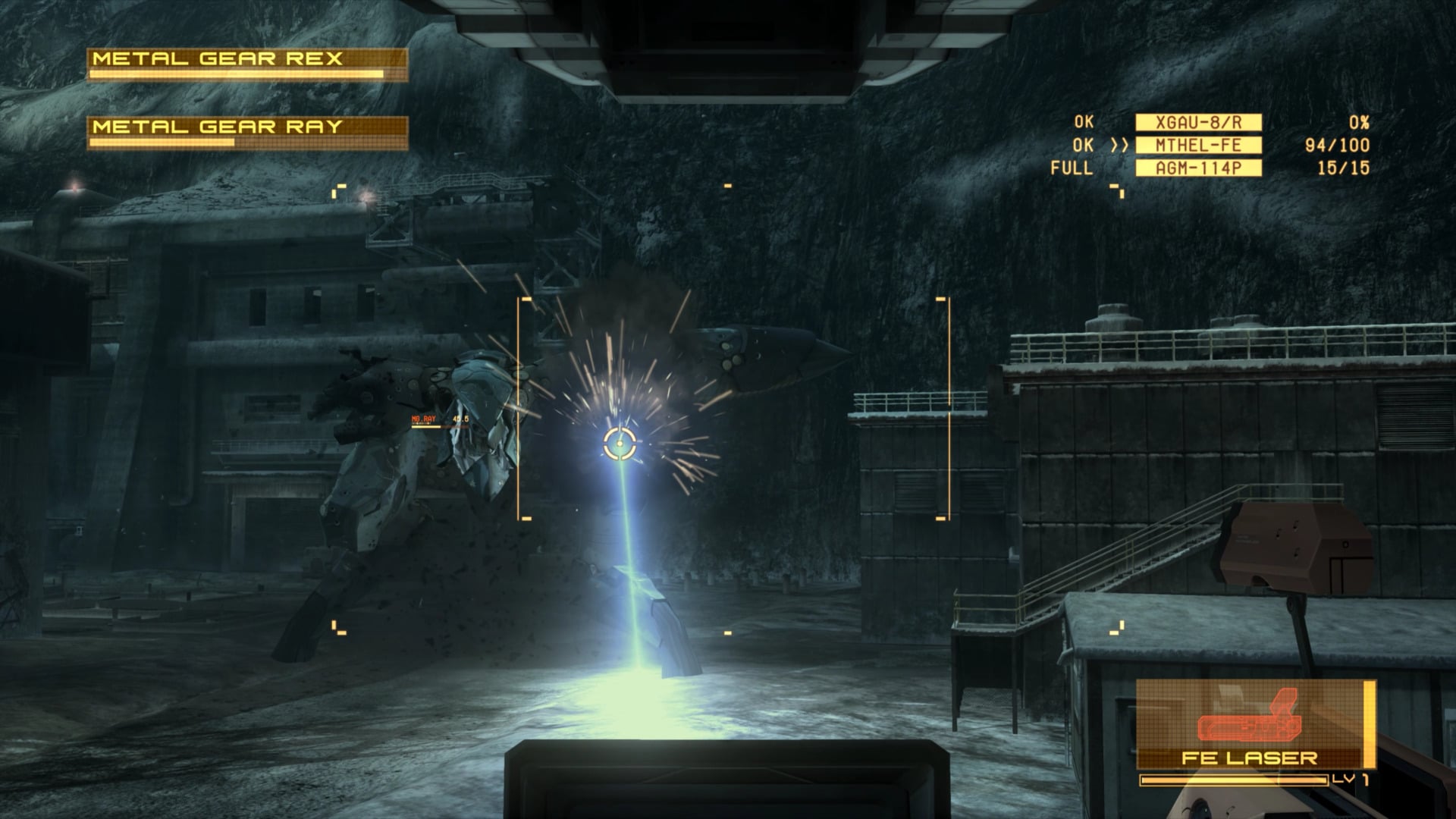
And I’ll say it: some of it worked on me. Why not? I love these guys. Every Raiden appearance had me on my feet, never mind that his arc here is just a far more boring retread of what he already went through in Metal Gear Solid 2. (Once more I wonder: is this The Point? Maybe, maybe not, I’m just grateful we got Metal Gear Rising: Revengeance out of it.) Liquid Ocelot is a delightful villain, with voice actor Patric Zimmerman just absolutely devouring the scenery every chance he gets. Obviously the Rex vs. Ray fight, which was engineered in a lab to make me, specifically, pop off, made me pop off. I realize it’s possible that, in these moments, I’m falling into Metal Gear Solid 4’s honeypot, becoming the exact sort of pop culture necrophile it ostensibly hates. But I’m not so sure. It strikes me as far more likely that Kojima could not quite resolve his competing interests in both satisfying and criticising his audience, and the Metal Gear Solid 4 we got was borne out of that friction.
In either case, it’s lamentable that much of the franchise’s usual political urgency is sacrificed on the altar of navel-gazing lore. There are still traces of it in the margins—the game notably begins with a clash between local civilians and an American-backed military power in the Middle East, a scenario that is, tragically, no less relevant in 2026 than it was in 2008. But where other Metal Gear Solid games were more forthright about ideological struggles, between people and between countries—the standout example being Metal Gear Solid 3, which placed its characters on opposing sides of the Cold War—Metal Gear Solid 4 speaks largely in abstractions. The rebels and PMC combatants fighting in these wars are effectively blank slates, completely devoid of ideological motivation or cultural background.
This is, explicitly, by design. Metal Gear Solid 4 envisions a dystopian near-future in which state governments are sustained by what it calls the “war economy,” a global system generating revenue through privatization of warfare. And in the war economy, personal beliefs are irrelevant. To quote Snake’s opening monologue: “War has changed. It’s no longer about nations, ideology, or ethnicity. It’s an endless series of proxy battles, fought by mercenaries and machines. War, and its consumption of life, has become a well-oiled machine.”
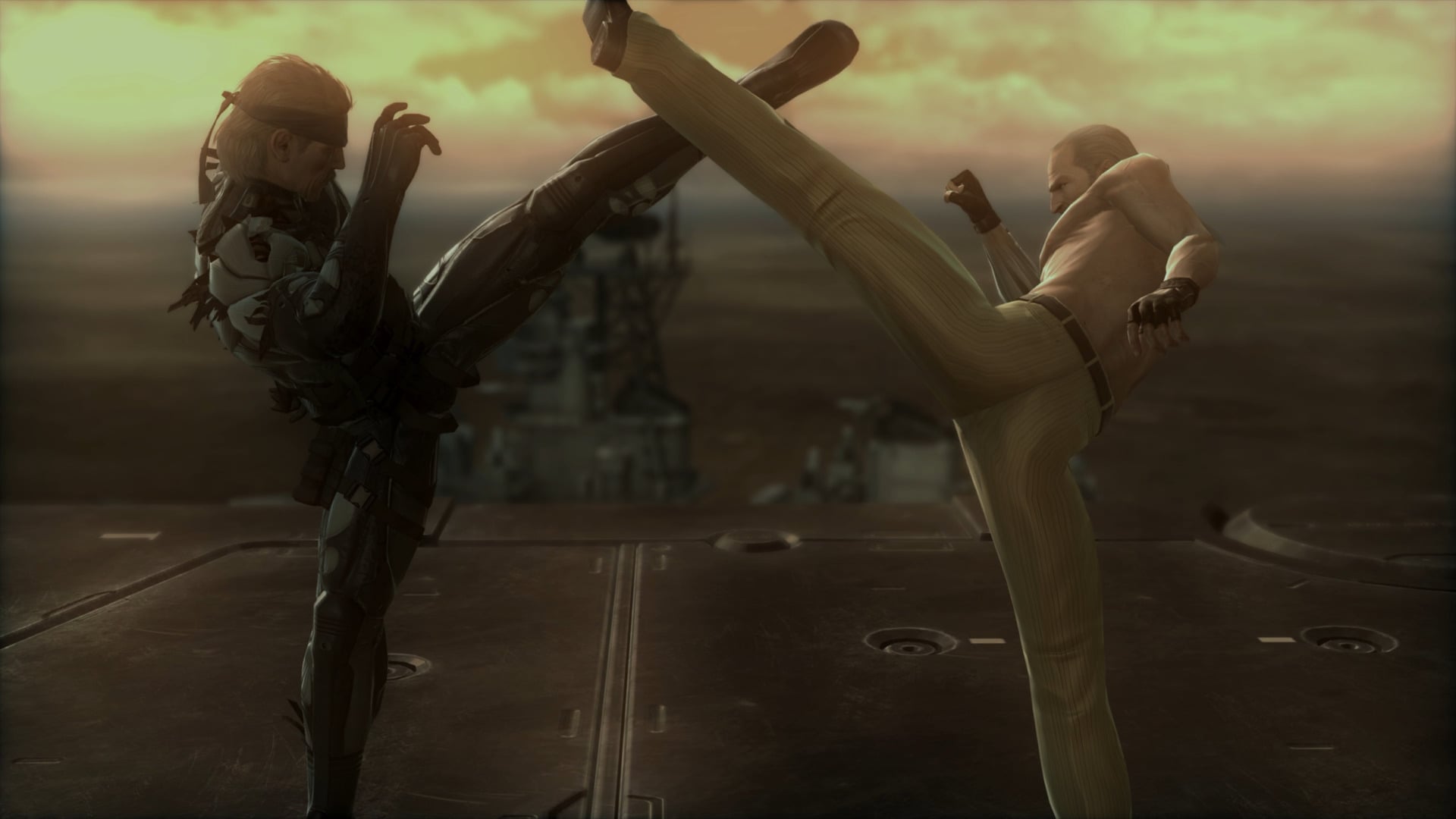
Compelling as this concept may be, in execution it scans as little more than a cop-out, an excuse for Metal Gear Solid 4 to flatten most of the political conflicts in its story into…exposition about Metal Gear Solid. The game rips itself (and its predecessors) down to the studs, haphazardly retrofitting recognizable characters into a pre-established timeline of events in the name of tying off loose ends that didn’t even exist until Kojima decided they did. It already didn’t matter who the Patriots are, and it especially doesn’t matter that they’re a bunch of people we knew about all along. When I say Metal Gear Solid 4 is about itself, this is what I mean: for all its prescience, for all its flashes of insight, it remains convinced that any curiosity it has can only be sated by turning inward.
As a Metal Gear Solid finale, it’s a mess.
As a Metal Gear Solid object, on the other hand…
Metal Gear Solid 4‘s most audacious formal experiment occurs near the beginning of its fourth chapter, when Snake et al. are en route to Shadow Moses island. After a brief cut to black, the screen fades into Metal Gear Solid. Not an evocation, not a recreation, but the actual heliport area of Metal Gear Solid on the PlayStation. (In the PS3 release, this was accomplished using the system’s built-in PS1 emulator.) Players have full access to Snake’s moveset, and are free to proceed as they wish: sneaking around, using items, provoking guards, the works. Once the area is cleared, the game snaps back to reality, Snake suddenly morphing back into a hyper-detailed, geriatric PS3 character as he wakes up from a dream.
Metal Gear Solid and Metal Gear Solid 4 were released almost exactly ten years apart. In that time, video game technology progressed at a rate that now seems inconceivable; the series completely and permanently altered the trajectory of games as an art form; its creator tried to end it on his own terms, unsuccessfully, twice. Now, trotting it out for a fourth time, Hideo Kojima assesses the density of the last decade, the growth of the medium, his growth as a creator, the birth, life, and death of Metal Gear Solid. He assesses all of these things, and synthesizes them in the image of a polygon becoming a person. And that’s good enough for me.
